Wooden Train Set Types Compared: Sets, Accessories & Expansions
At a glance
- A wooden train set is a good fit when your child's age, your space and your building mood all line up.
- Starter sets are often plenty: tracks, 1 train, 1 switch – and the evening is sorted.
- Compatibility often works, but special pieces and couplings are where things can get tricky.
- With a storage box, a sorter and a play mat, the kids' room stays reasonably friendly.
- Look for clear age recommendations, warnings and transparent safety information.

A wooden train set is “the right one” when it's quickly ready to play with and can grow along with your child. Want to pick a set (or expand one) without first earning a degree in track science? Totally understandable. Here you get a relaxed comparison: starter set vs. large set, accessories, expansions – plus the topics that really matter in everyday life: compatibility, track gauge, couplings, space requirements and storage. By the end you'll know what you need now – and what can happily wait until later.

Ulli & Flo
Owners of bieco · Hamburg · parents themselves
We like to keep things practical: first a small layout that actually gets played with – then expand step by step. That way the wooden train stays a favorite toy and doesn't turn into a never-ending project. Feel free to browse our Wooden Trains collection.
Table of contents: jump straight to whatever is on your mind right now.
- What types are there?
- Starter set or large set?
- Which size suits which age?
- Accessories: what really adds more play?
- How do I spot a well-rounded set?
- Compatibility, track gauge & couplings
- Space requirements & storage
- 3 households, 3 fitting solutions
- FAQ
What types of wooden train sets are there, anyway?
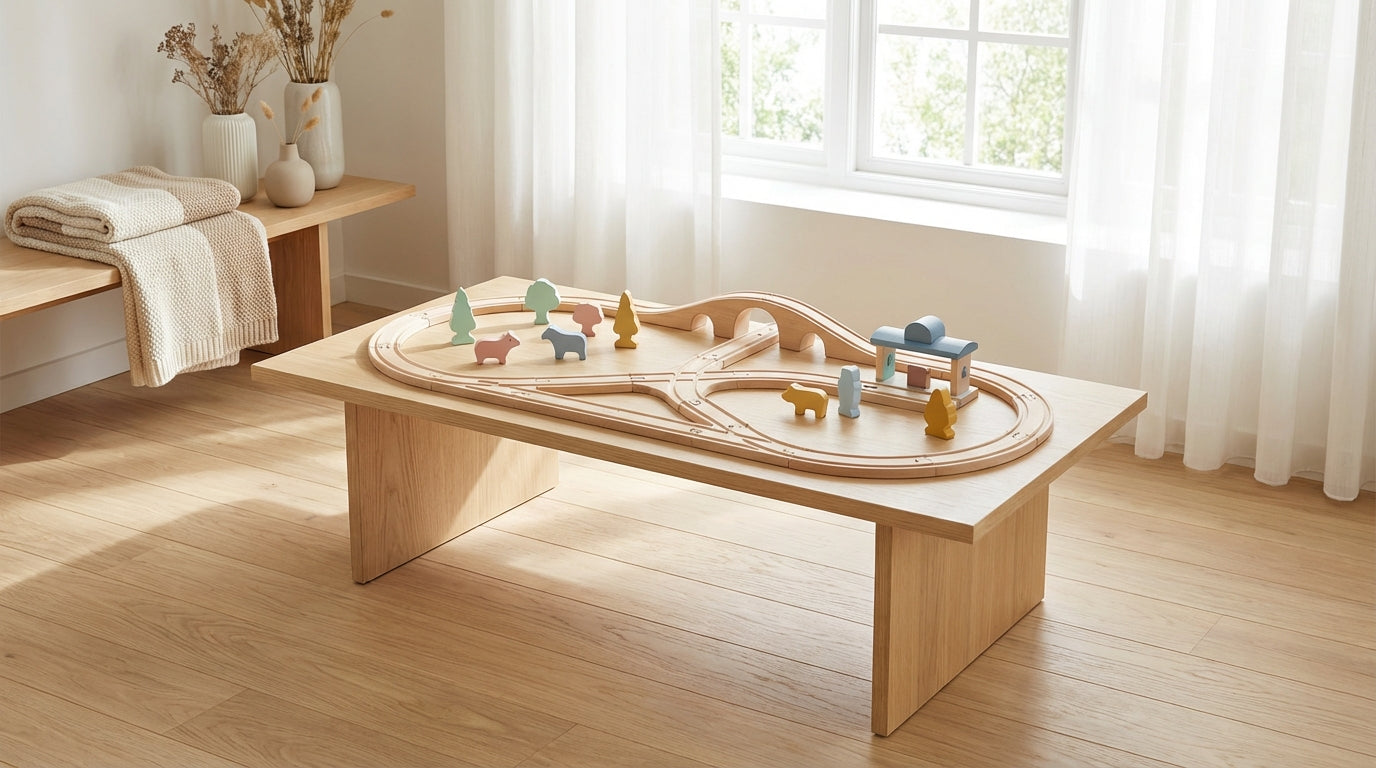
Wooden train sets differ mainly in set type, track system and accessories. In everyday life, most families end up with one of three approaches: (1) buy a set and start playing right away, (2) expand existing tracks with a plan, or (3) add accessories when your child suddenly wants “more story” (a station! Animals! A construction site!).
A wooden train set is a combinable track-and-train toy made of wood. The practical benefit: you can build layouts, rebuild them and create new play ideas with accessories again and again.
And because real life rarely stops at “just one”: many families start with a set and add tracks, switches or themed accessories later. That's not only budget-friendly – it's also easy on the nerves, because you can see what actually gets played with.
Practical tip: If you're unsure: first “be able to drive,” then “build a world.” One train, one oval, one switch – and the rest is free to grow.
Starter set vs. large set: what suits your family?
A starter set is usually the more relaxed choice while you're still getting a feel for it. Large sets look impressive – but they need space, sorting and often a parent who doesn't lose patience right away during setup. (It happens. Even to nice people.)
| Option | Good if … | Typical stumbling block |
|---|---|---|
| Starter set (small/medium) | you want to start quickly, have little space, or are looking for a gift | Your child soon wants “just one more branch” |
| Large set | you have plenty of floor space and enjoy building together | A jumble of pieces without a box or sorting system |
| Modular (tracks + accessories bought separately) | you already have tracks or want to expand with a plan | Check the fit of special pieces beforehand |
More pieces don't automatically mean more play – often just more tidying up. If your child is more of a “Drive the train, please. Now.” type, a manageable set is worth its weight in gold. If they love to build, tinker and rebuild, it can certainly be bigger.
Which set size is age-appropriate?
The younger the child, the more important sturdy pieces and a frustration-free setup become. Little ones want to connect, push, knock over and rebuild – and please without fiddly mini parts that vanish instantly (usually into socks or under the sofa).
- Age recommendations & warnings are real guidance, not decoration. According to the BMUKN (German Federal Ministry for the Environment), safety requirements for toys apply across the EU (Directive 2009/48/EC, implemented in Germany through the 2nd ProdSV, among other things) – that's why manufacturers state age ratings and warnings. BMUKN: Safe toys
- Easy to grip beats fine detail. Trains and figures should be easy to hold, especially while there's still a lot of “mouth checking” going on.
- Stability is playing fun. A simple oval plus a branch is often better than a complicated plan that falls apart at every bump.
Safety note: Small parts or magnetic connections belong in play only if they match the age rating and are used under supervision.
We see it every day: children play longer when they can build on their own. And because we've been a family business in Hamburg accompanying toys for 66 years, we also know the most common parent question: “Can they do this by themselves?” If the answer is often “yes,” you've gained a lot.
Accessories: what really adds more play?
Accessories are especially worthwhile when your child plays out stories. That's the moment when “train going in circles” suddenly becomes “station, tickets, construction site, detour” – and you might even get to drink your coffee while it's still warm. Sometimes.
Wooden train accessories are add-on pieces that extend play ideas without changing the basic system. In practice, that means you don't have to buy everything new, but can add “more world” where it counts.
Switches & crossings
A switch is the smallest expansion with the biggest “aha” effect. It turns one loop into two destinations – and instantly opens up more play ideas. Crossings are great for several routes, but need more space and work best when the track lies stable.
Bridges, ramps, tunnels
Height differences are fantastic, but they're less forgiving of wobbling. If ramps are too steep or transitions don't sit cleanly, the train derails more easily. In that case, better to start flatter or just use a tunnel for now – it brings the “wow” without everything tipping over.
Station, depot, figures & vehicles
A station brings role play – and that's often the long-term favorite. Figures, animals, little houses or a depot are worth their weight in gold when children love to tell stories. And yes: sometimes the station ends up being more important than the train. That's life.
If you're looking for inspiration, take a relaxed look at matching add-ons. In the Wooden Trains overview you'll find sets and accessories all in one place.
How do I spot a well-rounded set?
A good set delivers a complete play idea – not just a high piece count. These points help with comparing, whether you're starting fresh or adding to what you have:
- Track mix: straights + curves plus at least one play feature. That could be a switch, a level crossing or a small station.
- Vehicles: the train should roll easily and be simple to push. Sounds trivial, but it's the difference between “plays forever” and “just lies around.”
- Expandability: are there matching add-ons if your child wants more? Ideally, you can build it out step by step later.
- Transparent safety information: materials, warnings, test standards. According to DIN, the DIN EN 71 series “Safety of toys” describes requirements for, among other things, mechanical/physical properties and chemical safety. DIN: Clear requirements for safe toys
Test marks can help – what matters is what exactly was tested. TÜV SÜD explains that toys are often tested according to EN 71-1, EN 71-2 and EN 71-3. TÜV SÜD: Test marks/EN 71
Compatibility & track gauge: what really fits together?
Compatibility often works with standard tracks – with special pieces it can occasionally get fiddly. Many wooden track systems use similar connectors and a comparable track guidance, which is why basic shapes like straights and curves can often be mixed. But there's no guarantee, and that's exactly where most frustrating moments arise.
Track gauge & tolerances (briefly explained)
Track gauge refers to the spacing/guidance in which the wheels run safely. In practice, it's often small manufacturing tolerances that decide whether transitions are “butter smooth” or whether the train keeps rumbling over one spot.
- Standard tracks are usually uncritical. Straights/curves often work mixed too, as long as the joints close cleanly.
- Special pieces are the diva of the system. Double switches, crossings, ramps and bridges have more geometry – and therefore more places where things don't fit perfectly.
- Heights are a common catch. If a manufacturer builds tracks slightly higher or lower, edges appear – and that's exactly where derailments like to happen.
Couplings: not all magnets are alike
With trains, couplings are often a bigger compatibility sticking point than the tracks. Some locomotives/wagons use magnetic couplings, others hooks/loops or hybrids. Even with magnets, shape, strength and spacing can vary – then the train holds together somehow, but not nicely.
Practical tip: If you want to mix: test a single special piece first (e.g. a switch) – not the whole big expansion box right away.
For concrete ideas on building out your layout, take a look at proven expansions. If you want to dive deeper into switches, tracks and accessories: Accessories for wooden trains: switches, tracks & more.
Space requirements & storage: so it doesn't end in chaos
A wooden train set needs less space for playing than for “lying around.” That's the truth you only discover when you step barefoot on a switch in the middle of the night. (Not ideal, to put it mildly.) With a few simple solutions, things stay relaxed.
How much floor space is realistic?
Better to plan small and expandable than big and permanently in the way. An oval often fits in a free corner of the living room. Complex layouts with crossings, bridges and a station need considerably more connected floor space – and that isn't always free every day in family life.
Storage that kids will go along with
Tidying up works better when sorting doesn't look like work. This has nothing to do with pedagogy, but with tiredness. Yours and your child's.
- One big box for tracks, one small sorter for small parts. Switches, signs, figures and vehicles will otherwise reliably disappear.
- Store “track pieces” separately from “story pieces.” That means tracks in one place, accessories in another – so you find what you need faster.
- A play mat or carpet remnant as a base for the railway. It dampens noise, protects the tracks and prevents sliding.
Safety note: Store small parts out of reach if younger siblings live in the household.
Which wooden train set suits which household? (3 quick profiles)
The right choice usually depends on space, building patience and play style. Here are three typical situations – maybe you'll recognize your family:
- Small apartment, little floor time: Starter set + one switch. Quick to set up, quick to put away.
- Lots of space, building together: A larger set with a bridge/tunnel. Add clear storage, otherwise it gets messy fast.
- Child loves role play: Station + figures + a few vehicles. The tracks don't need to be huge – the main thing is that there are “places.”
FAQ
From what age does a wooden train set make sense?
A wooden train set makes sense as soon as your child enjoys pushing, connecting and acting things out. What matters is the manufacturer's age recommendation and warnings, because sets differ greatly in small parts and complexity. To start, sturdy tracks and an easy-rolling train are usually the most stress-free combination.
Which expansion is worth getting first?
Most often, a switch and a few straight tracks bring the biggest leap in play. Straights extend the layout stably, and a switch instantly creates new routes. Only once you build regularly and have enough space do crossings, ramps and larger themed worlds pay off.
Can I mix tracks from different systems?
With standard tracks, mixing often works, but with special pieces there's no guarantee. Differences in connectors, height and transitions can cause wobbling or derailing. If you mix, it's best to test a single piece first (e.g. a switch) before buying more.
How do I best clean wooden tracks and trains?
Usually a slightly damp cloth is enough, followed by letting everything dry well. Wood doesn't like staying wet for long, and harsh cleaners are unnecessary. For stubborn dirt, work gently and then dry completely – that keeps the surface looking nice for longer.
What can I do if the layout keeps falling apart?
Then the layout is usually too “tricky” for the surface, or the connection is too loose. Start with more straights and fewer transitions, and place the railway on a non-slip base (carpet/mat). For bridges and ramps, it often helps to build flatter and realign the transitions cleanly once more.
Buy a large set or expand little by little?
Expanding little by little is more practical for many families. You see what actually gets played with and can buy exactly what's needed. Large sets are great if you have the space and your child loves to build. For role play, fewer tracks are often enough – but more “places” like a station and figures.
Bottom line: start manageable, keep it compatible – and build out wherever your child's eyes light up. If you'd like to take your time looking at sets, tracks and accessories, our Wooden Trains overview is a good starting point for browsing and adding to your collection.