Wooden Train: A Guide to Types, Safety & DIY Personalizing
At a glance
- Wooden train: look for large, easy-to-grip pieces and smooth edges.
- Pastel looks calmer in the room – playtime stays just as wild.
- Personalizing works best when it is small, flat and kept away from the couplings.
- DIY succeeds with clean preparation, thin layers and plenty of drying time.
- CE marking and clear age recommendations are the minimum baseline for toy safety.

A wooden train is a great choice if you want a long-lasting toy that children keep discovering in new ways. It rolls, it couples, it carries “important cargo” (usually a cookie or a dinosaur) – and that is often enough to spark a lot of imagination. In this guide you will find the different types (classic, colorful, pastel), an everyday safety checklist and a DIY guide to personalizing that doesn’t end in crafting frustration.

Ulli & Flo
Owners of bieco · Hamburg · parents themselves
What we learned about personalizing: less is more – and drying time isn’t a suggestion, it’s a lifesaver. A wooden train can be pretty, but above all it has to stay playable. Feel free to browse our wooden railway collection.
And just between us: nothing here has to be perfect. The main thing is that your child plays – and that you don’t have to go on a small-parts safari through the living room every evening.
Table of contents
- Jumping ahead saves your nerves when your child is already shouting “Train!”
- Why a wooden train? Why children (and adults) love it
- Which type suits which age?
- Types: pastel, classic/colorful & (when relevant) tracks
- Safety & standards: what your family can really check
- DIY: personalizing a wooden train – step by step
- Care & storage: keeping the wooden train beautiful for a long time
- FAQ
Wooden train: why children (and adults) love it so much
A wooden train is an open-ended toy: few rules, lots of imagination. Today it drives to the “construction site,” tomorrow to the zoo, the day after it is a rescue train for stuffed animals. And when nothing else is working: push it, let it roll, done. This very simplicity is often worth its weight in gold in family life.
Wood feels good to grip and has a pleasant natural weight. That isn’t magic, it’s material: it sits more steadily in the hand and often feels more “real” than very lightweight toys. And yes, it will also survive the occasional rough landing from the sofa – purely in theory, of course.
Definition (quotable): A wooden train is a toy train made of wood with a locomotive and wagons that is pushed or pulled. For children that means: coupling, loading, unloading, sorting – and role play follows quite naturally.
Wooden train for kids: which type suits which age?
For small children, “easy to grip” matters more than “lots of accessories.” With a wooden train for children, look above all at the size of the pieces, the couplings and whether small parts are included. The age recommendation is a sensible guide here, because it takes typical abilities and behaviors into account.
- Early play stage: Simple trains with large pieces for pushing, without delicate add-ons.
- More role play: Additional wagons, cargo (e.g. blocks) and simple “jobs” like sorting or delivering.
- More combination ideas: If your child enjoys building, a track world can be added later.
The age label is a safety and usage recommendation, not decoration. It is linked, among other things, to how children play at certain stages (putting things in their mouths, throwing, biting – you know how it goes). According to the European Union, the Toy Safety Directive 2009/48/EC sets out essential safety requirements so that risks are minimized under foreseeable use (According to EUR-Lex).
Safety note: If your child still puts a lot of things in their mouth, check the surface and connections especially carefully: nothing loose, nothing flaking, no rough spots.
If you are already thinking about tracks: a wooden train is often the entry-level vehicle. To browse (and to get a feel for the world behind it), take a look at our overview: wooden railway.
Types: pastel, classic/colorful – and what “compatible” means in everyday life
The right type is the one your child likes to touch and use. Sounds simple, and it is. Still, a few guidelines help so the train doesn’t become “just decoration” after three days (and you wonder why you wrote the name so beautifully).
Pastel: calm in the room, not boring in play
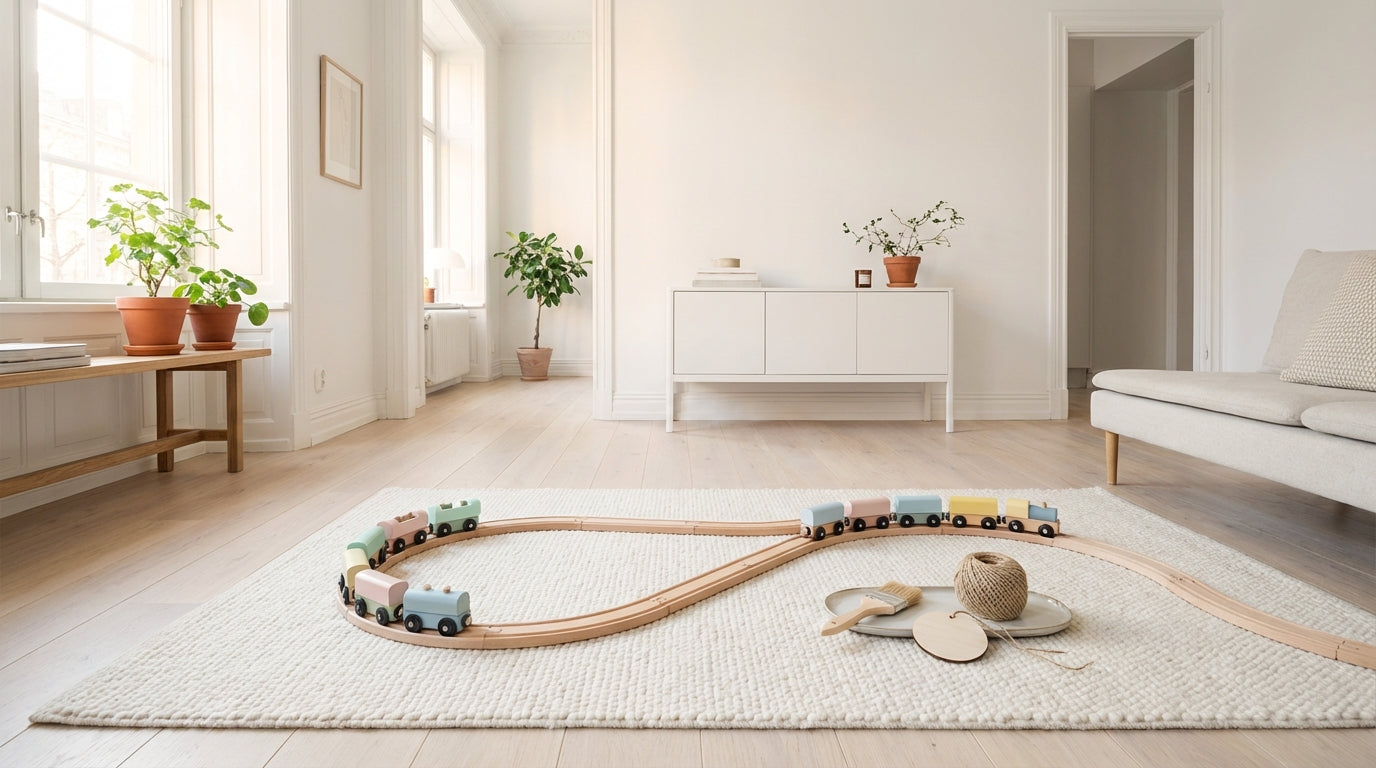
Pastel often looks tidier without slowing down the fun. A pastel wooden train is a good middle ground for many families: child-friendly, but not “funfair on the shelf.” Especially when the children’s room and living area flow into each other, it quickly feels more relaxed.
Practical tip: Pastel plus one or two bold wooden blocks as “cargo” looks lively without getting loud.
Classic/colorful: lots of stimulation, lots of recognition
For many children, colorful trains are easier to recognize and tell apart. Colors can help with sorting, naming and role play (“the red wagon,” “the blue locomotive”). If you are looking for a gift, colorful is often the safe bet – pastel is more the “fits the decor perfectly” choice.
Track-compatible: nice, but not a must
Track compatibility is practical, but a wooden train works perfectly well on its own. If you want to expand later, it pays to look for a coherent system early on. If you simply want a train to push around: totally fine, then “locomotive + two wagons” is plenty.
Safety & standards: what your family can really check
With toys, safety isn’t an extra, it’s standard equipment. In the EU, toys may only be sold if they meet essential safety requirements; this is regulated by the Toy Safety Directive 2009/48/EC (According to EUR-Lex).
CE doesn’t mean “luxury,” it means: essential requirements must be met. For your family, that is a minimum point of reference – and then comes the part you can really check with your eyes and hands: workmanship, stability, surface, couplings.
- Surface: smooth, without splinters, without flaking spots.
- Connections: nothing wobbles, nothing looks “half attached.”
- Couplings: easy to use, but not so loose that everything keeps falling off.
- Size: for younger children, prefer larger pieces and fewer tiny bits.
- Smell: a strong, pungent smell is at least a warning sign to take a closer look.
Definition (quotable): “Migration” in toy testing describes whether certain substances can transfer from materials into contact media. For parents, that boils down to a down-to-earth question: does the surface stay stable and not release anything that doesn’t belong there?
Standards are often used as a testing basis to make safety measurable. EN 71-1 covers mechanical and physical requirements, and EN 71-3 describes requirements and test methods for the migration of certain elements from toy materials (According to the standard texts, available e.g. via law.resource.org and DIN Media).
If you also want to look at environmental and pollutant criteria, an eco-label can help. According to Blauer Engel, the Blue Angel for toys (DE-UZ 207) focuses on avoiding and minimizing harmful ingredients; the German Environment Agency describes the Blue Angel as an eco-label with more far-reaching criteria (According to Umweltbundesamt).
DIY: personalizing a wooden train – step by step (without crafting frustration)
You can personalize a wooden train without “overdoing” it: small, flat, durable. The most relaxed approach is a personalization that doesn’t get in the way of play: not on the couplings, not on moving parts, not so thick that children keep picking at it. And yes: drying time is the secret hero here.
What you need
You will get furthest with very few materials. Only use things you are sure are suitable for contact with children (follow the manufacturer’s instructions). I deliberately don’t give a “miracle list,” because products and formulas can change.
- Soft, dry cloth for cleaning
- Pencil for sketching
- Painter’s tape for clean edges
- Suitable pen or lacquer according to the manufacturer’s instructions for child contact
- Fine brush (if lacquer is used)
- Very fine sandpaper only for tiny corrections, used carefully
Time required (realistic, not Instagram)
Plan for an evening plus drying time rather than “just a quick job.” The lettering itself often takes only 10–30 minutes. The surrounding steps (sketching, taping, letting it dry, checking) are what make it clean.
Step 1: Preparation
A clean, dry surface matters more than artistic talent. Wipe the train dry. No oil, no “shine products,” no experiments. Then choose a spot that isn’t constantly touched or rubbed during play – the side of a wagon is usually a good candidate.
- Cleaning: wipe dry, let it dry thoroughly.
- Test spot: try it first on an inconspicuous area.
- Layout: keep the name short, sketch lightly with a pencil.
Step 2: Personalize (clean and thin)
Thin layers often last better than one thick “once and done” coat. Use painter’s tape as an edge if you want straight lines. Work slowly, but without going over the same spot too often. If you touch up, do it after drying.
- Taping: painter’s tape as a border so nothing frays at the edges.
- Writing/painting: even strokes, not “pressing until the wood gives way.”
- Layer 2: only if necessary, after complete drying.
Practical tip: If you need a steady hand: prop up your elbow, breathe out deeply, and only then place the first letter.
Step 3: Let it dry (really let it)
“Feels dry” is not the same as “holds up in everyday life with kids.” Leave the train for as long as the manufacturer specifies for the material you used. And yes: ideally out of reach. Otherwise you end up with a personalized handprint – also lovely, but different.
Step 4: Finish & check
In the end, what counts is: nothing sticky, nothing peeling, nothing getting in the way of play. Run your fingers over the spot: smooth? firm? no edge to catch on? Then do a “play test”: couple, roll, handle it – just as your child will.
- Surface: nothing may be sticky or rub off.
- Edge check: no rough spots, no splinters.
- Function: couplings free, wheels running smoothly.
Safety note: Don’t use unknown old paints or lacquers “from the basement.” Only use materials with clear manufacturer information on suitability, and let everything cure completely.
If you would rather read up in peace instead of doing DIY, track knowledge helps with the wooden train too. Two articles to keep browsing: Wooden Railway Types Compared: Sets, Accessories & Expansions and Accessories for Wooden Railways: Switches, Tracks & More.
Care & storage: keeping the wooden train beautiful for a long time
Wooden toys stay beautiful longest when they are stored dry and clean. It’s not rocket science, more of a “grandma always knew that” thing. Moisture, sticky residue and hard friction are the usual spoilsports.
- Cleaning: wipe with a slightly damp cloth, then rub dry.
- No soaking: wood doesn’t like staying wet for long.
- Regular check: every now and then run your hand over edges and connections: all smooth, all firm?
- Storage: a box or a basket is enough; the main thing is dry – and not “under the wet muddy trousers.”
Why we at BIECO are so relaxed-but-picky about this
We are a family business from Hamburg – and we know toys in real life. Not in glossy photos, but amid breakfast crumbs and “Look, Mom!” moments. Ulli & Flo write here as parents for parents, and we are pragmatic in the northern German way: better clear and honest than loud and shiny.
For 66 years we have seen it: the simple play ideas are often the best. A wooden train doesn’t have to do everything. If it rolls well, feels good in the hand and children weave it into their stories, it has done its job.
Transparency is part of it: standards, testing and material questions are not secret knowledge. If you go by CE marking, age recommendations and clean workmanship, and add further labels like the Blue Angel where needed, you are already in pretty good shape for everyday life.
FAQ
From what age does a wooden train make sense?
A wooden train often makes sense once a child can grasp and push securely. Many children find this exciting early on, but what matters is the size of the pieces and the manufacturer’s age recommendation. The younger the child, the more important large, sturdy pieces and an intact, smooth surface without flaking become.
How can I tell if a wooden train is safe?
A safe wooden train has CE marking, a clear age recommendation and is cleanly made. Also check for yourself: smooth edges, stable connections, nothing wobbling, nothing splintering. In the EU, the Toy Safety Directive 2009/48/EC sets out essential safety requirements (According to EUR-Lex).
What role do EN 71 standards play for wooden trains?
EN 71 standards describe tests with which toy safety can be assessed. EN 71-1 covers mechanical and physical requirements, EN 71-3 the migration of certain elements from materials (According to the standard texts, e.g. available via law.resource.org and DIN Media). For families, this is a signal: there are defined testing benchmarks.
Pastel or colorful – which is better?
Better is whatever gets used in everyday life and suits your child. Pastel often looks calmer in the room, while colorful is easier for many children to recognize and name. Safety and quality questions matter equally for both: smooth surface, stable pieces, clear age recommendation and no spots where anything flakes off.
How do I personalize a wooden train without making it unsafe?
Personalize small, flat and not on moving or heavily used areas. Avoid couplings, edges and areas that are constantly rubbed. Only use materials with clear manufacturer information on suitability, and let everything dry or cure completely. Afterwards: finger test (smooth?) and play test (does everything work?).
Can I give a wooden train as a gift even if I hardly know the child?
Yes, a simple wooden train is a very welcome gift if you pay attention to the basics. Choose a simple, sturdy model with large pieces and a clear age recommendation. If you want to personalize it, keep it understated (name or initials). And if you are unsure: better to give it unpersonalized than “too much on it.”
If you are now in the mood for “more train world”: a wooden train is often just the beginning. Feel free to take a look at our wooden railway overview – and for reading up, the guide Wooden Railway for Kids: The Big Buying Guide 2024 is a calm compass.