
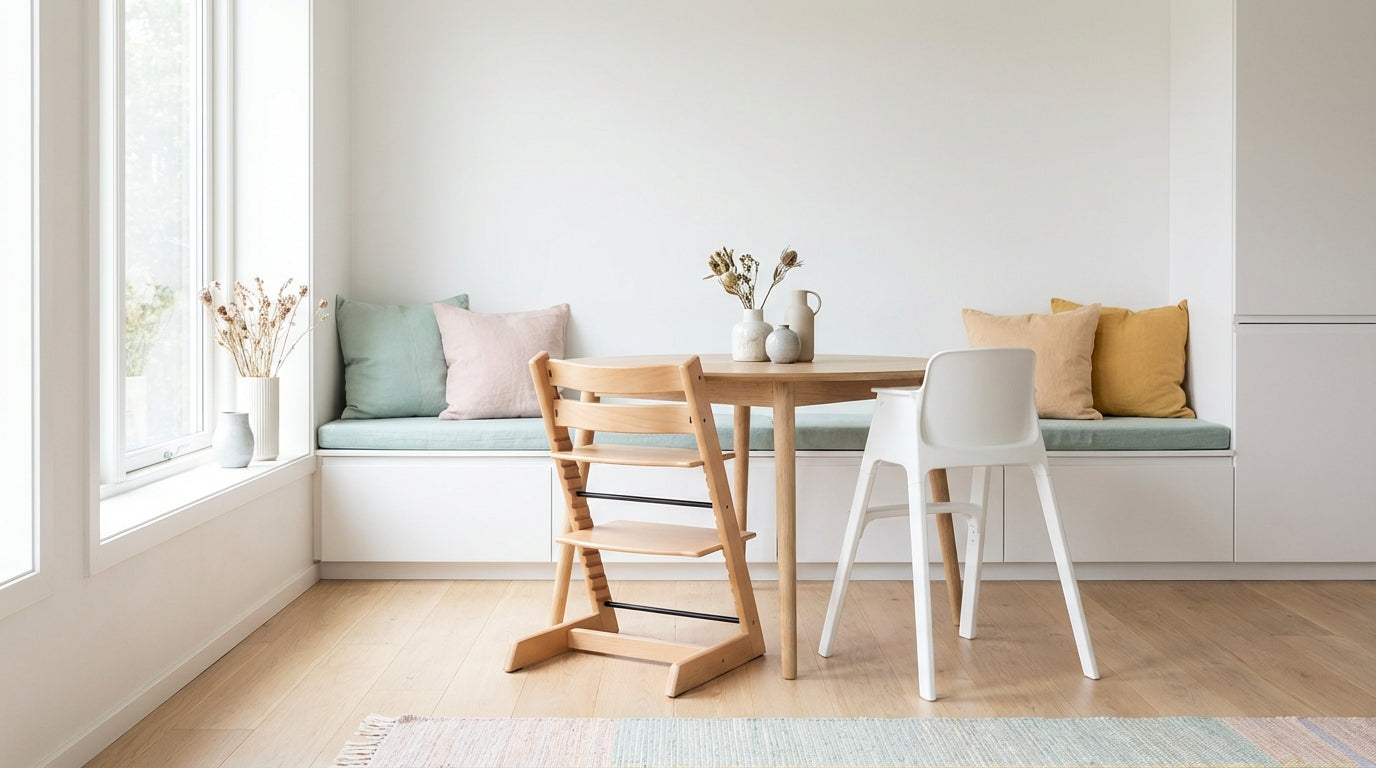
Wooden High Chair: Wood or Plastic? Comparison, Tips & Table
At a glance
- A wooden high chair is ideal if you're looking for something sturdy, long-lasting and "grows with your child".
- Plastic is often lighter, quickly wiped clean and easy to take along.
- What really matters: footrest, harness, stability and cleaning.
- A classic high chair only works once your child can sit up unaided.
- EN 14988 is an important minimum baseline for tested high chair safety.

A wooden high chair is the best choice when it stands securely and fits your everyday life. And yes: plastic can be just as sensible – it simply has different strengths. If you're torn between a wooden high chair, a plastic model, a tray, a foldable design or one that "grows with your child", you're in good company. Here you'll find a practical overview, a comparison table and a few small everyday tricks you can manage even with a child on your arm.

Ulli & Flo
Owners of bieco · Hamburg · parents themselves
With our first child we learned: the best high chair is the one you actually use day to day – porridge stains included. If this helps you decide with a bit more peace of mind, it was worth it. Feel free to browse our high chair collection.
Wooden high chair: why so many families love it
A wooden high chair often feels calmer because it has more weight to it. In family life that's sometimes half the battle – especially when your child is testing at mealtimes whether gravity is negotiable.

With wood you'll usually see two designs: classic high chairs (fixed seat, limited adjustment) and stair-style high chairs (adjustable seat and footboard). A wooden high chair that grows with your child in particular can last a long time, because you can readjust the seating position again and again.
A stair-style high chair is an adjustable high chair for ergonomic seating. The benefit is simple: seat and footrest can be adapted to your child's size and posture.
If that's exactly what you're looking for, the stair-style high chair overview shows several variants – often the "do it right once" route, without rethinking it every year.
Practical tip: If your child keeps slipping forward, check the footrest first, then the cushion. Dangling feet make many children restless.
Plastic high chair: light, easy to care for, often underrated
In everyday life, plastic is often hard to beat when things need to be clean fast. Smooth surfaces, few crevices, one wipe and you're done. Especially in small kitchens, when the chair gets moved around a lot, or when it occasionally travels to Grandma's, every kilo counts.
A well-known example: IKEA describes the material and usage requirements for the ANTILOP and states compliance with the safety requirements of EN 14988:2017+A2:2024. (Source: IKEA)
What plastic is often good at:
- easy to clean (smooth shell, few edges)
- low weight, often quick to take apart
- frequently cheaper to buy
What to keep in mind: some plastic models offer fewer adjustment options for seat and footrest. That's not automatically bad – it just means your child and your table height should match well.
Wood or plastic? Comparison table for a quick overview
The best choice depends on space, cleaning, ergonomics and how long you'll use it. So that you don't end up with 27 tabs open, here's a simple side-by-side comparison.

| Criterion | Wooden high chair | Plastic high chair |
|---|---|---|
| Stability/stance | Often very steady thanks to its weight; feels "calm" | Can be stable, but often feels lighter; look for non-slip feet |
| Cleaning | Depending on the model, edges/crevices; the surface is key | Usually quick to wipe, smooth surfaces |
| Ergonomics | Wooden stair-style high chair is often very adjustable (seat/footboard) | Often less adjustable; works well if child and table height match |
| Space/transport | Usually heavier; likes to stay in one place | Light, often easy to move around or take along |
| Grows-with-your-child feature | Common with stair-style high chairs; long service life possible | Depends on the model; often more of a "phase" |
| Price | Wide range; growing models are often pricier but usable for longer | Often cheaper, accessories may cost extra |
Wooden stair-style high chair: what "grows with your child" really means day to day
"Grows with your child" means the seat and footrest can be readjusted again and again. That sounds like a DIY session at first, but it's usually done quickly – and saves you later discussions along the lines of "Muuum, I'm sitting funny!"

What to look for in a stair-style high chair:
- Footrest: adjustable and large enough for both feet
- Seat: deep/wide enough so your child doesn't "hang"
- Stability: no wobbling, even when your child pushes against it
- Accessories: baby set, harness, tray – if you really need them
If you'd like to click through the types in general: in the high chair overview you can usually see quickly which design suits your kitchen.
White wooden high chair: pretty, but please keep your sense of humor
A white wooden high chair rarely stays "catalogue perfect" for long. Curry, tomato, blueberry – life happens. And honestly: a chair that gets used is allowed to look like it. In northern Germany we call that "honest".
Practical points for light surfaces:
- Surface: lacquered is often easier to wipe than open-pored
- Joints/edges: that's where porridge likes to stick – a soft cloth helps more than scrubbing
- Cleaner: mild is usually better; harsh products can damage surfaces
If you'd like a short routine for this, our guide High Chair Safety & Care: How to Keep Your Child Protected offers everyday steps without turning housekeeping into a side job.
Children's high chair with table (tray): yes, no, it depends
A tray is great if you feed flexibly or have little space. It can make everyday life easier, especially when the dining table is currently "occupied" – by laundry, craft supplies or the laptop that should really have been closed yesterday.
Important: a tray doesn't turn a wobbly seat into a good seating position. Make sure your child sits securely and has a footrest (or can get one later). Otherwise mealtime quickly turns into a slide.
A restraint system is a harness or bar system that makes it harder to climb out or stand up. The benefit is simple: it keeps your child in position when you're briefly distracted.
Safety note: Always use the harness – even "just for a moment". Those short moments are unfortunately the classics in everyday life.
Baby high chair: when does a high chair make sense?
A classic high chair is meant for children who can sit without help. IKEA states this explicitly for the ANTILOP ("able to sit up unaided"). (Source: IKEA)
If you'd like to start earlier, that only works with a suitable newborn attachment designed for it (reclined/semi-reclined position, matching harnesses). Please don't improvise – putting a baby "in" before they can sit steadily is not a good idea.
If you'd like to dive deeper into the topic: When can my baby sit in a high chair? Tips & recommendations.
Standards, tests, transparency: what to look for without stress
A standard is not a guarantee of everyday suitability, but it is a solid minimum baseline. The standard behind many high chairs is called EN 14988. According to DIN Media, the current German edition is DIN EN 14988:2024-08 and describes requirements and test methods for children's high chairs. (Source: DIN Media)
Independent tests can help as well: on 21.11.2024 Stiftung Warentest tested twelve children's high chairs and reports that only three models were rated "good"; it also points out, among other things, problems with safety/comfort and with harmful substances. (Source: Stiftung Warentest)
What we keep taking away from families' questions (and, honestly, from our own kitchen chaos): it helps when manufacturers clearly state materials and tests. The less vagueness, the better – whether wooden or plastic high chair.
Putting well-known models in context: design over brand wars
With well-known names, look first at the design, accessories and seating position. In its list of tested models, Stiftung Warentest names Tripp Trapp, Nomi and Roba Born Up Set, among others. (Source: Stiftung Warentest)
Very roughly, for orientation (no ranking and no promises):
- Stair-style principle: usually wood, seat/footboard adjustable, often usable for a long time.
- Lightweight principle: often combinations of wood and plastic parts; can be very flexible depending on the set.
- Set solutions with attachment: chair plus baby attachment, often with a 5-point harness in the attachment.
For the "Born Up" set, roba describes the material and names standards for the chair and attachment. (Source: roba)
And as an example of material transparency: IKEA states the material and an EN 14988 note for the ANTILOP. (Source: IKEA)
For the Nomi, retailers often list details such as a wooden center column and polypropylene for the seat/back parts. (Source: 2Modern)
Why we look at certain details with wooden high chairs
You can often recognize a good high chair by the unassuming things: adjustment, edges, harness routing. We're a family business from Hamburg and have been doing this for 66 years – and yes, we're a little bit northern-German fussy about it. Not because it sounds fancy, but because parents ask us exactly these questions: "How do I clean it?", "Does it wobble?", "Will it fit at the table?"

What often makes the difference in practice:
- Footrest: adjustable is better than "it'll sort of do"
- Stance: secure, no wobbling, even when your child pushes off
- Surfaces: ones you can actually get clean
- Transparency: clear information on materials and tests
FAQ
Is a wooden high chair better than plastic?
No – a wooden high chair has different strengths than plastic. Wood often feels sturdier and "calmer", while plastic is usually lighter and wiped clean faster. What matters is stability, harness, footrest and whether the chair suits your daily routine. Lots of moving it around: plastic. A fixed spot at the table: wood is often a pleasure.
Does a high chair test really help with choosing?
Yes, as a guide – especially for safety and harmful substances. On 21.11.2024 Stiftung Warentest tested twelve children's high chairs and reports that only three models were rated "good"; problems with safety/comfort and harmful substances are also mentioned, among other things. (Source: Stiftung Warentest) After that, it's worth checking against your own kitchen.
From what age can a baby use a high chair?
Only in a classic high chair once your child can sit without help. Many manufacturers phrase it this way; IKEA explicitly writes "able to sit up unaided" for the ANTILOP. (Source: IKEA) For earlier use there are suitable newborn attachments as a system – please don't just "sit them in".
EN 14988 – what does it mean for high chairs?
EN 14988 is the safety standard for children's high chairs, including test methods. According to DIN Media, the current German edition is DIN EN 14988:2024-08. (Source: DIN Media) That's a minimum baseline – correct use in everyday life still counts, above all the harness.
Wood or plastic: which is easier to clean?
Plastic is usually clean faster because its surfaces are smoother. Wood can also be cleaned well if the surface is robust – but edges, screws and crevices can be more of a "porridge trap". If a lot goes astray at your place every day (it happens), an easy-care build matters more than looks.
Does a children's high chair with a tray make sense?
Yes, if you feed flexibly or don't always sit at the big table. A tray makes everyday life and cleaning easier, but it doesn't replace a good seating position. Make sure your child sits securely and has a footrest or can get one later. And: the tray should be easy to remove.
Mini FAQ (short & sweet)
- From what age a high chair? When your child can sit without help; earlier only with a suitable newborn attachment.
- Wood or plastic easier to clean? Usually plastic, because it's smoother; wood depends heavily on the surface.
- EN 14988 – what does it mean? Safety standard for children's high chairs; it describes requirements and tests.
If you're now thinking, "Okay, I know what to look for" – then we're happy. For the next step, a look at designs rather than gut feeling often helps: in our high chair overview and among the stair-style high chair models you'll quickly see what suits your space, table and family rhythm.


