Wooden Dollhouse Accessories: Scale, Furniture & Buying Checklist
At a glance
- Wooden dollhouse accessories fit best when doors, figures and furniture height all work together.
- Scale quick guide: 1:12 (classic), 1:16 (compact), 1:18 (smaller).
- Start with 2–3 rooms and add details as play ideas come up.
- Look for smooth edges, sturdy pieces and small parts that suit your child's age.
- With wooden miniature furniture and a bit of DIY, your dollhouse will feel truly “lived in”.

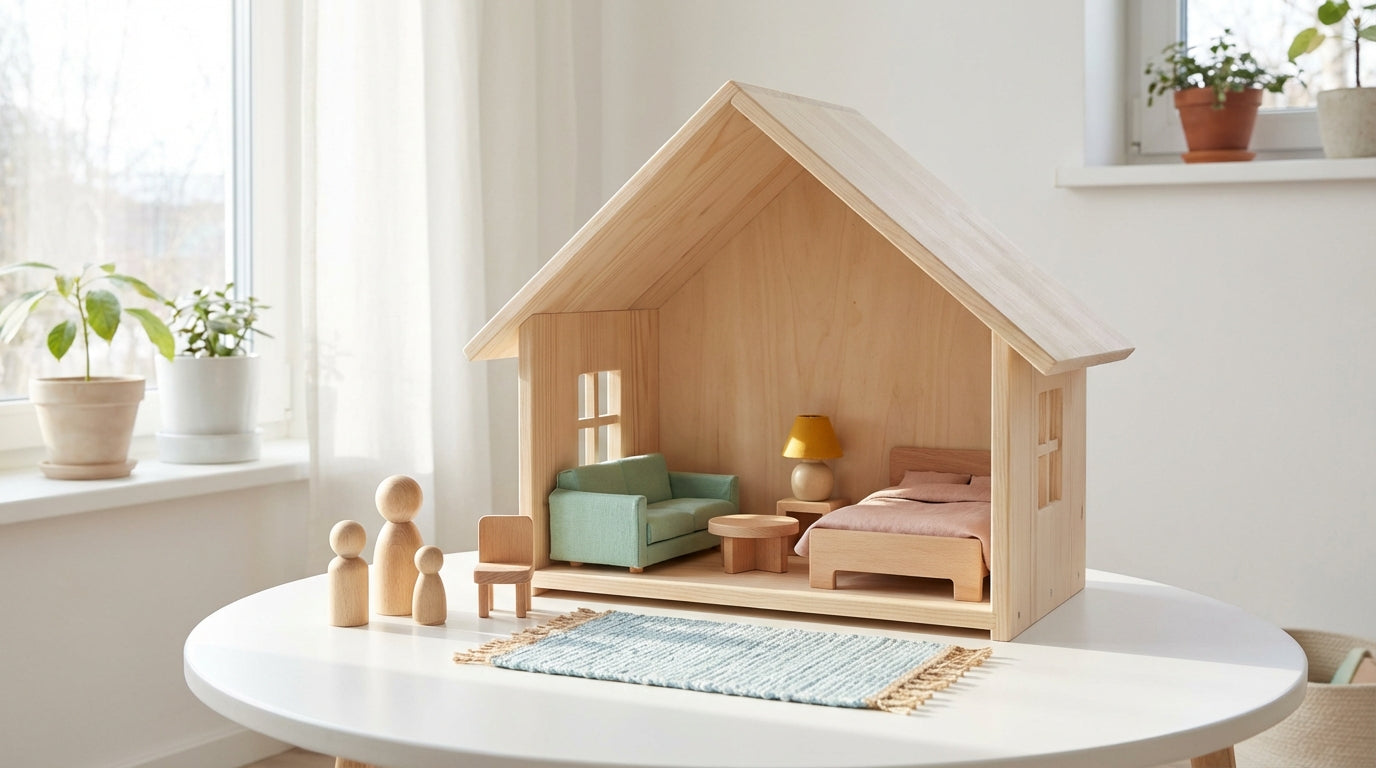
Wooden dollhouse accessories work best when scale, door height and furniture height match. Then figures can really sit on chairs, beds don't look like guest towels, and the house isn't just admired but actually played with. In this guide you'll find a simple scale helper, a buying checklist, ideas for wooden dollhouse furniture and accessories – plus quick DIYs that work even with tired parent hands. And don't worry: you don't need to be a carpenter or live a “Pinterest-perfect” life to pull it off.

Ulli & Flo
Owners of bieco · Hamburg · parents themselves
We've learned that once scale and door height fit, play instantly becomes more relaxed. And it's often the little details that children love most. Feel free to browse our dollhouse collection.
What accessories and furniture are available for dollhouses?
To start with, basic furniture for each room is enough – the rest comes with the stories. Children rarely play “interior design”; they play everyday life: getting up, eating, bathing, sleeping, having guests over. For that you don't need 80 pieces, just a few good anchors.

- Living room: sofa/armchair, coffee table, shelf, rug, small lamp
- Kitchen: kitchen unit/stove, table, chairs, fridge, dishes
- Bedroom: bed, wardrobe, nightstand, small blanket/pillow
- Bathroom: bathtub/shower, sink, toilet, mirror
- Nursery: mini toys, cradle, high chair, books, building blocks
- Outdoors: bench, planter, swing, bicycle, picnic blanket
Wooden dollhouse furniture is often durable and “forgiving” of wild play. That's handy when the dollhouse isn't just decoration but gets used every day. If you'd like to click through the options: you'll find a starting point in the Dollhouse Hub, and under Dollhouse Accessories & Furniture you can work your way through the rooms.
Practical tip: If you're looking for a gift, ask about the door height or have a photo sent with a ruler next to it. That saves you the classic “sorry, doesn't fit” round.
How to find the right scale (without the math headache)
The scale decides whether figures can sit and doors remain usable. Many wrong purchases don't happen out of carelessness, but because “it looks about right” rarely holds true in miniature worlds.
Dollhouse scale is the size ratio between the miniature world and the real world. It helps you judge which figure size and furniture size go together, without having to test every single piece.
Practical check instead of calculating: Measure three things on the house: door height, room height, floor depth. Then take a figure you want to use and check: Does it fit through the door? Does it fit at the table? Can it sit on a chair without everything tipping over? If that works, you're in the green.
Scale quick guide (1:12, 1:16, 1:18)
You'll come across these three scales most often – and they feel very different. Important: manufacturers can vary slightly, so measuring is always the final truth (just like when buying children's shoes).
| Scale | What it's often used for | How you recognize it in everyday use |
|---|---|---|
| 1:12 | Classic dollhouses, many furniture and figure worlds | Feels “generous”: chairs, beds and doors have plenty of room |
| 1:16 | More compact houses, less floor space, still great for play | Everything is a bit daintier, but still easy to grasp |
| 1:18 | Smaller miniature worlds, often more of a decorative character | Pieces get very small quickly – take a close look at small parts |
Accessories are compatible when figure, chair and table “work” together. The best test is simple: the figure sits on the chair, feet roughly toward the floor, table edge not at chest height – done.
Which figures fit into a dollhouse?
The right figure is one that stands steadily, is easy to hold and fits through the door. Children are ruthlessly practical about this: if everything wobbles, it gets boring fast – and suddenly dinosaurs are living in the bedroom. (Also fine, but you know what I mean.)

Dollhouse figures are play figures that take on roles in mini everyday life. They should match the furniture height so children can act out typical activities: eating, sleeping, bathing, carrying, sitting down.
- Height: The figure should fit through doors and be able to “join in” at the table.
- Sitting: If the figure can sit, the play value rises immediately.
- Stability: A steady stand means less frustration and less tipping over.
- Material: Wood is sturdy, fabric/felt feels soft, plastic is often easy to wipe clean.
A family set brings action into the house right away, while individual characters add spice. Common “favorites” are grandma/grandpa, a baby or a pet – because they suddenly create new scenes (visiting, babysitting, walking the dog).
Wooden dollhouse accessories: what to look for when buying
You can recognize good accessories by their craftsmanship, material information and a clear age recommendation. With wood especially, the hand test is worthwhile: smooth, sturdy, no splinters, no wobbly joints.

- Edges & surface: Does it feel a bit rough or have splinters? Better to leave it or sand it down properly.
- Paints & colors: Look for transparent information and reputable testing notes.
- Stability: Wooden miniature furniture shouldn't fall apart at the first “move”.
- Small parts: The younger the child, the larger and sturdier the pieces should be.
- Fit: Check scale/size (door, table, chair – the three classics).
Safety note: Small parts can be swallowed – for younger children, choose only age-appropriate items and stay nearby while they play.
The DIN EN 71 series of standards describes safety requirements for toys in Europe. According to DIN, this includes mechanical/physical requirements, flammability and the migration of certain elements (DIN).
The EU Toy Safety Directive sets out essential safety requirements and labeling obligations. According to the BMUKN, this covers technical and structural safety, chemical requirements and labeling rules, among other things (BMUKN).
Why we pay such close attention: we're a family business from Hamburg – for 66 years. And yes, we've seen it all: chairs that are too small for anyone to play with, wobbly mini tables that “accidentally” go flying after two days. We're northern Germans: better to check honestly than to be annoyed later.
Checklist before buying: will it really fit in your dollhouse?
This short list helps you avoid the typical “looks great, but doesn't fit” wrong purchases. I'd love to say: that only happens to other people. It doesn't.
- Scale/size: Quickly compare door height and table height.
- Figure test: Can a figure sit and stand/sit at the table?
- Floor space: Does the piece fit on the floor without blocking half the room?
- Small parts: Does it suit your child's age and the supervision you can give in daily life?
- Craftsmanship: Smooth, sturdy, no sharp edges.
- Play idea: Which scene does it make possible (eating, sleeping, bathing, visitors)?
If you're looking for wooden accessories, it helps to look at matching series. In the end it looks calmer, especially when the house is in the living area. If that interests you: wooden dollhouses are a good starting point.
Creative extras: small details, big play value
The best additions are often tiny – and still make the biggest difference. A rug, a picture, a laundry basket: presto, the room is suddenly “lived in”.
- Textiles: mini felt rugs, blankets from fabric scraps, curtains from cotton ribbon
- Wall decor: picture frames from cardboard, wallpaper from gift wrap, mirrors from aluminum foil
- Everyday bits: mini books (folded paper), cushions, plants (paper + wire/pipe cleaners)
- Light: small battery-operated LED tea lights only under supervision
If you want to let a dollhouse grow, plan small bites rather than a big shopping spree. That takes the pressure off, is kind to your wallet and turns the house into a long-term toy.
DIY: 5 quick ideas for wooden dollhouse accessories & everyday items
DIY works best when it's quick and sturdy enough for children's hands. Perfection is overrated – a crooked picture frame is no reason to move out in real life either.
1) Mini shelf from wood scraps
A small shelf brings order and creates new reasons to play. You'll need: craft strips/wood scraps, wood glue, sandpaper. Sand the edges smooth, glue the strips into a “U” shape, let dry. Optional: paint thinly with water-based paint and let dry thoroughly.
2) Felt rug
Felt is great because it doesn't fray and looks cozy right away. Cut to size, done. If you like: add a pattern with a fabric marker or embroidery thread. Tip: muted colors make wooden dollhouse furniture look especially lovely.
3) Cardboard picture frame
With little effort, every room gets its own mood. Cardboard strips as the frame, a small picture inside (from a magazine or drawn yourself). An adhesive dot on the back – ideally one you can peel off again when it's time to redecorate.
4) Mini cushion from fabric scraps
A cushion is what turns a bed into a home. Two fabric rectangles, sew all around (or use fabric glue), leave a small opening, fill with stuffing, close. Don't feel like sewing? Wrap fabric around stuffing and tie it off with thread – it often holds better than you'd think.
5) Wooden crate as a toy box
In the dollhouse, a crate is what it is at our place, too: an all-rounder. Sand a small wooden crate from the craft store smooth, and glaze it if you like. Mini books, building blocks or “laundry” (fabric strips) disappear inside – and tidying up goes faster.
Practical tip: Craft in stages: cut today, glue later. Kids love a “workshop in bite-sized pieces” – and you keep your nerves.
Care & everyday life: how wooden accessories stay beautiful for a long time
Wooden toys stay beautiful the longest when they're stored dry and cleaned gently. In family life that means: not complicated, but consistent.
- Cleaning: Wipe with a slightly damp cloth, then let dry.
- Water: Don't soak – wood doesn't like long baths (unlike the rubber duck).
- Checking: Now and then run your fingers over edges and joints: if something has become rough, sand it down briefly.
- Storage: Small baskets or boxes for each floor help against mini chaos.
Wood and plastic are both fine – wood often scores with its feel and repairability. If a corner gets a ding, with wood it's often more “patina” than total loss. And honestly: toys are allowed to look like they're being played with.
Building room by room: an order that has proven itself
If you get sidetracked, it gets expensive – and your child ends up playing with the box. So here's an order that has worked well for many families:
- Bedroom: bed + blanket + 1 figure. First story: “Good night!”
- Kitchen: table + 2 chairs + “food” (paper circles). Breakfast always works.
- Bathroom: sink + mirror. Acting out routines is an evergreen.
- Living room: sofa + rug. Then it gets cozy.
- Extras: pet, stroller, plants, pictures – depending on your stories.
If you're looking for even more ideas, go ahead and take an inspiration round. We have Play Ideas & Inspiration for that, plus the article Creative play ideas for the dollhouse.
FAQ
Which scale makes sense for which age?
The practical scale is the one where pieces are easy to grasp and not too fiddly. For younger children, larger, sturdy pieces are often more relaxed in everyday life. Regardless of scale: if there are a lot of tiny parts, supervision makes sense – and sometimes “less, but sturdy” simply makes for a better mood.
How do I know if furniture is compatible with my dollhouse?
It's compatible if door height, table height and a figure fit together. Measure the door and ask yourself: can the figure walk through? Then the seat test: figure on a chair, at the table – if that looks right, the rest usually fits too. Photos with a ruler help when buying more later.
How do I recognize good wooden dollhouse accessories?
Good wooden accessories have smooth edges, sturdy joints and clear age information. Look for clean craftsmanship (no splinters), sturdy pieces and reputable information about testing. According to DIN, DIN EN 71 describes safety requirements for toys in Europe (DIN).
Is wooden miniature furniture better than plastic?
“Better” depends on your daily life: wood is often sturdy, plastic is often easy to care for. Wood feels warm and is often long-lasting, while plastic can usually be wiped clean quickly. What matters is craftsmanship, stability and whether size and small parts suit your child. In the end it should be played with, not just look good.
Can I make dollhouse accessories myself?
Yes, many things are quick: felt rugs, cardboard picture frames, fabric cushions. Make sure nothing has sharp edges and that small parts are only used under supervision with younger children. DIY is especially lovely when kids get to help – even if it turns out “creative”.
What are typical wrong purchases with dollhouse furniture?
Typical ones are furniture that's too big, figures that are too small, or very fiddly decor. The look may work in the online shop, but in the house a sofa blocks the whole floor or a figure keeps tipping over. So: check door/table/figure first, then buy. It saves nerves and returns.
If you now feel like expanding your mini home: start small. A matching chair, a rug, a little shelf – and new stories begin. To browse, you'll find Dollhouse Accessories & Furniture with us, or the Dollhouse Hub as a starting point.