From What Age Is a Comforter Suitable for Babies? Choosing Safely
At a glance
- From what age is a comforter suitable for babies? Often early on during the day under supervision – but not in the cot at first.
- For safe baby sleep: keep the sleep space clear, place your baby on their back, use a firm mattress.
- When choosing: few parts, no long ribbons, firm seams, an easy-to-grasp size.
- Washability is everyday practicality: choose easy-care over “just pretty”.
- Introducing it works best calmly, briefly and regularly – without pressure.

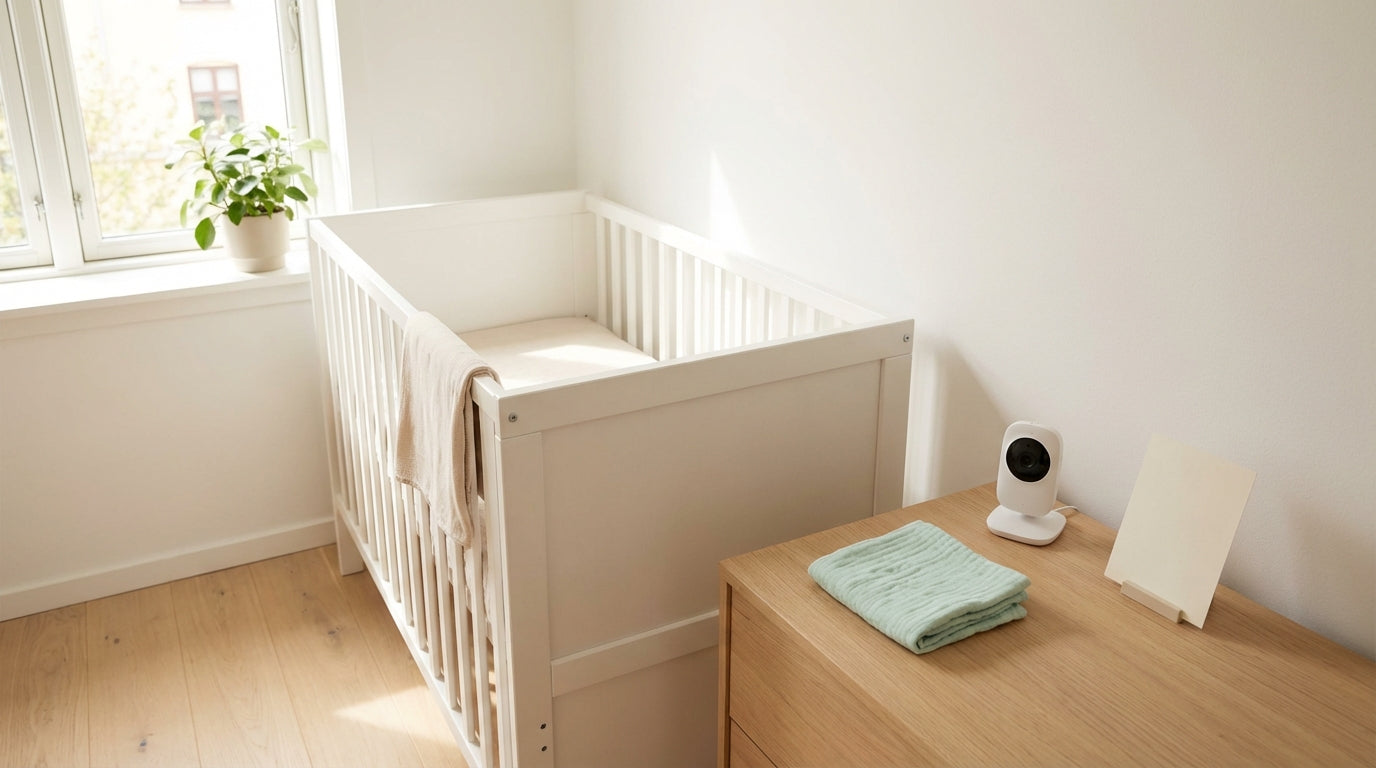
A comforter is usually fine during the day under supervision, but please keep it out of the cot at the beginning. For many families this is the simplest and safest separation: awake time = cuddling, feeling, soothing; sleep time = cot kept as empty as possible. According to The Lullaby Trust, the cot should be “clear” – without soft items such as toys or comforters (Source).

Ulli & Flo
Owners of bieco · Hamburg · parents themselves
We’ve noticed that a comforter can be a real anchor of calm during the day – if you introduce it in a relaxed way. And at night, a clear rule (“the cot stays empty”) helps you breathe easier. Feel free to browse our comforter collection.
Here you’ll find practical guidance: from what age, how to introduce it, and what to look out for. With a bit of northern German calm and no wagging finger. We (Ulli & Flo) are parents, and we’re a family business from Hamburg – we’ve been doing this for 66 years. That means we know the theory, but we also know the stains on a comforter after the third carrot puree.
From what age does a comforter make sense – and what is it for?
A comforter is mainly meant for awake time: closeness, touch, familiarity. Many babies find it interesting once they can grasp more deliberately, hold on and bring things to their face. This doesn’t happen at the same time for every baby – and that’s completely okay. What matters is the setting: you’re there, you see what’s happening, and the cloth remains a companion, not a “permanent accessory”.

For the sleep space, the rule at the start is: it’s better to keep it consistently empty. According to the NHS, no soft items such as cuddly toys should be in the sleep area (Source). It’s a rule that’s easy to follow even on very little sleep.
Practical tip: Let the comforter lie next to you for a short while during the day (e.g. during breastfeeding or bottle feeding). That way it becomes “familiar” – and when it’s time to sleep, it goes back out.
What is a comforter (and what is a “clear cot”)?
A comforter is a small, soft cloth for grasping, feeling and soothing. It can feel familiar through its smell and texture – but it doesn’t have to “work” for every child. Some babies choose quite unexpected favourites: a muslin cloth, a sleeve, a cloth nappy. (Yes, really.)

“Clear cot” means: there are no loose, soft or bulky items in the cot. This clear sleep environment is recommended by The Lullaby Trust, among others, so that situations in which something covers the face don’t arise in the first place (Source).
Introducing a comforter: how to make it familiar (without the drama)
It’s best to introduce a comforter in calm moments, not when everything is in full alarm mode. When everything is already screaming (baby, tummy, washing machine), something new tends to be “too much”. Better: short, friendly, repeated – just like when you introduce a new spoon or a new hat.
- Start while awake: let your baby feel it for 1–3 minutes, then put it away again.
- Pair it with closeness: in your arms, while reading aloud, while humming softly.
- Repetition instead of pressure: several short encounters are usually better than one long one.
- Clear sleep rule: a short cuddle before falling asleep – then it goes out of the cot.
If your baby ignores it, that’s not a failure, it’s personality. You can offer it again later – or accept that your child is Team “Mum’s T-shirt”. In practice that’s often just as effective, only less photogenic.
Choosing safely: checklist for size, parts, seams and care
A safe comforter is simply made: little on it, lots to grasp. Here’s a checklist you can run through in your head when buying (or gifting):

Safety note: For babies’ sleep space, the NHS and The Lullaby Trust, among others, recommend a clear environment without soft items.
- Size: better handy and easy to grasp than huge and “draped over everything”.
- No long ribbons/loops: the less that “dangles”, the better.
- No hard, protruding parts: eyes/nose should preferably be soft or securely made.
- Firm seams: give it a tug all around and see whether anything comes loose.
- No loose small parts: anything that can come off will come off at some point.
- Washability: read the care instructions – a comforter gets washed often.
- Clear material information: you should know what it’s made of and how to care for it.
If you see a certification label: OEKO-TEX® STANDARD 100 stands for textiles tested for harmful substances. According to OEKO-TEX, textiles are tested for harmful substances; the more intensive the skin contact, the stricter the requirements (Source).
Material & standards: what “EN 71” means in everyday life
EN 71 is a European series of standards for toy safety. Put simply, it covers mechanical and physical requirements, among other things, so that, for example, no dangerous parts come loose. A freely accessible version of EN 71-1 can be viewed at law.resource.org (Source).
Transparency helps parents: clear warning and care instructions aren’t “small print”, they’re a service. At BIECO, we make sure you can find material, care and safety information easily – without guesswork. If you’d like to see examples: in our comforter overview you can see different shapes and details at a glance.
Size & everyday life: what’s really practical
The best size is one your baby can hold themselves and that fits in your bag. There is no standard size – and honestly, in real life what counts is whether the cloth doesn’t constantly drag along the floor in the pushchair and whether you can wash it quickly.
Specific measurements help you judge, which is why it’s worth looking at the product details. According to the product page, the Hase Fine comforter measures 26 × 34 × 1 cm; the Bär Mika comforter measures 30 × 27 × 8 cm. That’s more “handy” than “duvet” – and that’s exactly what often makes it so pleasant on the go.
Practical tip: If it becomes “the one” comforter: get a second identical one. One is at hand, one is in the wash – that saves weekends.
Baby sleep & risk: why “empty is safer” is recommended so often
A precise time frame for suffocation risk isn’t reliable, which is why recommendations focus on prevention. The idea behind it is simple: if nothing soft is in the way, there’s less chance of something “accidentally” covering the face. That’s why several organisations emphasise a clear sleep space.
The AAP recommends keeping soft objects and loose bedding out of the sleep area. According to the American Academy of Pediatrics, soft objects and loose bedding should be kept out of the sleep area to reduce risks such as suffocation, entrapment or strangulation (source).
If you’re unsure about sleep: a midwife or paediatrician can help you assess your situation. Especially with premature babies, special sleep situations, or if you simply have an uneasy feeling, a quick check is often more reassuring than ten forum posts at midnight.
FAQ
From what age is a comforter suitable for babies?
A comforter is usually suitable early on during the day, but not in the cot at first. Once your baby can grasp and hold on deliberately, you can offer it during awake periods under supervision. For the sleep space, the NHS and The Lullaby Trust, among others, recommend a clear environment without soft items (Source).
When should you introduce a comforter?
Ideally in calm, positive moments: briefly, regularly, without pressure. Let your baby feel and scrunch it while awake, and link the cloth with closeness in your arms. For the sleep environment, the same applies as before: keep the cot clear, because soft items are not recommended there (Source).
Why do babies need a comforter?
They don’t necessarily need one, but many like having something familiar to feel. A comforter can make transitions easier (e.g. on the go or when winding down), because it always smells and feels the same. But it doesn’t replace a safe sleep environment; the AAP advises keeping soft objects out of the sleep area (source).
How big should a comforter be?
Handy is usually best: easy to grasp, easy to take along, easy to wash. There is no one-size-fits-all, which is why it’s worth looking at the measurements and the workmanship. Firm seams, as few protruding parts as possible and clear care instructions are important. In everyday life, what counts is whether your baby can hold it themselves.
When should you get a baby used to a cuddly toy?
Getting used to it works more through repetition than through a plan – and sometimes not at all. Offer a cuddly toy or comforter in relaxed awake moments and see whether there’s interest. If not, that’s okay. For the sleep space, the recommendations stay the same: no soft items in the cot (Source).
How long does the risk of suffocation last for a baby?
A fixed time frame isn’t reliable, which is why prevention is the more sensible path. Keep the sleep space free of soft items, use a firm, flat mattress and place your baby on their back to sleep. Exactly this “clear sleep space” rule is emphasised by the NHS and The Lullaby Trust, among others (Source).
If you’re looking for a comforter that fits your everyday life, an overview of shapes and sizes helps. Feel free to take a look at our comforter world. And if you’re scrolling with one hand right now while parking a baby with the other: that counts as strength training.