What Is a Motor Skills Loop? Age, Benefits & Buying Criteria
At a glance
- What is a motor skills loop: beads slide along wire tracks above a sturdy base.
- Benefits: practises hand-eye coordination, finger dexterity and concentration through play.
- What age is a motor skills loop for? It's best to follow the manufacturer's recommendation (often from 12 months).
- What matters when choosing: stability, clean workmanship, clear safety information (e.g. EN 71).
- Care: usually wipe with a damp cloth, mild soap, let dry thoroughly.

A motor skills loop is a toy where children slide beads along curved metal tracks. It's no rocket science – which is exactly why it fits so well into everyday life: little hands are busy, the mind is engaged, and you often get that rare “I'm doing it myself!” calm. In this guide we explain how the toy works, which benefits are realistic, what age it typically suits, and what to look for in terms of safety, material, size, stability and cleaning.

Ulli & Flo
Owners of bieco · Hamburg · parents themselves
For a long time, the motor skills loop was the toy in our house that worked “on the side” – while the coffee stayed warm. We hope this helps you quickly figure out what suits your child's age and your daily routine. Feel free to browse our motor skills loop collection.
What is a motor skills loop?
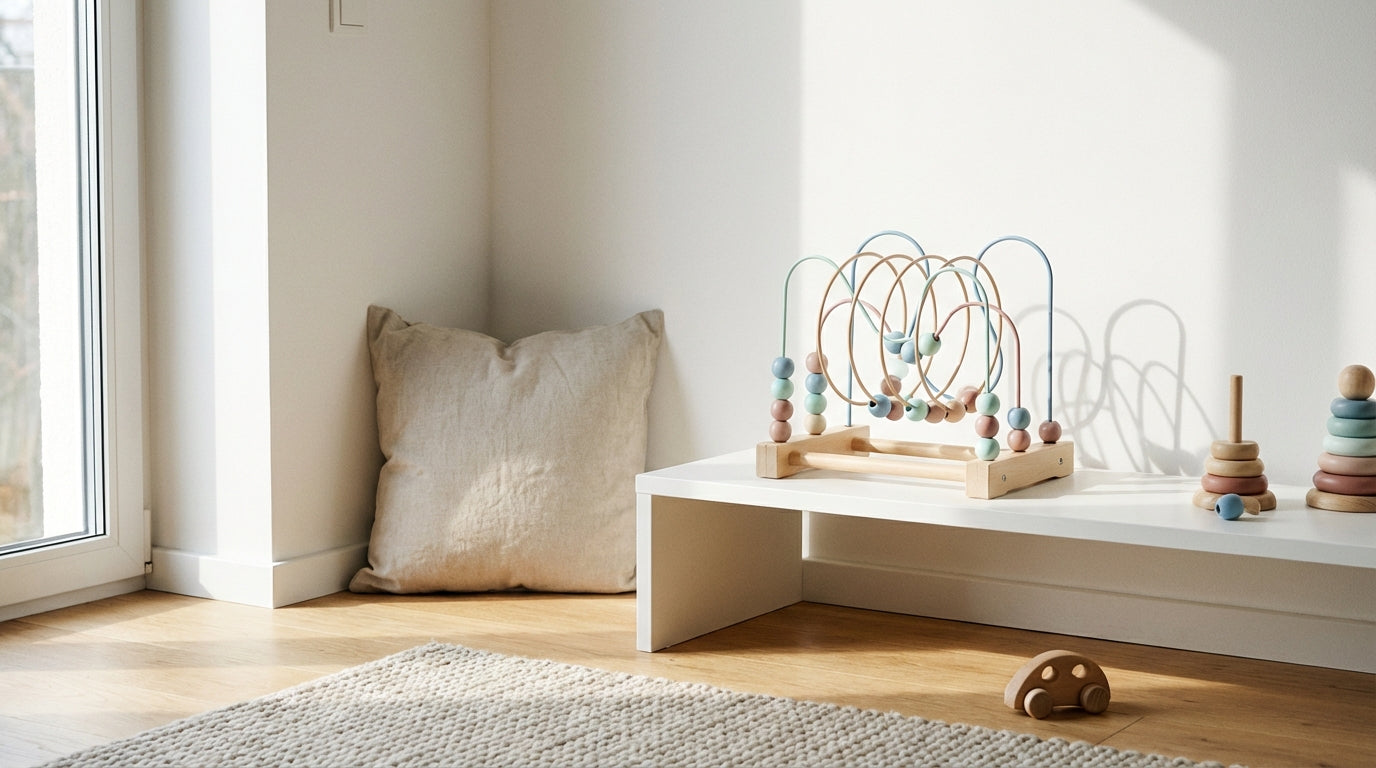
A motor skills loop is a fixed-mounted sliding and grasping toy with beads on wire tracks. Usually everything sits on a wooden base, with one or more curved metal rails on top carrying beads, shapes or little figures. Children slide the elements through curves, over crossings and sometimes past small “bottlenecks” – and are often remarkably focused while doing so.

Hand-eye coordination means: the eyes plan, the hands carry it out precisely. With the motor skills loop, your child sees the next curve and guides the bead so that it doesn't get “stuck”.
Fine motor skills are small, precise movements of the fingers and wrist. Grasping, sliding, turning and repositioning train these movements without it feeling like practice.
How does a motor skills loop work in everyday life (no magic involved)?
The principle is simple: grasp, slide, turn and guide through curves. Some children start with “just back and forth”, others immediately want to conquer the trickiest spot (and yes, we know those little stubborn ones).
- Curves & crossings call for planning: “How do I get through there?”
- Different shapes change the feel of the grip: round, angular, large, small.
- Controlling speed practises control: slowly through bottlenecks, faster on the straights.
Practical tip: Put the motor skills loop where you're sitting for a moment anyway (dining table, coffee table). Then it becomes a play-on-the-side toy instead of an “extra programme”.
What are the benefits of a motor skills loop?
The motor skills loop mainly supports coordination, finger dexterity and concentration. It's not a loud action toy but rather a quiet classic: repeat, try out, notice success. And when things get stuck, your child starts again – with or without a dramatic sigh.

Fine motor skills: little hands grow more confident
When sliding and turning, children practise grip strength, finger control and wrist movements. This can help in everyday life when zips, spoons or chunky wax crayons become interesting later on – without having to turn it into a science.
Hand-eye coordination: eyes and movement work together
The eyes “read” the track, and the hands translate that into the right movement. The curves and crossings in particular are little mini-challenges: plan, try, adjust. And yes: sometimes “again!” is the loveliest word of the day.
Concentration & perseverance: sticking with it without pressure
Many children stay engaged because the task is clear and manageable. Moving a bead from A to B is doable – and feels good. It's not about “higher, faster, further”, but more about “I can do this”.
Language & concepts: naturally woven into conversation
Motor skills loops offer plenty of opportunities to talk about colours, shapes and directions. “The red bead up”, “through the middle”, “turn left” – this often happens automatically when adults sit alongside and comment a little.
A motor skills loop is not a miracle cure, but a really good practice ground. It doesn't replace romping around, reading aloud or being outdoors – but it's a reliable building block in everyday life when you need both hands free for a moment.
What age is a motor skills loop for? Guidance that actually helps
The best guidance is the manufacturer's age recommendation, because the product was tested for it. Many models are recommended from 12 months – at Bieco, too, you'll find motor skills loops with a “from 12 months” recommendation and notes on testing according to EN 71 as well as independent testing for harmful substances, e.g. for the Motor Skills Loop with Mirror (according to the product page).
The right age for a motor skills loop is less about a number and more about: what can your child do safely right now? If your child already grasps with purpose, slides things deliberately and no longer puts everything straight into their mouth, the toy usually makes much more sense – and is more relaxed for everyone.
Motor skills loop from 1 year: often a good starting point
From around 12 months, purposeful sliding works much better for many children. The hands become steadier, the attention span grows a little, and the play principle is understood more quickly. Still, some children are interested earlier, others later – and both are completely normal.
Motor skills loop from 6 months: why this is often not recommended
Under 12 months, exploring usually takes centre stage: feeling, tapping, putting things in the mouth. Whether a model is suitable for this depends on the specific design and its age rating. If you start earlier, then only with a product approved for that age and under supervision.
Safety note: For children under 3 years, detachable small parts are especially critical. According to the Bavarian consumer portal, this is tested, among other things, with the small parts cylinder according to DIN EN 71-1. (Bavarian consumer portal)
Safety & standards: what to look for in motor skills loops
You can recognise good safety by clean workmanship and clear test information. In everyday terms, that means: nothing sharp-edged, nothing wobbly, no exposed wire ends, no flaking paint, and a base that doesn't tip over at every nudge.

EN 71 explained (without the legalese)
EN 71 is a series of standards describing requirements for toy safety. Depending on the part, it covers, among other things, mechanical/physical requirements and chemical requirements – for parents, it's above all a sign that testing was done according to defined criteria.
EU toy safety is specified through EU rules and harmonised standards. According to the European Commission, toy safety in the EU is governed, among other things, by Toy Safety Directive 2009/48/EC; the Commission also provides information on harmonised standards in the field of toy safety. (European Commission) (European Commission)
Small parts, wire ends, paints: the quick checklist
If you only have 30 seconds, look at these three things. First: Do the beads and elements sit firmly, without play? Second: Are the wire ends safely capped and not “prickly”? Third: Does the surface feel smooth and robust, without splinters or sharp edges?
Buying criteria: material, size, stability (so it's not just pretty)
A motor skills loop above all needs to stand firmly and be easy to grip. Everything else is a bonus. Here are the criteria that really count in family life – whether you're buying for your own child or as a gift.
Material: wood, metal and the honest question of everyday suitability
Wooden bases and metal tracks are common because they're robust and keep their shape. What matters is less “which wood exactly” and more: Is the surface smooth, are the edges neatly finished, and is there clear information about testing and materials?
Size: fits on your table (and into your life)
Compact is often worth its weight in gold when space is tight and days are full. For siblings or nursery groups, bigger can be more relaxed because several hands can play at the same time. At home, a model that sits comfortably on the dining table without taking over the whole table is often enough.
Stability: the underrated peacemaker
A heavy, non-slip base prevents tipping and frustration. If the toy wanders around while being pushed, many children lose motivation faster than the last banana in the fruit bowl disappears.
Design: pretty is fine – but please not at the expense of usability
Good legibility of colours and shapes helps small children with sorting. Very “delicate” colours can look lovely, but some children prefer to reach for clearly recognisable contrasts. In the end, what counts is: Does your child enjoy touching it?
Practical tip: As a gift: quickly ask whether there's already a motor skills loop at home. Two is fine – if one of them is small enough to take along.
Cleaning & care: how to keep the motor skills loop looking good for a long time
For most motor skills loops, wiping with a damp cloth and letting it dry thoroughly is enough. At Bieco, for example, the Motor Skills Loop with Mirror has the care instruction “clean with a damp cloth and mild soap” (according to the product page). Please don't soak wood or put it in the dishwasher, and simply let it air dry afterwards.

When it's “everything goes in the mouth” time, short, regular wiping usually works better. That's more practical than rare big clean-ups that end up cancelled because your child happens to be tired just then.
Play ideas by age: how to keep it interesting (without craft stress)
With small challenges, sliding becomes a game that can grow with your child. You don't need a learning programme for this – just a bit of imagination and the willingness to say the same thing five times. Welcome to the club.
Starting simple (when your child is just discovering it)
At the beginning, this is often enough: “Slide the bead to the next curve”. You can sit alongside and name what's happening: “up”, “down”, “stop”, “keep going”. That gives structure without overwhelming.
For more variety (once the principle has clicked)
Once sliding works, mini-challenges keep the game interesting for longer. For example: finding colours (“Where's the blue one?”), sequences (“first red, then yellow”), or a “race” between two beads – but please without sweeping the toy off the table.
For preschoolers (yes, some still love playing with it)
Older children often like rules: counting, laying patterns, making up stories. “The bead may only travel along the upper track”, “every curve scores a point”, or “the angular bead is the bus and stops at every crossing”. Dryly put: sometimes that's more of a rulebook than in Ludo.
Where can you find motor skills loops at Bieco?
In the overview, you can see different models and age recommendations at a glance. If you'd like to browse: Motor skills loop.
As a concrete example, there's the Motor Skills Loop with Mirror (from 12 months according to the product page). It also lists material details, care instructions and safety information (incl. EN 71).
We're a family business from Hamburg and have been doing this for 66 years. That's why we'd rather take one extra look at materials, workmanship and test information – family life is exciting enough already.
FAQ
What is a motor skills loop?
A motor skills loop is a toy where beads are slid along metal tracks. Children guide the beads through curves and crossings, practising coordination and finger movements as they go. Because the goal is clear (move the bead along), many children stay remarkably focused for a long time – with no noise and no batteries.
What age is a motor skills loop suitable for?
Follow the manufacturer's recommendation – it's often 12 months. This information matters because the product was tested for it. Some children show interest earlier, others later. What's decisive is stability, safe workmanship, and whether your child already slides with purpose rather than just exploring.
What are the benefits of a motor skills loop?
Typical benefits are hand-eye coordination, fine motor skills and concentration. Children plan movements, regulate their strength and stick with a manageable task. Along the way, there are good opportunities to talk: colours, shapes, up/down or left/right. It's playful, without feeling like “learning”.
How can I tell if a motor skills loop is safe?
Look for smooth edges, capped wire ends and clear test information. For children under 3 years, detachable small parts are especially critical. According to the Bavarian consumer portal, this is tested, among other things, with the small parts cylinder according to DIN EN 71-1. (Bavarian consumer portal)
How do I clean a wooden motor skills loop properly?
Usually it's enough to wipe with a damp cloth and mild soap and then dry thoroughly. Wooden toys shouldn't sit in a water bath or go in the dishwasher. At Bieco, for example, the care instruction “damp cloth, mild soap” is given for the Motor Skills Loop with Mirror (according to the product page). Wiping briefly and regularly is often the most practical approach.
Which motor skills loop makes a good gift?
As a gift, a sturdy model with a clear age recommendation is the most relaxed choice. If in doubt, quickly ask whether there's already a motor skills loop at home and how much space there is. For many families, a compact classic that fits on the table and can be tidied away quickly is ideal.
If you'd like to look at a model now, the easiest way to start is the overview. In the motor skills loop collection you'll find different variants with age recommendations and details on material and care – so you can calmly choose the one that fits your everyday life.