Are Trampolines a Safe Outdoor Toy for Kids? A Checklist
At a glance
- Are trampolines a safe outdoor toy for kids? Yes – with rules, the right age and a safe setup.
- The most important everyday rule: only one child at a time (to avoid collisions).
- Standards & guidance help: DIN EN 71-14 describes safety requirements for toy trampolines.
- Location matters: level, free of obstacles, with plenty of space all around.
- Don't forget maintenance: check the padding, net and connections regularly.

Trampolines can be a safe outdoor toy for kids if you take setup, rules, supervision and maintenance seriously and stick to them. If not, they're unfortunately a pretty efficient way to turn the afternoon into “Where's the cold pack?” Here you'll find a clear checklist: what matters when buying, how to set up properly in the garden, which rules really count and how to keep the trampoline safe all season – practical and down-to-earth, without the drama.

Ulli & Flo
Owners of bieco · Hamburg · parents themselves
We've learned that with a trampoline, the jumping isn't the hard part – the everyday rules are. With a clear checklist, everyone can relax a little more. Feel free to browse our Outdoor Toys collection.
Are trampolines a safe outdoor toy for kids?
A trampoline is “safe” when it reduces risks – not when it makes them vanish. A safety net can reduce falls to the outside, but many injuries happen on the jumping surface itself, for example through collisions or awkward landings. The American Academy of Orthopaedic Surgeons stresses that many injuries happen on the mat and that several children jumping at once is a major risk factor; it also says there is no data showing a clear reduction in injury rates from nets or equipment (according to the AAOS: Trampoline Safety).
The younger the child, the less a trampoline fits into everyday life. Many medical guides recommend that children under 6 should not jump and that a strict “one person only” rule be followed (according to Mayo Clinic Press: Keeping kids safe on trampolines). That's not a lecture – it's simply the shortcut to fewer tears.
Definition: An outdoor trampoline is a jumping device for the garden that significantly increases the risk of falls and collisions when used incorrectly. In practice, that means it's play equipment with house rules – not something to use “just casually on the side.”
Which standards and labels matter for trampolines?
For toy trampolines used at home, DIN EN 71-14 is a key point of reference for safety requirements. The DIN consumer council describes requirements for stability, minimum net height, material durability, entrapment points, sharp edges and warning notices, among other things (according to DIN: In-ground or with a safety net).

Warning notices are part of the safety concept – not just stickers to ease your conscience. According to DIN, these typically include notices such as “One user only,” “Adult supervision required,” “Close the net,” “No somersaults” and “Read the instructions for use” (according to DIN: Warnings under DIN EN 71-14).
Definition: A safety net is an enclosure meant to reduce falls to the outside, but it does not prevent collisions on the jumping surface. That's why net and rules belong together like rain boots and mud.
Practical tip: Take a photo of the type label, the warning notices and the first page of the instructions – and save it on your phone. If something needs checking or reordering later, you'll be glad you did.
Checklist before buying: size, net, padding, access
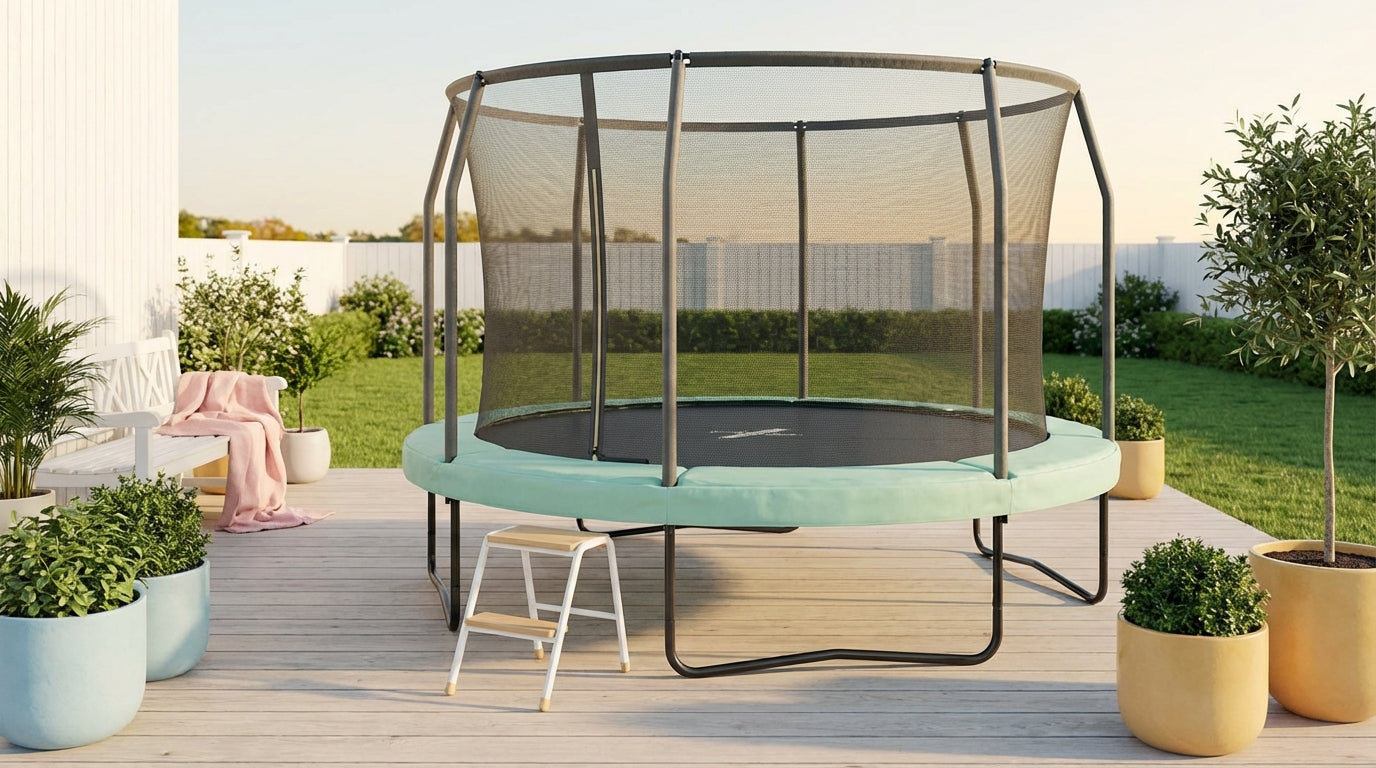
When buying, what matters most is: no hard parts in the landing area and no nasty gaps. Make sure the springs and frame are reliably padded, the net feels sturdy and closes properly, and there are no gaps where fingers or clothing could get caught.

Size affects how much control you have while jumping – and the temptation to let “just one more child” on. A larger surface can help kids stay in the middle instead of constantly landing on the edge. At the same time, you need to be all the clearer: it stays at one person. Otherwise “bigger” quickly turns into “more chaotic.”
Access is a safety lever: a ladder is handy, but it doesn't have to be attached all the time. Many families remove the ladder when no supervision is possible; Mayo Clinic Press mentions this as a measure for added safety (according to Mayo Clinic Press: Keeping kids safe on trampolines).
Look at the instructions before you buy – not only once the thing is standing in your garden. If assembly, warnings and care instructions are easy to understand, that's worth its weight in gold in everyday life. And if you're already thinking “Huh?” while reading, setup rarely gets better.
Setup step by step: how to make it stable and practical
A safe setup starts with actually reading the instructions all the way through once. It sounds like parent humor, but it's meant seriously: many mistakes don't happen while jumping, but while assembling with a “Oh, that'll be fine” attitude.
- Lay out and check all parts. Make sure the padding, net, poles, connecting parts and screws are complete and undamaged.
- Build the frame and check its stability. The frame must sit flat and must not wobble – otherwise it will work itself loose later while jumping.
- Tension the jumping mat and springs evenly. Work symmetrically (opposite sides) so nothing pulls crooked.
- Attach the padding properly. The padding should cover the frame and springs – not just lie next to them for decoration.
- Mount the net and test the closing mechanism. A net only helps if it is closed and stays closed.
- Final check: wiggle, pull, press. Go around once: Are the screws tight? Are the poles stable? Are there any open edges or gaps?
Safety note: Don't let children “help” during assembly while standing on the half-finished trampoline. Half the stability plus full curiosity is a bad mix.
The right spot in the garden: ground, distance, surroundings
Place the trampoline on level, firm ground – with free space all around. In practice, that means away from fences, garden furniture, walls, playhouses, rotary clotheslines and anything that is hard or pointy if someone trips or “flies out.”

A safety net does not replace a safe location. Nets can reduce falls to the outside, but they're no free pass to squeeze the trampoline in somewhere between other things.
Safety note: Make sure there's no play space for smaller children underneath the trampoline. Children, animals or objects under the jumping mat are a real risk.
In-ground trampolines are not automatically “safer,” but they should be assessed differently. The DIN consumer council explains that in-ground trampolines have been included in the scope of the standard; for trampolines at ground level, a net is not mandatory because the fall height is lower, and shock-absorbing material around the trampoline can be provided as an alternative (according to DIN: In-ground or with a safety net).
Rules for jumping: the 7 things that really count
Rule number 1 stays the same: only one child at a time. That's not a spoilsport rule, it's accident prevention – and it's also emphasized in warning notices (according to DIN: Warnings under DIN EN 71-14).
- Only one jumps, the rest wait. Ideally with a fixed waiting corner (a picnic blanket works wonders).
- No somersaults, no flips. “No somersaults” is a typical warning notice under DIN (according to DIN: Warnings under DIN EN 71-14).
- Always close the net before starting. Sounds trivial – but it's a common “it was only for a second” mistake.
- No wild games on the mat. Tag, shoving, “Who can jump higher?” – all fun, but please somewhere else.
- No objects on the trampoline. Bottles, toys, sticks: they land surprisingly reliably exactly where a foot wants to go.
- Supervision means actually watching. “Adult supervision required” is a typical warning notice (according to DIN: Warnings under DIN EN 71-14).
- Take age seriously. Many medical guides advise that children under 6 should not jump (according to Mayo Clinic Press: Keeping kids safe on trampolines).
Practical tip: Put a little “rule card” nearby (laminated, if you're feeling wild). Kids love clear rules of the game – and so do visitors.
Maintenance & seasonal check: what to inspect regularly
A trampoline ages outdoors – and that's exactly where the creeping danger begins. Weather, UV light and moisture wear down the net, padding and jumping mat. Check regularly for tears, brittle spots, loose seams, bent parts and wobbly legs.

If the padding or net visibly wears out: better to replace it sooner than curse later. The DIN warning notices also mention that a net should be replaced according to the manufacturer's specifications (e.g. every one or two years) (according to DIN: Warnings under DIN EN 71-14).
A simple rhythm helps: start of season, midsummer, end of season. That fits nicely with what many families do anyway: turn the garden inside out once before birthday-party season begins.
If you want to look after your outdoor toys in general, proper storage and cleaning are worth it. Our guide How to Store, Protect & Clean Outdoor Toys Properly fits well here – especially for anything outdoors with fabric, nets or padding.
Which age is right – and how to handle it in family life
“Right for the age” means: the child understands rules and can land in a controlled way. Age recommendations are a guide, but in everyday life temperament, coordination and whether your child is more of an “I'll just try it” or an “I listen” type also matter. Many medical guides advise that children under 6 should not jump (according to Mayo Clinic Press: Keeping kids safe on trampolines).
For siblings, the waiting rule is often the real stress test. What helps: a fixed order (e.g. an hourglass or timer), a clear “waiting zone” and a sentence everyone knows: “Whoever grumbles isn't next.” Sounds strict – but it saves arguments when friends are over.
Why safety matters to us (from a parent's perspective, no drumroll)
For us, safety isn't an extra, it's the part that saves family harmony. We're a family business from Hamburg and have been doing this for 66 years – and we know that parents need clear instructions, honest warning notices and materials that are easy to understand. That “calmly well done” approach is, in the end, what relaxes you most in the garden.
If you think of your garden as a safe playground, things get calmer for everyone – including your pulse. The overview in Outdoor Toys is a good place to start, and for hot days Water Toys for the Garden is a great fit – then at most the water does the jumping.
FAQ
Are trampolines a safe outdoor toy for kids?
Yes, if you consistently put rules, supervision, a safe setup and maintenance into practice. A net can reduce falls to the outside, but many injuries happen on the mat – especially with several children. Follow warnings such as “one user only” and “close the net” (according to DIN) and check the padding, net and stability regularly.
From what age does a trampoline make sense?
Many medical guides advise that children under 6 should not jump on a trampoline. The reason often given is that coordination and control are not yet sufficient. If you're unsure: better to wait, or start with calm movement games in the garden first – a year later, everything is often easier.
Is a safety net enough to prevent injuries?
No, a net is only one building block – rules are at least as important. Nets can reduce falls from the trampoline, but collisions, twisted ankles and awkward landings happen on the jumping surface. Orthopaedic sources point out that nets and equipment do not clearly reduce the injury rate (according to the AAOS).
Why should only one child jump at a time?
Because collisions and double bounces significantly increase the risk. When two children jump, the smaller one is often launched uncontrollably into the air or lands at an angle. “One user only” is a central warning notice (according to DIN), and medical recommendations also stress “one at a time” as the most important rule.
What should I check on the trampoline regularly?
Check the net, padding, jumping mat, legs and connections – regularly, not just when you hear noises. Look out for tears, brittleness, loose fastenings and wobbly parts. According to the DIN warning notices, regular net replacement according to the manufacturer's specifications may also be required – that then belongs firmly in your seasonal plan.
Where is the best place to set up a trampoline?
On level ground, with plenty of free space all around and no hard obstacles nearby. Distance from fences, walls, furniture and play equipment reduces the risk in case of missteps or falls. A net helps, but doesn't replace a safe location. In-ground solutions should be assessed differently (according to DIN).
If you set it up properly now and firm up the rules, you'll have much less stress later. And if you're looking for more ideas for outdoors: you'll find inspiration in the Outdoor Toys section – and on summer days, Water Toys for the Garden are often the more relaxed alternative to “higher, farther, wilder.”