Toys for 1-Year-Olds: Choosing Wisely – Safe, Simple, Loved
At a glance
- Toys for 1-year-olds make sense when they genuinely let your child try things out independently.
- 6–10 good pieces are often enough – rotation brings more calm than buying more.
- Big, sturdy pieces matter more than lots of features and noises.
- Pushing, pulling, stacking, sorting and books are true everyday classics.
- With ride-ons, stability and steady rolling matter more than the age on the box.

Toys for 1-year-olds make sense when your child can get started on their own and stay safe while doing it. At this age, children are little explorers: they grab, put things in their mouths, push, set off walking (or stubbornly practice it) and copy you like a pro. Here you'll find a practical guide to choosing, proven categories, concrete rotation ideas and a few things you're better off avoiding from age 1. And yes, we'll talk about balance bikes too – without the hero stories.

Ulli & Flo
Owners of bieco · Hamburg · parents themselves
At 1 year old, “I'll do it myself” is the big theme – and that's exactly what toys should be chosen for. A few good pieces and a little rotation often make everyday life noticeably more relaxed. Feel free to browse our collection 1st Birthday Gifts.
Which toys make sense from 1 year?
Sensible toys let your child practice a skill – without constant help. Between 12 and 24 months it's mostly about “I'll do it!”: cause and effect, imitation, first role play, lots of movement. Good toys aren't the loudest ones, but the ones that work again and again.
A simple rule of thumb saves money and nerves: it's a good fit if your child understands within 30 seconds what they can do with it – and still finds new ideas weeks later.
- Motor skills: inserting, stacking, turning, pushing, pulling, rolling
- Thinking: sorting, matching, “in/out”, “open/closed”
- Language: pointing, naming, imitating sounds, acting out little routines
- Movement: pushing, carrying, climbing, balancing (within a safe setting)
Practical tip: Imagine explaining the toy to a tired parent at 6:10 a.m. If it takes you longer than 10 seconds, it's often too complicated.
What is typical development at 1 year – and what fits it?
At 1 year, independence is the secret engine behind almost everything. Many children can sit steadily, pull themselves up, cruise along furniture or take first free steps. Hands and eyes become better coordinated, and interest in “how does this open?” is… let's say: still a work in progress.

Fine motor skills are the ability to control hands and fingers deliberately. You see it when inserting, turning, turning pages, or when a lid “almost” fits.
Gross motor skills describe big movements like standing up, walking and climbing. Toys that allow pushing, carrying or balancing connect well here.
What follows from this: things your child can grasp, move and repeat often are worth their weight in gold. At this age, repetition isn't “getting stuck” – it's training with a plan.
How do I recognize suitable toys for 1-year-olds? (Safety check)
Suitable toys are well made, sturdy and clearly labeled. That sounds dry, but it's exactly the part that spares you the later “why is there a broken-off tiny button on the floor?”

- No swallowable small parts: According to the Bavarian consumer portal, parts are considered critical if they fit into the test cylinder (small parts cylinder) (Verbraucherportal Bayern).
- Sturdy construction: Nothing should wobble, splinter, have sharp edges or come loose easily.
- Take clear warnings seriously: Warnings such as “Not suitable for children under 36 months” are regulated in the EU Toy Safety Directive (Directive 2009/48/EC).
- Traceable materials & testing: The EN 71 series describes safety requirements for toys; DIN EN 71-3, for example, covers the migration of certain elements (DIN e. V.).
Safety note: Check toys regularly for loose parts, cracks and flaking paint. If something breaks off or can be pulled loose: sort it out without hesitation.
What to avoid from 1 year? (To keep things more peaceful at home)
Avoid anything that produces small parts, overwhelm or constant frustration. Of course every child is different – but a few pitfalls are surprisingly reliable.
- Toys with lots of tiny parts: Even if it says “from 12 months”: if you're already cursing while tidying up, it won't get better in daily life.
- Too much “all at once”: 20 functions, lights, sounds – can be exciting, but often leads to quick tapping instead of deep play.
- Wobbly cheap mechanics: When flaps jam or wheels run crooked, curiosity quickly turns into anger.
- Too “babyish” with no new play idea: Very simple rattles are sometimes done after a short while – unless they're part of a ritual.
Said the northern German way: If a toy keeps you busier than your child, it's allowed to go. No guilty conscience.
Proven categories: which toys for 1-year-olds really get used
The best categories are often the unspectacular ones – but they're in use every day. Here come classics that accompany many children for a long time and that you can happily give as gifts without including an instruction manual.
1) Stacking & inserting
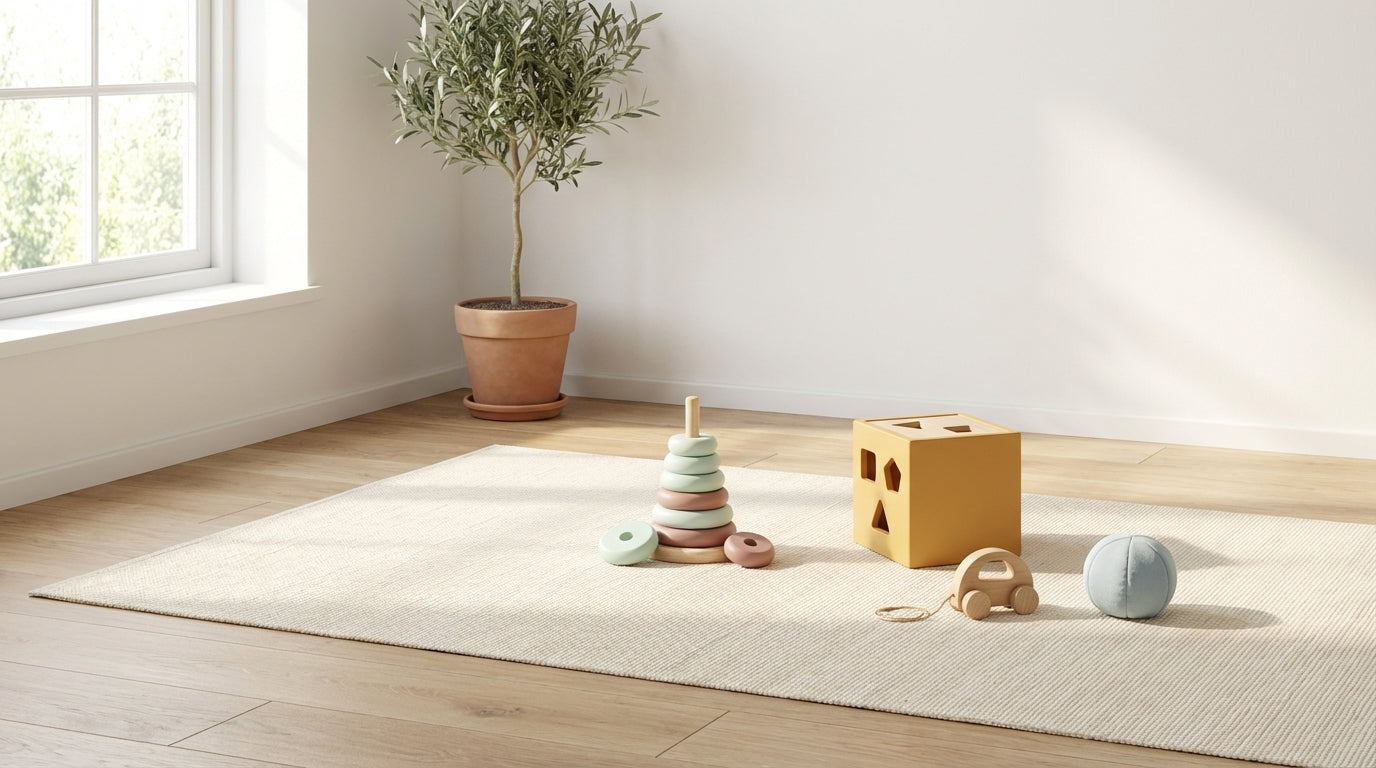
Stacking and inserting train coordination and patience along the way. Stacking cups, putting rings on a post, simple shape puzzles: your child practices aiming, grasping, letting go – and celebrates every hit like a little final.
If you're looking for something specific: A stacking tower is the kind of toy that rarely stays in the cupboard for long. Take a look at wooden toys – you'll find these classics in a sturdy version there.
2) Sorting & “in/out”
“In, out” isn't a phase for 1-year-olds – it's a hobby. Shape sorters, sorting boxes or simple containers with lids (child-friendly!) support cause and effect, perseverance and first matching skills.
3) Pushing, pulling, rolling
Push and pull toys support movement without turning it into competitive sport. Especially when the first steps arrive, it helps to have something to “hand-over-hand” along – as long as it's sturdy and doesn't tip over right away.
Browse without stress: In our selection of gifts for the 1st birthday you'll find these everyday hits collected together.
4) Building (large blocks)
Large blocks are ideal because they're safe and bring quick success. Building towers, knocking them over, building again – that's developmental work with a built-in giggle factor. Look for shapes that are easy to grip and don't slip away like soap.
5) Books & first music
Board books are often the underrated toy from age 1. Pointing, naming, “again!” – that's language in everyday life, without any pressure. For instruments, simple, sturdy pieces make sense; your ears will thank you later.
For the cozy corner: Under baby toys you'll also find quiet play ideas that go well with reading aloud and cuddling.
Practical tip: Choose a “on-the-go toy” (e.g. a small book or an inserting piece). It stays in the hallway or in your bag – a lifesaver for waiting times.
Toy rotation in practice: how to do it without Pinterest pressure
Toy rotation means: offer fewer toys at once, but swap them regularly. The goal isn't perfection but calm: less chaos, longer play phases, less “Mamaaa, what do I do?” every minute.

- Start small: Leave 6–10 pieces visible (a mix of motor skills, movement and books).
- Put the rest away: In a box outside the living room – otherwise it'll be taken out “just for a moment” after all.
- Swap every 1–2 weeks: Exchange 2–3 pieces. You don't need more than that.
- Observe instead of planning: If a piece is being used daily right now, it simply stays a while longer.
And yes: Sometimes the empty kitchen roll is the star. That's not a parenting mistake, that's childhood.
Montessori toys from age 1: what really fits into everyday life?
Montessori mainly means: easy to survey, usable independently, a real task. Many Montessori ideas can be implemented with ordinary toys – as long as they're sturdy and allow a clear action.
- Inserting & sorting: matching shapes, putting on rings, opening simple flaps
- Practical exercises: turning, sliding, opening/closing (without small parts)
- Everyday role play: “cooking”, “cleaning”, “phoning” – with simple, child-friendly things
Montessori material is good when you don't have to correct constantly. If your child can get started alone, they stick with it – and you might get two minutes to persuade the dishwasher.
Balance bike from age 1: sensible or too early?
A balance bike from age 1 can make sense if your child stands steadily and walks well. Some are already zipping around at 12–14 months, others only much later – both are normal and say nothing about being “fit” or “not fit”.
- Suitable seat height: Feet should reach the floor well so that braking with the legs works.
- Stable start: For very young children, more stable vehicles (e.g. with more wheels) are often easier.
- Weight: Lighter is usually better – for you too, when it's “all done” after 7 minutes.
- Surroundings: Level ground, no stairs within reach, no steep slopes.
Safety note: Secure the area (stairs, edges) and follow the warnings on the product. Requirements for warnings are described in the EU Toy Safety Directive (2009/48/EC).
Caring for wooden toys: short, practical, made for everyday life
Wooden toys stay beautiful longest when you clean them gently and sparingly. In practice, a slightly damp cloth is usually enough; if needed a mild detergent, then let it dry thoroughly. Long soaking is rarely a good idea – wood prefers northern German dry over tropical.
When teeth are involved: That's normal. Just check regularly whether splinters, cracks or loose parts appear anywhere – then it's better to replace the toy.
How many toys make sense from age 1?
Usually a few good pieces are enough – the rest is often just living-room decoration with a trip hazard function. When everything is available at once, children often just “tap” things. With a small selection, longer play phases emerge (and maybe your coffee even stays warm for once – a parent can dream).

- Good basis: 2–3 inserting/stacking pieces, 1–2 push/pull items, 2–3 books, 1 ball
- Optional: large blocks, a simple music piece, a role-play object
And honestly: The best toy is still you. But nobody can be an entertainer 24/7 – that's what good, simple toys are for.
Why we at bieco are so picky about toys for 1-year-olds
We think about toys from the perspective of family life: safe, sturdy, honestly described. We're a family business from Hamburg, and we've been doing this for 66 years – long enough to have seen plenty of children's rooms and to know: a toy has to withstand a lot, be easy to understand and feel good. Ulli & Flo write here as parents for parents, and when it comes to materials, testing and warnings, we prefer transparent over sugarcoated.
FAQ
Which toys make sense from age 1?
Sensible toys are ones your child can operate alone and that practice a clear skill. Stacking, inserting, sorting as well as push and pull toys have proven their worth. Look for large, sturdy pieces and a simple function – then your child stays engaged longer and you have to “help” less.
How many toys make sense for a 1-year-old?
Often 6–10 well-chosen pieces are completely enough. A mix of motor skills, movement and books is usually plenty. If you rotate (swap 2–3 pieces every 1–2 weeks), it feels “new” to your child – without you constantly having to buy more.
Wood vs. plastic: what's better for toys for 1-year-olds?
The better material is the one that is safely made and suits your daily life. Wood is often pleasantly grippy and sturdy, plastic can be very light and easy to wipe clean. What matters is clean workmanship, no loose small parts and traceable safety information (e.g. EN 71 notes).
Balance bike from age 1: is it really sensible?
Yes, if your child stands steadily and already walks well. Make sure the feet reach the floor well and the vehicle is stable. For some children it's great at 12–18 months, others start later – it's not a competition, but motor development at their own pace.
Which toys are suitable for children from age 1 (safety)?
Suitable toys have no swallowable small parts and are sturdily made. According to the Bavarian consumer portal, parts are critical if they fit into the small parts cylinder (Swallowable toy parts). Take warnings seriously and check toys regularly for damage.
What toys from age 1 if you already have everything?
Then rotation almost always helps more than buying new. Put some away and swap them out every 1–2 weeks. Adding something is most worthwhile for things you use every day: a new board book, a sturdy inserting or stacking piece, or something to push/pull.
Finally, northern German pragmatic style: If you're looking for a gift that will really get used, take a look at our selection of gifts for the 1st birthday – or keep reading in The best gift ideas for the 1st birthday: classics, trends & tips. And if you'd rather make something yourself: Creative & personalized gift ideas for the 1st birthday.