Sand Toys for 1-Year-Olds: Choosing Safely, Checking Size, Digging Without Stress
At a glance
- Sand toys for 1-year-olds work best with large pieces that are easy to grip.
- Under 3, read the warning labels and consistently avoid small parts.
- A starter set is often enough: bucket/cup, big shovel, 2–3 moulds.
- Give the sandpit a quick check and wash hands afterwards – it saves hassle later.
- Material is secondary: workmanship, edges and ease of cleaning are what count.

Sand toys for 1-year-olds are usually a good idea as long as the pieces are large, nothing breaks off and you keep an eye on your child. For babies, “experiencing sand” works earlier too – but more with hands, a big cup and no classic set. Here you'll find clear age guidance, a quotable checklist, answers to typical sandpit questions (yes, including “sand in the mouth”) and a few everyday tricks so that digging is fun instead of an extra construction site.

Ulli & Flo
Owners of bieco · Hamburg · parents themselves
We love sandpit days – as long as half the sand doesn't end up living in the car. With large pieces, clear rules and a quick check, everything gets more relaxed for everyone. Feel free to browse our sand toys collection.
Practical tip: For 1-year-olds, 3–5 pieces in a bag are plenty. Less lugging, less squabbling, more play – and you'll find everything again.
From what age can sand toys be used?
Sand toys usually suit children from around 12 months really well, because that's when they grip, tip and “deliberately” build with more purpose. Before that, sand is still exciting – just more as a sensory experience and less as a building project.

A rough, relaxed guideline (children, as we know, aren't standardised):
- 0–12 months: Feeling sand (hand, foot), ideally on a blanket at the edge. Toys: a big cup, a soft spoon, nothing small.
- From 12 months: Getting started with large tools: bucket/cup, big shovel, chunky moulds.
- 2–3 years: More of a “plan”: sieve, rake, small watering can, simple vehicles without small parts.
- From 4 years: Projects: castles, roads, water channels, role play (bakery/building site). Accessories can be more complex, but please make them sturdy.
Sand toys are simple tools that children use to pour, shape and move sand. The simpler the piece, the better it often works in real life.
And now the parent truth: if your child is currently putting everything in their mouth (including the beach), then it's not age that matters – it's size, sturdiness and how close you are.
Sand toys for babies: what works – and what's better left out?
For babies, sand play is above all a sensory activity: feeling, trickling, tipping out and filling up again. That's perfectly fine – just without tiny parts and without “surely they can be alone for a moment…”.
What often works well for babies:
- Big cup or small bucket: in, out, in, out (yes, 20 times).
- Very large shovel: better too big than too small, with a thick handle.
- Soft shapes that are easy to grip: without hard edges and without detachable decoration.
Safety note: Avoid anything with small parts or detachable elements. Warnings such as “Not suitable for children under 36 months” are there to clearly flag risks for under-3s (e.g. choking).
What you can skip for babies:
- Tiny moulds and mini sieves: they quickly become “snack bowls”.
- Toys with removable wheels/plug-in parts: anything that can come off will be tested.
- Very hard edges: if your child tips forward, their face is down there faster than you can say “oops”.
The warning “Not suitable for children under 36 months” points to typical risks for under-3s. It doesn't mean “dangerous for everyone”, but “not right for the smallest ones”.
Checklist: sand toys for 1-year-olds (short & quotable)
If you can tick off these points, you're well prepared for the sandpit. And yes: it doesn't have to be perfect, just sensible.
- Pieces large enough: no mini moulds, no loose plug-in parts.
- Handles thick and short enough: easy to hold, not “fiddly”.
- No sharp edges: run your hand over it once, take one look.
- Sturdy: nothing that bends easily or splinters.
- Easy to clean: sand + water + sun = everyday life.
- Warnings read: especially on sets and vehicles.
Sand toys for 1-year-olds: the best choice to get started
At 1 year, sand toys really pay off, because your child now shovels, tips, pats and repeats with (great) determination. A small basic kit often provides plenty of playtime.
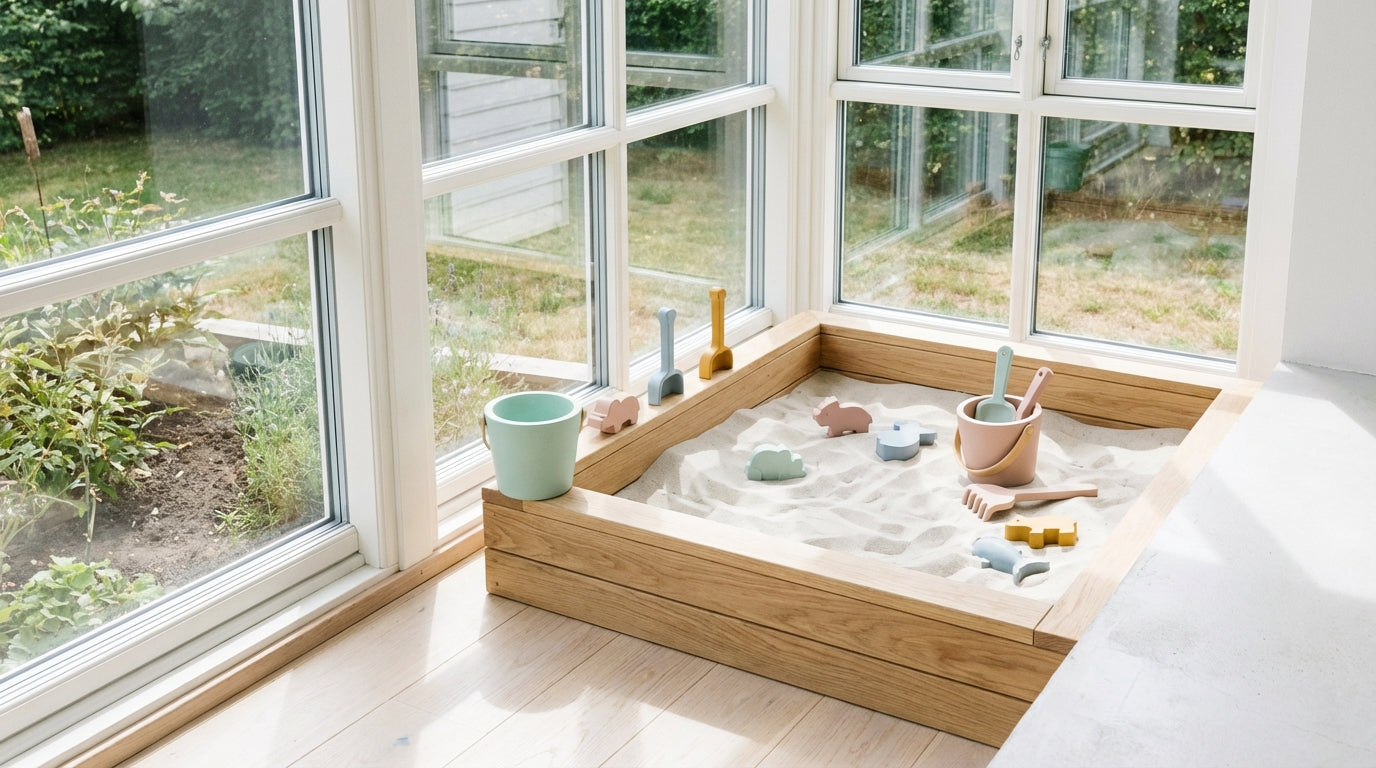
A starter set that won't fill the whole boot of the car:
- 1 large bucket or cup (sturdy, easy to carry)
- 1 large shovel (thick handle, not too short)
- 2–3 large moulds (easy to press down firmly)
- Optional: 1 sieve (suddenly makes “sand cakes” very serious business)
A few good pieces are often better for 1-year-olds than a huge set. Then your child plays more – and you search less.
If you'd like some inspiration: in the sand toys overview you'll find sets and individual pieces that are easy to sort by age and use.
Material & workmanship: silicone vs. plastic vs. wood (explained for everyday life)
The material matters less than the workmanship and care. In the sandpit, what counts is: easy to grip, no edges, easy to get clean.
- Silicone: often soft and grippy, usually straightforward to clean. If you'd like to take a look: silicone sand toys.
- Plastic: often light and robust; what matters is that nothing splinters and no sharp edges develop.
- Wood: feels lovely, but needs more care and isn't always happy in wet sand.
Good workmanship means: nothing wobbles, nothing comes loose, nothing scratches. Give it a quick check before the piece disappears into the digging action.
Safety & standards: what you should really look out for
The biggest stumbling blocks are small parts, contamination and lack of supervision. That sounds strict, but it's actually reassuring: with a few checks you have it well under control.
1) Read the warnings (yes, really)
Warnings are clear risk information, not decoration. Under the EU Toy Safety Directive 2009/48/EC, warnings must be visible, easily legible and understandable; the text of the directive can be viewed on EUR-Lex: EU Toy Safety Directive 2009/48/EC.
2) Size & construction: better chunky than delicate
For small children: large pieces, thick handles, nothing detachable. Anything that can come off will be tested at some point – and gladly with teeth.
3) What does EN 71 mean?
EN 71 is a series of standards with safety requirements for toys. DIN describes, among other things, DIN EN 71-3 as the part dealing with the migration of certain elements from toy materials; you can find an overview from DIN e. V.: DIN: DIN EN 71-3.
4) Sandpit check: clean sand is half the fun
A quick look at the sand before playing saves a lot of drama later. According to kindergesundheit-info.de, when checking a playground you should make sure sandpits are not contaminated by things like broken glass or dog mess: Playground check.
And if it's your own sandpit in the garden:
- Cover it: reduces contamination from leaves and animals.
- Rake regularly: helps loosen the sand and find dirt before little hands do.
- Wash hands: after playing (and before snacks – obvious, but easily forgotten in everyday life).
The Unfallkasse NRW (a German statutory accident insurer) also recommends checking sandpits for contamination before use. You can find their guidance here: Unfallkasse NRW.
Practical tip: A small pack of wet wipes is worth its weight in gold on the go – for hands and “sand at the corner of the mouth”. It doesn't replace hand washing, but it saves your nerves.
How we choose sand toys (transparency from family life)
We look first at size, workmanship, warnings and cleaning. It's not glamorous, but it's exactly what counts in everyday life.
- Material & surface: grippy, without sharp edges, easy to wash.
- Sturdiness: pieces shouldn't break or come loose easily.
- Warnings & age recommendations: not overlooked, but taken seriously.
- Standards & requirements: guidance comes from, among others, the EU Toy Safety Directive and the EN 71 standards (details per product).
We're a family business from Hamburg and have been doing this for 66 years. That doesn't mean “we know everything”, but: we know children's hands, parents' nerves and sand in every jacket pocket.
Sand toys for bigger kids: how to keep it exciting (without you becoming the entertainer)
Bigger kids don't necessarily need more toys, but better ideas. And the good news: the sand provides them for free.
What often goes down really well at ages 4–7+:
- “Building site”: roads, tunnels, car parks, bridges. Shovel, rake and vehicles fit right in.
- “Bakery”: sand cakes, “gateaux”, decorated with shells/stones (please nothing pointed).
- Water channels: canals, dams, a “harbour”. (Things will get wet. That's not a defect, that's the concept.)
- Team projects: “We're building a city” – works surprisingly well with several children.
If “cooking” is currently your thing, a mud kitchen often fits like a glove. For more on that: The mud kitchen: from what age is it worth it & for how long?
Cleaning & storage: so it doesn't get smelly (and you don't lose it)
Sand toys last longer if they're rinsed from time to time and dried well. That's the difference between “back again next year” and “why is this so sticky?”
- After the beach/salt water: rinse briefly with clean water.
- After wet sand: let it dry, otherwise it gets musty.
- Storage: breathable (mesh bag/box with holes), don't lock it in a closed bucket.
If you manage to rinse on the same day, you're officially very organised. If not: tomorrow is another day (says Hamburg, while it drizzles lightly).
If you're looking for a simple routine: Cleaning & storing sand toys: tips for parents.
FAQ
Sand toys for 1-year-olds: what size makes sense?
The bigger and simpler, the better. For 1-year-olds, thick handles and large moulds are ideal because they're safer to hold. Mini shovels and delicate pieces quickly frustrate – and are more likely to end up in the mouth. If you're unsure: better to leave a piece out than take it along “just for a moment”.
What should I do if sand ends up in the mouth?
Stay calm and, if possible, let your child rinse their mouth with water. Many children try sand once (or five times) because it's “new”. What matters is avoiding small parts and staying close while they play. If symptoms persist or you're worried, seek medical advice.
Silicone vs. plastic: which is better for sand toys?
“Better” is the material that is robust, easy to grip and easy to clean. Silicone is often soft and grippy, plastic often light and sturdy. What's decisive are clean edges, no detachable parts and that you can get it properly clean after sand and water. Also check the age recommendations and warnings.
From what age can sand toys be used?
Sand toys usually suit children very well from around 1 year. That's when they can grip and shovel with more purpose and stay with one thing for longer. Before that, sand experiences are possible too, but more with large, simple pieces and always supervised, because babies like to put sand and small parts in their mouths.
What should I look out for in the sandpit itself?
The sandpit should be quickly checked for contamination before playing. According to kindergesundheit-info.de, it's important that there is no dog mess or broken glass in the sand. The Unfallkasse NRW also recommends a visual check before every use. In your own garden, covering it and raking it through regularly helps.
Finally, nice and relaxed: sand toys are often the smallest effort for the biggest effect. If you're now in the mood, take a look at our world of sand toys – you'll find ideas for babies, toddlers and big diggers.