Pop-up Beach Shelter: Benefits, UV Protection & Wind Safety Explained
At a glance
- A pop-up beach shelter goes up fast – unpack it, let it spring open, anchor it.
- Important for family life: secure it against the wind, or you'll have a beach adventure on your hands.
- UPF is a measured value for textile UV protection – “shady” isn't always enough.
- Size, groundsheet, ventilation and packed size decide whether it's really relaxing.
- Taking it down works in 30 seconds – once you've practiced the trick.

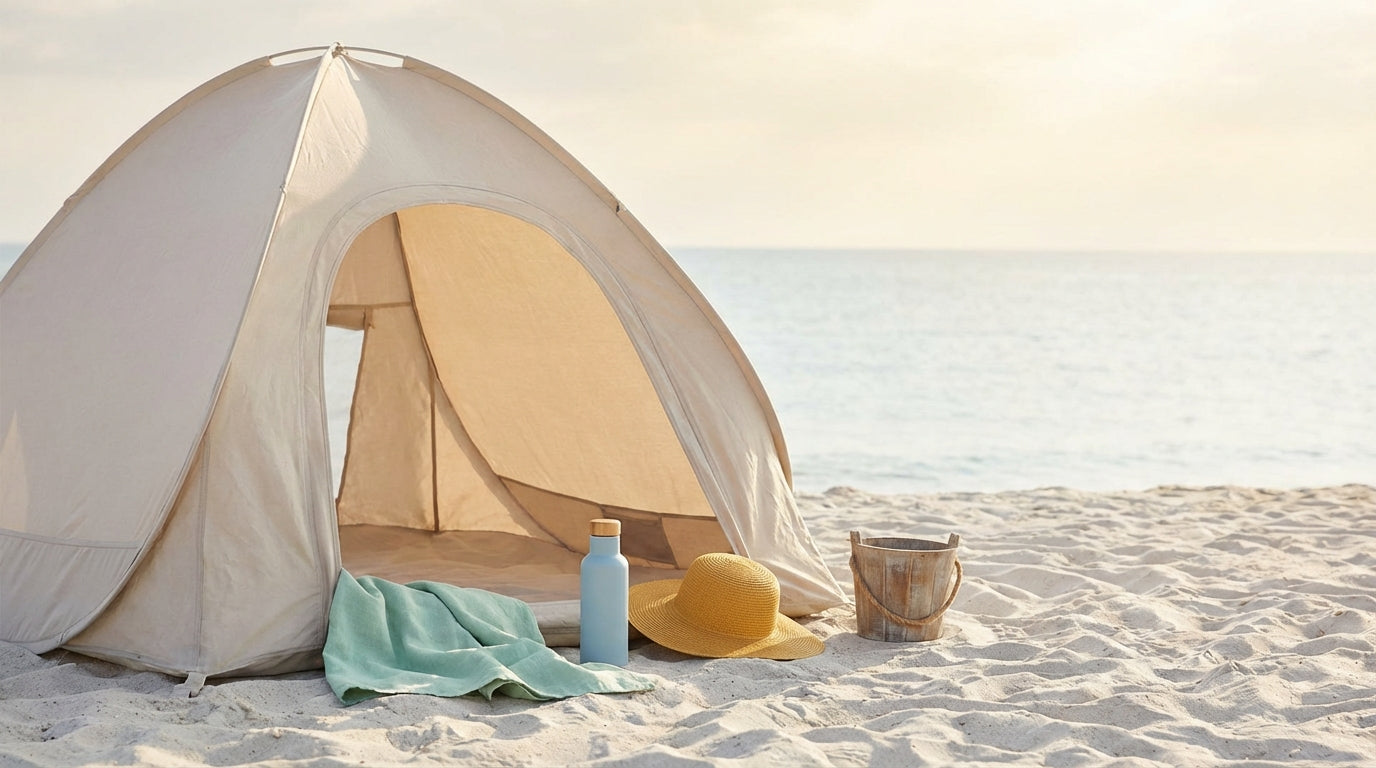
A pop-up beach shelter is a self-erecting sun shelter that, thanks to its spring frame, almost sets itself up when you take it out of the bag. You pull it out of the round carry bag, it “springs” into shape – and you quickly have a shady spot for the beach, the lake or the garden. In this guide I'll show you how to recognize a good pop-up beach shelter, how to make it safe in the wind, what UPF really means and how to take it down without swearing. Totally practical – just the way you need it between apple slices and sand in the lunchbox.
You can find our pop-up beach shelters with UV protection here.

Ulli & Flo
Owners of bieco · Hamburg · parents themselves
We love beach days that feel easy: shelter up, shade ready, everyone takes a deep breath. And when it comes to taking it down, our rule is: sort things out first, then twist. Feel free to browse our beach shelter collection.
What does pop-up beach shelter (throw-up shelter, throw tent) mean?
“Pop-up” means a spring frame opens the shelter by itself when you take it out of the bag. That's why it's also called a throw-up shelter or self-erecting beach shelter – you don't have to assemble any poles, just position it and secure it. This is especially handy when you have a child on your arm and someone is already shouting “Shade, please!”

Definition: A pop-up beach shelter is a compact beach tent with a flexible spring frame that can be set up and taken down in a few simple steps, without a classic pole system.
And yes, taking it down is often the part that inspires respect. That's not your fault, it's the tension in the frame: folding it usually requires a specific folding and twisting motion. Once you've understood it, it's more “zap” than “circus”.
Practical tip: Practice folding it once at home (living room or garden) – not for the first time in wind, in front of an audience and with sticky ice cream around.
What is a pop-up beach shelter – and what isn't it?
It's quick shade and wind protection, but not a storm tent for gust experiments. A pop-up beach shelter is made for short distances, fast setup and family life: baby in the shade, changing a child, parking snacks out of the wind, taking a breather. It can break the wind and reduce blowing sand – but only if you position it properly and anchor it firmly.
It isn't automatically “UV-safe” just because it's darker inside. Depending on the surroundings, UV radiation can also arrive indirectly (e.g. through reflection from sand or water). That's why it makes sense to see the shelter's UV protection, clothing and sunscreen as a team.
UPF explained in 2 sentences (and why it matters for kids)
UPF is a test value that shows how much UV radiation a textile lets through. According to Hohenstein, textile UV protection is determined in test procedures and stated as a UPF value so that materials can be compared (Hohenstein: Textile UV protection).

A high UPF helps – but it doesn't replace smart sun rules. According to gesund.bund.de (the German federal portal), protective measures are recommended from UV index 3, and babies should stay out of direct sun (gesund.bund.de: UV protection).
Sizes & number of people: How much space do you really need?
Plan for “people + gear” – otherwise it gets very cozy very quickly. Many shelters look generous in photos, but then at the beach there's also the bag, drinking bottles, toys, towels… and suddenly you're sitting like sardines, just with more sand.
- For 1 child + 1 adult: A compact shelter is often enough if you only want shade and short breaks.
- For 2 children or 2 adults: It's better to go up a size so air can circulate and nobody sits right at the entrance.
- For baby + changing gear: Think of a quiet corner inside where nothing tips over or fills up with sand.
If you often head out with friends or grandparents, “too big” beats “too small”. Nothing is as relaxing as having room to stretch out your legs without someone's zipper in your ear.
Material & groundsheet: What makes the difference at the beach?
At the beach what counts is: sturdy, easy to clean and as little of a “sand trap” as possible. With a pop-up beach shelter, look for clean seams, stable anchor points and a floor solution that suits your style.
- Groundsheet yes/no: With a groundsheet it often stays tidier inside, but it can also get warmer. Without a groundsheet it's airier, but sand gets in more easily.
- Cleaning: Smooth fabrics are usually easier to shake out and wipe down than “fuzzy” surfaces.
- Ventilation: Mesh inserts or windows are worth their weight in gold in the heat, especially when children sleep or play inside.
Definition: A groundsheet is an additional layer of fabric on the floor that protects against moisture and reduces sand inside when it closes off cleanly.
Wind: anchor points, sand pockets, pegs – how to keep it where it belongs
Pop-up means fast – but without securing it, a “shelter” quickly turns into a “kite”. Wind is completely normal at the beach, and a throw-up shelter has a decent surface area for it to catch. That's why securing it isn't an extra, it's a must.

- Anchor points: The more and the sturdier, the better you can keep the shelter steady.
- Pegs: Work well in firm sand or grass; in very loose sand you sometimes need other solutions.
- Sand pockets: Often very helpful in loose sand, because the weight sits directly on the shelter.
- Orientation: Don't face the opening into the wind, otherwise it will blow sand and toys right in.
Safety note: Always secure the shelter immediately after setting it up, and take it down in strong wind. Unsecured, it can blow away.
When children are running around, you don't want a flying structure at your back. That's not “overly cautious”, it's simply north German pragmatism: secure first, relax after.
Packed size & weight: The parking lot test (honestly, it matters)
The best shelter is no use if you curse it on the way there. Many pop-up models come in a round carry bag – practical, but sometimes bulky. Think for a moment about how you really get around:
- Short walk (car nearby): Weight is less critical, comfort may matter more.
- Long walk (15 minutes on foot): Packed size, carry strap and total weight suddenly become very relevant.
- With stroller/wagon: Round bags don't always fit well – a “trial pack” beforehand can save your nerves.
My tip: Mentally add the shelter to “drinks + towels + toys”. If reading this already gives you back pain, it may not be the right model.
Setup: Step by step (so it really works in seconds)
Setting up is easy: unpack, let it pop open, position, secure. Here's how to go about it calmly with most pop-up beach shelters:
- Choose a spot: Not in walkways, not right at the water's edge, and if possible not in the blazing midday sun.
- Unpack: Open the bag, hold the shelter firmly with both hands and let it spring open in a controlled way.
- Position: Turn the opening so the wind doesn't blow directly in.
- Secure: Pegs/sand pockets first, then towels inside. The other way around, everything may fly around your ears.
- Use ventilation: Open the windows/mesh so it doesn't turn into an “oven” inside.
Practical tip: If the wind is annoying: stand with your back to the wind and briefly “shield” the shelter while you secure it.
Takedown in 30 seconds: How to do it without an origami degree
The trick is a clean order: empty, release, flatten, twist, stow. This is a general procedure that fits many self-erecting beach shelters (depending on the model, the exact twist can be slightly different):
- Empty the interior: Everything out, shake it out once (sand is stubborn, but we stay friendly).
- Release the anchoring: Remove pegs/sand pockets, but hold on to the shelter while you do.
- Press flat: Bring the shelter together so it looks like one big, flat circle.
- Form a “figure eight”: Twist the frame in a controlled way so that two smaller circles end up on top of each other.
- Into the bag: Use the straps/loops, zip it up – done.
If it sticks: stop once, start over, don't fight the frame. It's easier with two people at first: one person holds the shape, the other does the twist.
What to look for: a compact checklist (to save in your head)
If you only check five things, make it these: UV information, wind securing, size, ventilation, packed size. Here's a quick overview:

| What to look for? | Why it matters in everyday life |
|---|---|
| UV information (e.g. UPF) clearly stated | You can better judge how strongly the material blocks UV radiation. |
| Anchor points + pegs/sand pockets | Wind is normal at the beach; without securing it, things quickly get dangerous or annoying. |
| Size suited to people + gear | Too small = heat build-up, grumbling, constant rearranging. |
| Ventilation (windows/mesh) | Helps against heat build-up, especially when children rest inside. |
| Packed size & carrying comfort | The way to the beach is part of the outing – unfortunately. |
Why we look so closely (a quick word from Hamburg)
We're a family business from Hamburg and have been doing this for 66 years. That's why we don't beat around the bush when it comes to beach gear: material, seams, ventilation and securing decide whether a beach day is relaxed or whether you've walked more than you've swum afterwards.
And we value transparency on safety topics. If information about UV protection, anchoring or material is unclear, things get unpleasant fast in real life – especially with children who, understandably, think more about ice cream than guy lines.
FAQ
What is the difference between a pop-up beach shelter and a regular beach shelter?
A pop-up beach shelter sets itself up thanks to its spring frame, while a regular one usually has poles. Pop-up is faster to set up, but needs a bit of practice when folding. Pole models take longer to set up, but are often more “logical” to pack and less spring-happy.
Is a self-erecting beach shelter suitable for babies?
It can be practical because you create shade quickly, but it doesn't replace complete sun protection. According to gesund.bund.de, babies should stay out of direct sun, and protective measures are recommended from UV index 3 (gesund.bund.de). Make sure there is good ventilation and secure anchoring, and use clothing and sunscreen in addition as needed.
Does a pop-up beach shelter really protect against UV radiation?
It can protect well if the fabric's UV protection is clearly stated (e.g. UPF) and you use it sensibly. According to Hohenstein, textile UV protection is determined through test procedures and given as a UPF value (Hohenstein). It also remains important that shade, clothing and sunscreen go together.
How do I stop a throw-up shelter from blowing away in the wind?
Secure it immediately after setting it up: use the anchor points, drive in pegs or fill sand pockets. Don't face the opening into the wind and don't leave the shelter unsecured – not even “just for a moment”. When it gets really gusty, taking it down is often the safest solution.
Why is folding a pop-up beach shelter so hard?
Because the spring frame is under tension and needs a specific twisting motion. The first time it feels as if the shelter has plans of its own. With a clear sequence (flatten, twist into a “figure eight”, lay on top of each other) it usually works quickly. Practicing once at home saves beach nerves.
What is more important: groundsheet or ventilation?
For many families ventilation is more important, because heat build-up quickly becomes uncomfortable. A groundsheet helps against sand and moisture, but can also trap warmth inside. Ideally, you want a shelter that solves both well: a tidy floor and windows/mesh inserts for air exchange.
Finally: A pop-up beach shelter is a real everyday helper when you take wind securing and UV protection seriously. If you'd like to look around, you'll find an overview of our beach shelters – and for the UV part also our article Which UV protection matters for beach shelters for babies and children?. Then the beach can come. And the sand. That comes anyway.