Easter Gifts for Babies: Loving Ideas for a Stress-Free Easter Basket
At a glance
- The best Easter gifts for babies are small, safe and easy to grasp.
- Easter gifts for babies: go for sensory and grasping play rather than sweets.
- From 3 months, contrasts, soft materials and gentle sounds are what count.
- From 6 months, things to chew, rattle and explore are a great fit.
- Quick check: age, workmanship, no small parts, cleanly packaged.

The best Easter gifts for babies are safe, age-appropriate little things they can grasp, feel or listen to. If you've ever stood in front of a mini Easter basket thinking, "And now please, no kitsch and no sugar shock," you're in the right place. You'll find ideas by age (from 3 months, from 6 months, around 1 year), a practical basket checklist, plus a little DIY for wrapping without plastic film. And yes: we're writing this as parents (Ulli & Flo) from a family business in Hamburg – for 66 years now – with one guiding thought: "It has to work in everyday life."

Ulli & Flo
Owners of bieco · Hamburg · parents themselves
We like Easter best without gift stress: a small basket, the right moment, done. And yes – quiet wrapping is sometimes the best present. Feel free to browse our Easter gifts collection.
What do you give a baby for Easter?
A good Easter gift for a baby suits their stage of development and has no small parts. At first, babies "play" with their senses: looking, touching, listening – and (surprisingly consistently) putting everything in their mouths. That's why simple things are often best: a grasping toy, a soft cloth, a small motor-skills toy or something that helps when you're out and about.
Definition: A teether-style grasping toy is a baby toy that small hands can easily hold. The benefit is simple: grasping works sooner, frustration stays smaller – and you don't have to say "here, take it again" every 20 seconds.
Practical tip: Ask the parents quickly: "What is she/he really good at right now – grasping, rolling, sitting?" That saves duplicate gifts and long faces.
Easter gifts for babies from 3 months: soft, light, not too much going on
For babies from around 3 months, soft, light things with clear stimuli are ideal. At this age, looking becomes more focused, hands wander toward the face more often – and everything gets thoroughly "tasted." Good choices are pleasant materials and shapes that don't overwhelm.
- Soft grasping and sensory toys with different surfaces (smooth, ribbed, fluffy).
- High-contrast mini play ideas for short awake periods (e.g. black-and-white patterns).
- Gentle rattle sounds: quiet, friendly, not like a tambourine concert at 6 a.m.
Definition: Sensory toys help babies practise seeing, hearing and touching in everyday life. It's not a "development programme," more like: baby discovers the world – and you might briefly rediscover your tea.
Clear age recommendations and warning notices on the packaging are a good guide. For toys in the EU, the Toy Safety Directive 2009/48/EC applies; CE marking is mandatory, as explained by the Bavarian consumer portal (source).
Easter gifts for babies from 6 months: chewing, rattling, exploring
Easter gifts for babies from 6 months can be sturdy, because now things get tested. From around six months, things get more active: objects are grasped on purpose, turned, dropped (again and again, for scientific reasons), and the mouth remains the most important "measuring device."
- Teething and grasping toys (age-appropriate and without detachable parts).
- Simple motor-skills toys with clear movements: pushing, turning, flipping.
- Fabric or wooden toys with a good grip and few individual pieces.
If you're looking for inspiration: better one item that's used every day than five that just roll around. In the Bieco overview of baby toys you'll find lots of ideas that work as a small Easter basket gift – with a focus on age-appropriate designs and everyday-friendly materials.
Standards such as DIN EN 71 ("Safety of toys") are a helpful safety anchor. DIN explains that the series of standards covers, among other things, requirements for mechanical properties, flammability and the release of certain elements (source).
Safety note: Babies put toys in their mouths. Check regularly for loose seams, protruding parts and cracks – especially after falls onto hard floors.
Easter gifts for babies around 1 year: stacking, pushing, "me do it!"
Around the first birthday, Easter gifts that support movement and independence are a good fit. Sitting, crawling, maybe first steps: toys can now do a bit "more" – but please keep them simple, so your child doesn't drown in a chaos of pieces (and neither do you).
- Stacking & sorting: cups, rings, simple shapes (without tiny parts).
- Pushing & rolling: things that can be pushed or pulled along.
- First pretend play: simple everyday objects to imitate.
Wood can be a good companion here, because it's durable and "honest" in its feel. In the Bieco wooden toys collection you'll find lots of ideas for children from 1 year – practical, sturdy and not "played out" after two days.
What belongs in the Easter basket? Ideas that actually get used
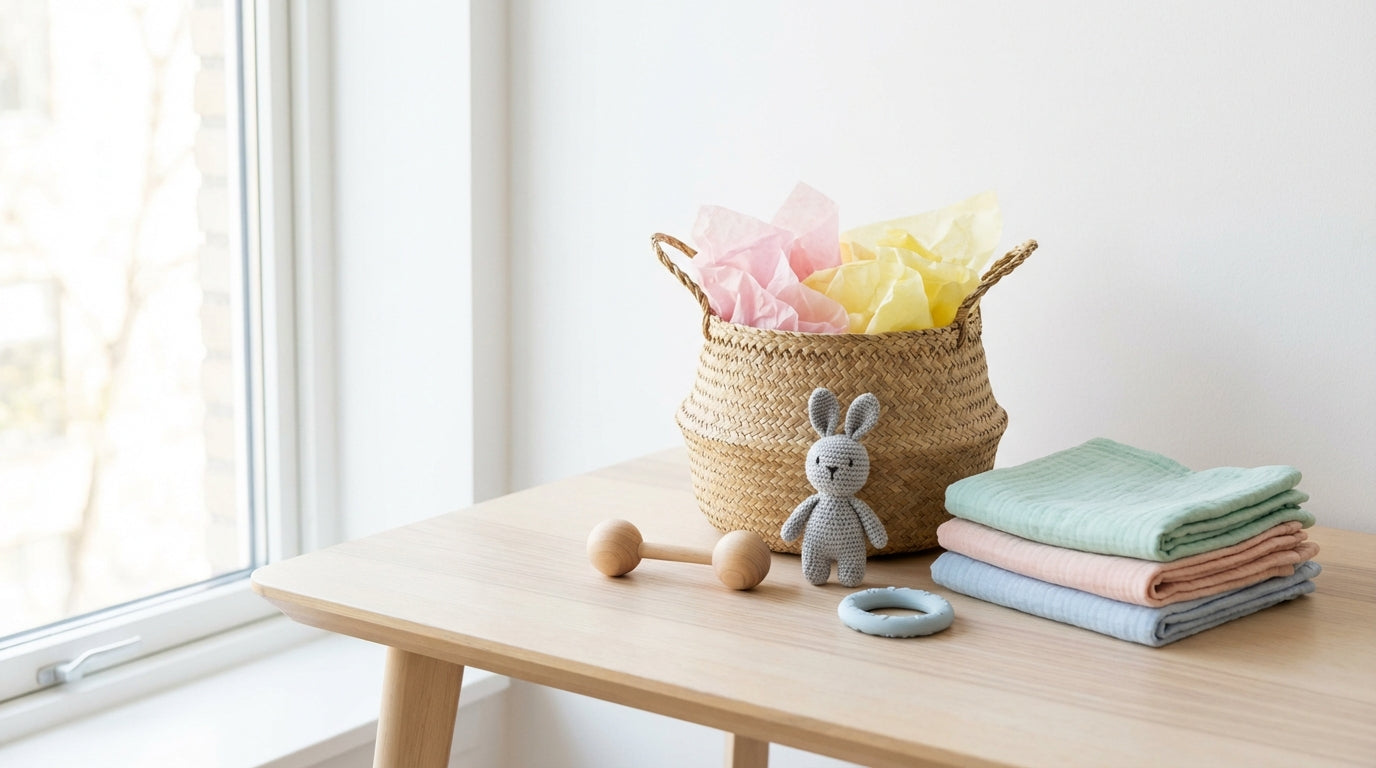
An Easter basket for babies doesn't have to be full – one fitting item is often perfectly enough. If you're wondering what "belongs in there": think less about tradition and more about everyday life. Babies don't need a theme world, they need things they're allowed to touch – and parents are happy about anything that doesn't get annoying after two minutes.
- Something to grasp (grasping toy, small rattle, teether – depending on age).
- Something to feel (mini touch-and-feel book, fabric elements, comfort cloth – if the family likes that).
- Something for on the go (small, light, easy to clean).
- A mini ritual (a photo, a card, "we'll go for a walk together").
If several people are giving gifts: better to coordinate, so three identical bunnies don't move in. That's not impolite, that's running a household with heart.
Meaningful Easter gifts instead of sweets: what suits babies better
For babies, sweets as an Easter gift are mostly unnecessary – sensory play and closeness are more valuable. If grandma or uncle still want to put "something sweet" in the basket: feel free to do so for the adults or for older siblings. With babies, "edible" quickly also means "risky."
Honey doesn't belong in a baby's diet in the first year of life – not even "just a little." The German Federal Institute for Risk Assessment (BfR) states that honey is a known source of infant botulism and should therefore not be fed to infants under one year (source).
The same goes for small snacks: babies choke faster than you can say "I only looked away for a second." The Federal Centre for Health Education (BZgA) points out that young children can easily choke on hard foods and names nuts and hard pieces, among other examples (source).
If you want to give something meaningful, think in situations: changing, falling asleep, playing on the floor, on the go. That's exactly where gifts end up that actually get used – and not on top of the cupboard "for later."
Mini checklist: safety check before gifting
A quick safety check before gifting prevents most "oops" moments. You don't need to be a testing lab – an alert eye is enough, especially if the gift is second-hand or has been in a drawer for a while.
- Does the age recommendation fit? Not "it'll be fine" – better to choose something suitable.
- No small parts? Nothing that can come loose, break off or be unbuttoned.
- Workmanship okay? No sharp edges, no loose seams, no cracks.
- Clean & odour-free? Wipe or wash once, if possible.
- CE marking on toys? It is mandatory in the EU, as explained by the Bavarian consumer portal (source).
Practical tip: Do the "sofa test" once: if you drop the item on the floor – does anything come loose? Then better to swap it before baby takes it over.
DIY: Easter basket or wrapping without plastic film (quick, pretty, quiet)
A DIY Easter basket without plastic film is quickly made and easy on the nerves. Babies often celebrate rustling film like a rock concert – parents more like a tinnitus test. So: better to use fabric, paper and things that can be reused later.
Option 1: Fabric bag nest (5 minutes)
- You'll need: a small fabric bag, a cloth/muslin square as the "nest," paper tag or card.
- How to: Lay the cloth in loosely, put the gift in, tie it at the top, attach the card.
- Bonus: Afterwards the bag lives on as storage for pacifiers, toys or a change of clothes.
Option 2: Cardboard basket from a box (10 minutes)
- You'll need: a small box, paper (kraft paper or construction paper), tape, scissors.
- How to: Cover the outside of the box, scrunch paper inside as "grass," put the gift in.
- Quiet upgrade: Instead of plastic grass, simply use paper strips or a soft cloth.
Safety note: Don't put plastic decorative "grass" or loose ribbons in the basket – babies find anything they can swallow or wrap around themselves.
Why we pay so much attention to safety with gift ideas (short & honest)
For us, good Easter gifts for babies are above all one thing: safe in real family life. We're a family business from Hamburg and have been doing this for 66 years – and in the team (and in customer service) we keep hearing the same questions: "Is it sturdy?", "Can it go in the mouth?", "Will it survive everyday life?" That's why we'd rather talk openly about materials, workmanship and clear age recommendations than sugarcoat anything for you.
FAQ
What do you give babies for Easter without sweets?
Without sweets, grasping toys, touch-and-feel books, teethers and motor-skills toys fit especially well. Baby has something to discover, and the parents don't get a sugar overload in the daily routine. Pay attention to the age recommendation, sturdy workmanship and few individual pieces – then the gift stays exciting longer than until Easter Monday.
Which Easter gifts for babies suit the youngest ones?
For the youngest, light, soft Easter gifts with clear stimuli are best. Contrasts, different fabrics and a gentle rattle are completely enough. What matters is that the toy is easy to grasp and safe to put in the mouth – because babies test quality with their palate first.
Which Easter gifts for babies suit from about 6 months?
From about 6 months, Easter gifts that support chewing, grasping and cause and effect are a good fit. Teething and grasping toys, simple rattle elements or motor-skills toys with few functions are ideal. Pay particular attention to sturdy parts, because at this age things are dropped and picked up again very consistently.
How do I best wrap Easter gifts for a baby?
It's best to wrap Easter gifts for a baby quietly and without loose small parts. Fabric bags, paper and a soft cloth as a "nest" work great and look lovely. Avoid plastic film, plastic grass, small decorative eggs or long ribbons – anything that rustles or can be swallowed will otherwise instantly become the main attraction.
Can a baby have honey or chocolate at Easter?
Honey should not be given in the first year of life, and chocolate is mostly unnecessary for babies. According to the German Federal Institute for Risk Assessment, honey is a known source of infant botulism and should therefore not be fed to infants under one year (source). If it has to be "something sweet," then better for the big ones.
If you still need an idea that fits in the basket: in our collection you'll find calm, everyday-friendly little things. Take a look at the Bieco Easter gifts collection – and if you want to browse further, The Best Easter Gifts for Children: Ideas for Every Age and Easter Gifts for Outdoors: Outdoor Toys and Activities are good reads too.
Bottom line: Easter gifts for babies can be small – the main thing is that they suit the child. If you keep age, safety and everyday life in mind, the basket is quickly done. And then there's more time for what babies truly remember: closeness, your voice, a quiet moment – and maybe a bunny that doesn't rustle.