Large Wooden Dollhouse: How to Find the Right Size, Scale & Accessories
At a glance
- A large wooden dollhouse works best when you check the scale and the space first.
- Leave room all around it, otherwise it quickly turns into a piece of décor.
- An open front is great for everyday play, because kids can reach everywhere.
- Checklist: stable, smooth edges, firmly attached small parts, clear labeling.
- Gift tip: start with the house plus a small set, then expand at your leisure.

A large wooden dollhouse is the right choice when scale, floor space and access all work together. Then it becomes a playground for stories – and not the pretty thing you only lift when vacuuming. In this guide you get a clear step-by-step decision aid: which size makes sense, which scale is common, how much room you need around the house – and how to spot safety and build quality in everyday life. No jargon, just a tape measure, common sense and a pinch of northern German calm.

Ulli & Flo
Owners of bieco · Hamburg · parents themselves
When we bought a dollhouse ourselves, we noticed: once the scale and the spot are right, play suddenly happens all on its own. And the accessories grow along with the stories anyway. Feel free to browse our dollhouse collection.
What should you look for when buying a dollhouse?
What matters most are scale, play access, stability and suitable age recommendations. If these four points are right, “pretty” is the icing on the cake – and not the only reason the house moves in.

- Scale & compatibility: Does the favorite figure fit into the rooms, through the doors and at the table?
- Play access: Open front, fold-open or playable from all sides – depending on age and space.
- Stability: A dollhouse gets pushed, turned, rearranged and sometimes misused as a parking garage.
- Small parts & age: The younger the child, the fewer mini pieces there should be and the sturdier everything needs to be.
- Workmanship: Smooth edges, neatly fitted parts, no splinters – that is everyday durability.
Practical tip: Write down three measurements: the spot for the house (W/D), the play height for your child and the figure size. With those, you can walk into any store completely relaxed.
Which sizes and variants are there – and what does “large” really mean?
“Large” is only good if your child can comfortably reach every floor. A big house can be fantastic – or a quiet attic with cobwebs (at least it feels that way).

- Compact/portable: Fewer rooms, but quickly put away. Good for small bedrooms or visits to Grandma and Grandpa.
- 2–3 floors (the classic): Lots of play value without taking up half the room.
- Large wooden dollhouse: More depth, more floors, more space for several children or lots of accessories.
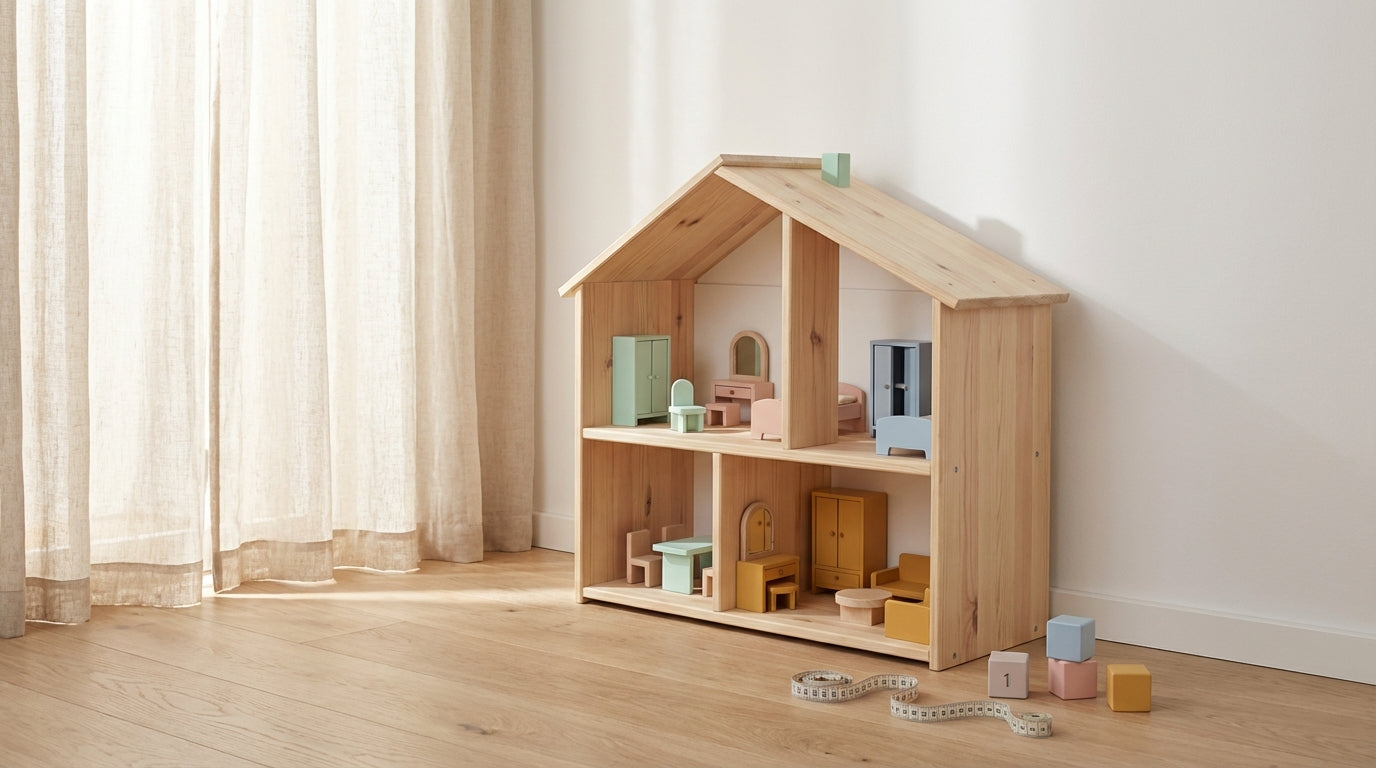
- Open shelf-style house: No front wall – very easy to reach, especially for smaller hands.
- Fold-open/suitcase house: Can be closed when things get messy. (And yes, that is a real feature.)
A large wooden dollhouse is especially worthwhile if you play together. With siblings or playdates, “more surface” often means less arguing – because not everyone has to reach into the same tiny bathroom at once.
Understanding scale: so dolls, furniture and house fit together
Scale decides whether accessories fit – not the number of rooms. And that is exactly where the classic gift mishaps happen: great house, great furniture, but together, sadly, a chair for giants and a table for gnomes.
Scale is the size ratio between the toy and the real world. It helps you choose furniture, figures and rooms so that play works without frustration.
Play access is the way children get to the inside of the house. Open fronts and large openings make role play easier, because hands and figures don’t have to go “down the chimney.”
Figure size is the quickest shortcut to the right scale. If you already have figures: roughly measure their height and check whether the doors, ceiling height and bed length in the house match. That saves you the “Why is the doll sleeping sideways in the hallway?” drama later.
Practical tip: Stick to one system: a mix of different sizes looks nice but often plays awkwardly – especially with tables, beds and doors.
Which size suits 30 cm figures?
For 30 cm figures, you mainly need enough room height and depth. Sounds trivial, but it is the crux: many houses look big, yet inside they are more “cute little rooms.”

- Check 1: Door height: Hold the figure up to the door (or measure at home) – does it fit without bumping its head?
- Check 2: Room depth: Can the figure sit without its knees touching the coffee table?
- Check 3: Bed/bathroom: Bed length and bathroom furniture quickly reveal wrong sizes.
If you are unsure, decide by furniture rather than by floors. A house with fewer floors but more depth per room often plays better than a tall tower with narrow rooms.
How much space does a dollhouse need all around?
Plan some space around the house so children can really play. A dollhouse that fits into the corner “just barely” often ends up as a backdrop in everyday life – because it is hard to get to.

- In front: Enough space for a child to kneel or sit.
- Sides: Handy if you can reach doors/floors from the side or play together.
- Above: With tall houses: can your child play on the top floor without balancing on tiptoes?
A permanent spot is half the battle for regular play. If the house has to be put away after every play session, it gets used less often – let’s be honest.
Safety & quality: a complete checklist for wooden dollhouses
You can recognize a safe dollhouse by its stable construction, clean workmanship and clear labeling. Here is the checklist you can really use in the store (or when unpacking):
- Stability: Does it wobble or tip under light pressure? Is it stable on a carpet, too?
- Edges & surfaces: Everything smooth, no splinters, no sharp corners, no rough spots.
- Firm connections: Are screws/plug-in joints secure? Does anything creak or come loose when you lift it?
- Back panel & floors: Sturdy back panel, floors that don’t sag, no “soft” boards.
- Small parts: Handles, knobs, mini décor – is it firmly attached and does it match the age recommendation?
- Openings: No spots where fingers could get pinched (e.g. with hinged parts).
- Smell: A strong chemical smell is a warning sign. “New” may smell, but it shouldn’t sting.
- Labeling: Age recommendation, warnings, manufacturer details – all present and easy to understand.
- CE marking: In the EU, toys generally require CE marking; according to the European Commission, the Toy Safety Directive 2009/48/EC sets safety requirements for toys. (Source)
- Standards as a guide: Testing to EN 71 is often cited as a reference for toy testing; according to TÜV SÜD, EN 71 is a common standard in this field. (Source)
Safety note: Accessories can include many small parts. For younger children, only use age-appropriate sets and stay nearby while they play.
Wood, plastic or fabric? Choosing materials without worry
Wood is popular, but what matters is the workmanship – not the label. Wood can be wonderfully sturdy and last a long time. At the same time: wood can also be poorly made, and plastic can be very well made.
- Wood: Look for smooth edges, clean transitions, a stable back panel and solid joints.
- Plastic: Often lighter and easy to wipe clean – sturdy parts and no sharp edges are what count.
- Fabric/felt: Light, quickly stowed away, better for gentler role play and less “furniture-compatible.”
For painted surfaces, traceable testing is a good compass. When manufacturers are transparent about tests and standards, it is simply more reassuring for parents – especially when the toy is in little hands every day.
Gifts: how to (almost) always get it right
As a gift, a large wooden dollhouse works best with three quick questions in advance. You don’t need secret agent training – a short phone call is enough.
- Where will it go? Kids’ room, living room, at the grandparents’?
- Are there already figures/furniture? Then go by those – scale beats looks.
- How does your child play? Long role-play sessions like more rooms; short, wild play likes an open front and sturdy parts.
If you are unsure: house + small set is often the best combo. The rest will come later anyway – usually as a very specific wish list (“I still need a bathroom. And a dog. And a second dog.”).
Why we at bieco pay so much attention to everyday life & safety
We think about dollhouses from the kids’ room – not from the brochure photo. We are a family business from Hamburg and have been doing this for 66 years – that adds up to quite a lot of “what really works?” experience.
- Northern German pragmatism: Rather easy to reach and sturdy than “stylish, but fiddly.”
- Transparency on safety: Clear age recommendations, warnings and traceable testing guidance are not an extra for us.
- Parent perspective: Ulli & Flo write as parents for parents – with an eye for small parts under the sofa.
If you want to browse: our dollhouse overview shows many variants at a glance. And if wood is your thing, take a look at our wooden dollhouses – they are easy to compare.
Finding matching accessories (without scale chaos)
Accessories are fun when they fit together and stay easy to grab. Especially with a large wooden dollhouse, the temptation to buy “one of everything” is big. It doesn’t have to be that way – piece by piece is often better.
- Start with the basics: A kitchen or living room plus a few figures is enough for the beginning.
- Expand based on play ideas: If your child constantly wants to “go to the bathroom,” that is a pretty clear signal.
- Plan for storage: A box next to the house isn’t pretty, but it is very effective.
You can find matching accessories organized by system in Dollhouse Accessories & Furniture. And if you are still torn between sizes, Large & Small Dollhouses helps you compare.
FAQ
Which size suits 30 cm figures?
For 30 cm figures, you mainly need enough door and room height. Measure the figure and compare it with door height, ceiling height and bed length. If the figure can only get through the house hunched over, play quickly becomes frustrating. When in doubt, choose fewer floors with bigger rooms.
How much space should stay free around the dollhouse?
There should be enough space around the dollhouse for children to kneel and reach. Free floor space in front of the open side is practical, plus a little room at the sides if two children play together. If the house is placed too tightly, it gets played with less often in everyday life – simply because it is hard to reach.
Which scale is common for dollhouses?
Various scales are common – what matters is that the house, furniture and figures fit together. Check the product details or go by the figure size and door dimensions. If you want to add accessories, stick to one system if possible. That saves nerves and prevents the “giant on a kid’s chair” effect.
Open front or doors – which is better?
An open front is often more practical in everyday life, because children can reach everywhere. Doors and lots of movable details can be great, but depending on age they need more patience and sometimes more supervision because of small parts. For younger children, “easy to reach” usually matters more than “super realistic.”
How can I tell if a wooden dollhouse is safe?
You can tell by its stability, smooth edges, firm connections and clear labeling. Check that nothing wobbles, that surfaces are cleanly finished and that warnings and age recommendations are clearly stated. According to the European Commission, the Toy Safety Directive 2009/48/EC sets safety requirements for toys. (Source)
Bottom line: sort out scale and space first, then fall in love – that way it stays a toy. If you now want to see what houses and add-ons are available: you will find the overview in Dollhouses, and you can expand to match in Dollhouse Accessories & Furniture.