Which Batting for a Baby Play Mat? Choosing Washable & Safe
At a glance
- Which batting for a baby play mat? Choose washable, shape-stable batting and secure it well.
- High-loft batting is easy to care for – as long as it doesn’t shed fluff or clump.
- Batting that’s washable at 40/60 degrees is often the most relaxed choice for everyday life.
- Securing/quilting the batting stops it from “wandering” and forming hard lumps after washing.
- Certifications help: according to OEKO-TEX, Product Class 1 is the strictest for babies.

For a baby play mat, the best choice is a washable, shape-stable batting that you secure reliably on the inside. That way the mat stays soft and even, and survives the usual family “stress tests”: spit-up, cookie crumbs, the washing machine, drying on a chair back, and then all over again. In this guide you’ll find a clear overview of materials, a checklist for “baby-friendly”, DIY instructions (including quilting spacing) and a small care plan. No drama – more like: practical, clean, done.

Ulli & Flo
Owners of bieco · Hamburg · parents themselves
We’ve learned that a play mat doesn’t have to be perfect – but it should be washable, evenly soft and free of loose parts. With the right batting and a few quilting seams, everyone can relax a little more. Feel free to browse our play mat collection.
Table of contents: jump straight to the topic you need.
- Short answer
- Types of batting in everyday life
- Checklist: baby-friendly batting
- Safety & certifications
- DIY: securing/quilting the batting – step by step
- What thickness makes sense?
- Care: washing at 40/60 degrees & drying
- FAQ
Which batting for a baby play mat – the short answer
The ideal batting is washable, shape-stable and firmly quilted in place. Whether you choose polyester high-loft batting, cotton batting or a blend: what matters is that it doesn’t crumble, doesn’t shed a lot of fluff and doesn’t turn into “hills and valleys” after washing. If you wash often, batting that tolerates 40 °C or 60 °C (depending on the manufacturer’s instructions) is usually worth its weight in gold.
Definition: Batting is the filling layer between two layers of fabric. In a play mat, it provides cushioning, a little warmth, and makes sure tiles don’t feel like tiles.
What types of batting are there – and what do they mean in everyday baby life?
Batting differs by fiber, thickness and how well it “holds together”. For parents, the translation is simple: How often can I wash it? Will it stay even? And does it feel pleasant when baby lands face-first on it?
1) Polyester high-loft batting (synthetic)
High-loft batting for a play mat is often the easiest to care for and dries faster. That’s handy when the mat is in use every day and you don’t want to stage a small textile opera every time. Pay attention to quality: some very cheap battings shed more fluff or look “flat” after a few washes.
- Good if: you wash a lot and want the mat ready for action again quickly.
- Watch for: low fluff shedding, clear care instructions, and that you can quilt it well.
2) Cotton batting
Cotton batting feels natural, but it tends to “work” more in the wash. That’s not a problem – you just need clean securing and should follow the manufacturer’s care instructions. If you use delicate fabrics for the top layer (e.g. muslin), calm, even quilting can help keep everything nice and flat.
- Good if: you prefer natural fibers and want a cozier, homey feel.
- Watch for: whether pre-washing is recommended and how much it may shrink (manufacturer information).
3) Bamboo/viscose blend batting
Blended battings are often very soft, but they need especially consistent quilting. The softer and “fluffier” the filling, the more likely it is to wander if you don’t secure it regularly on the inside. For a baby blanket, securing it isn’t optional extra credit but a must – otherwise it gets uneven after a few washes.
- Good if: you want a very soft lying feel.
- Watch for: washing temperature, drying and recommended quilting spacing.
4) Wool batting
Wool keeps you wonderfully warm, but it is often more delicate to care for than other battings. For a mat that lies on the floor every day and gets washed regularly, wool isn’t always the most nerve-saving choice. It can work for “quiet cuddle time” – as long as the care stays realistic.
- Good if: you’re looking for a warmer mat for indoors and rarely wash hot.
- Watch for: care instructions (e.g. wool wash cycle) and whether that fits your everyday life.
Practical tip: Wash a small piece of batting once, exactly the way you’ll later wash the mat. If it clumps or sheds fluff: better to find out now than after 3 hours of sewing.
How do I recognize “baby-friendly” batting? (Checklist)
Baby-friendly means: little fluff, no hard spots and even cushioning. Babies have an astonishing talent for putting into their mouths everything that isn’t nailed down. That’s why this short, honest checklist is worth it:
- Washability: Is the batting washable at 40/60 degrees (as needed) – according to the manufacturer’s label?
- Shape stability: Does the filling stay even after washing, or does it get lumpy?
- Low-fluff: Fluff quickly ends up on baby’s hands, in their face and eventually… well, you know where it goes.
- Suitability for quilting/securing: Can the batting be secured/quilted well without tearing or distorting?
- Transparent information: Are the top fabric, backing and filling clearly named (material, care, certifications where applicable)?
Definition: “Shape-stable” means a batting keeps its distribution after washing. This prevents hard spots and keeps the play mat similarly soft everywhere.
Safety: Which certifications and rules matter for baby blankets?
With baby textiles, verifiable testing counts for more than pretty words on the label. Two reference points are especially helpful in the EU:
- OEKO-TEX® STANDARD 100: According to OEKO-TEX, STANDARD 100 is a testing system for textiles for harmful substances; for babies and toddlers up to 3 years, the strictest Product Class 1 applies. OEKO-TEX® STANDARD 100
- EU Toy Safety Directive: If a mat counts as a toy/play mat, the requirements of Directive 2009/48/EC may be relevant. Directive 2009/48/EC (EUR-Lex)
Chemical restrictions for toys in the EU are also governed through REACH, among other things. According to ECHA, there are substances that are restricted in toys in order to protect children. ECHA: Substances restricted in toys
Safety note: For homemade play mats, no buttons, ribbons or decorations that could come loose. Anything that can come off will be tested – with baby teeth.
DIY: How to sew a play mat where the batting doesn’t wander
The best batting is no use if it isn’t secured on the inside. You don’t need a professional machine – just a bit of order in the “sandwich” and a quilting pattern that suits your washing reality.
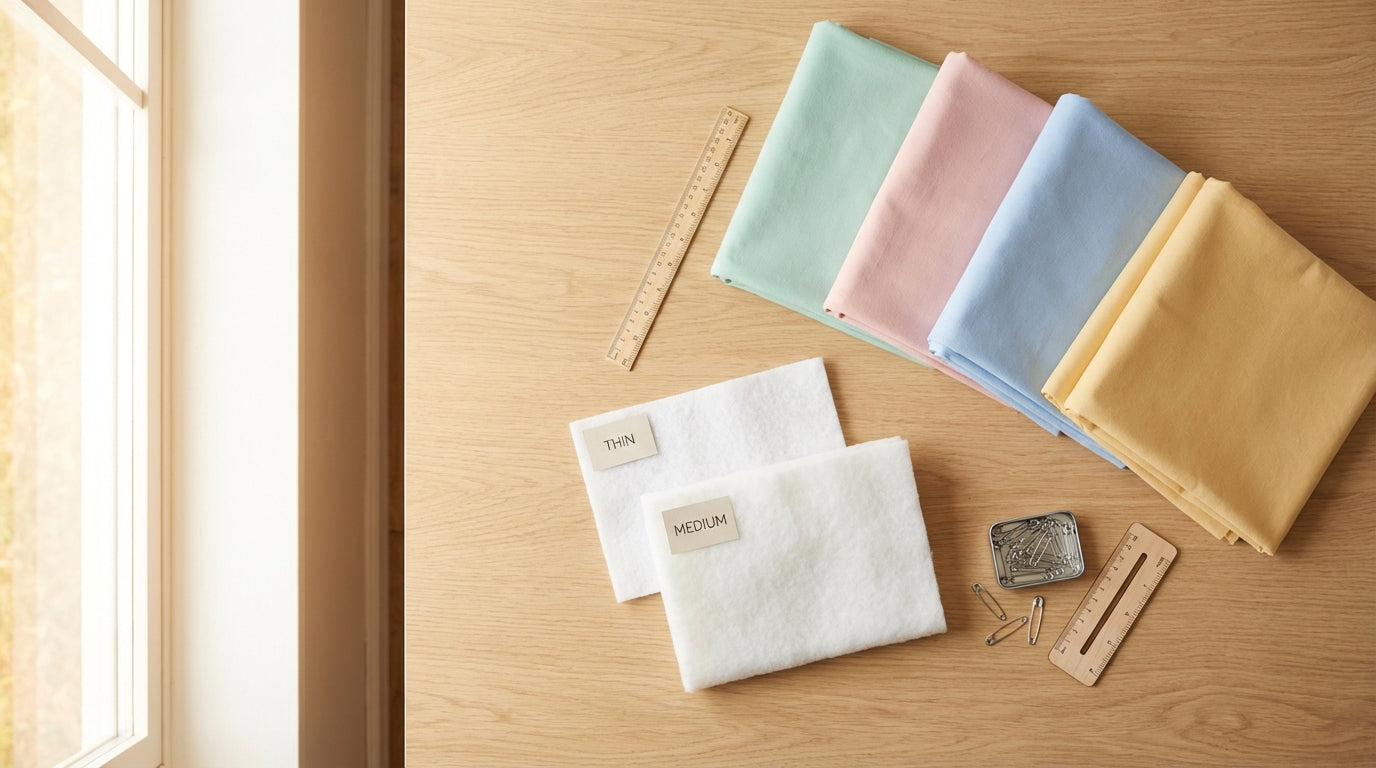
What you need (complete materials list)
- Top fabric: e.g. cotton, muslin or jersey (depending on feel and look)
- Backing: e.g. cotton, canvas or a soft fabric that won’t immediately take offense at the floor
- Batting: matching the desired washing temperature and thickness
- Thread: tear-resistant, matching in color or deliberately contrasting
- Sewing machine (straight stitch is enough), needle suited to the fabric
- Clips or pins (clips are often easier with thick layers)
- Basting thread or large safety pins for basting
- Optional: temporary spray adhesive for textiles (use sparingly, only if it’s meant for textiles)
- For the edge: binding strips or fabric for a turn-and-close finish
- Tools: fabric scissors/rotary cutter, measuring tape, chalk/marking pen, iron
Step 1: Cutting (so nothing “bunches up” later)
Cut all layers cleanly at right angles and as close to the same size as possible. If your batting is very thick, it can help to cut it 0.5–1 cm smaller all around so it doesn’t “bunch up” in the seam allowance. Important: with patterned fabrics, mark the direction, otherwise the whale ends up “upside down”.
Step 2: Build the sandwich (order matters)
Lay the layers like this: backing at the bottom, batting in the middle, top fabric on top. Smooth each layer individually before the next goes on. If you’re working on the floor: vacuum quickly first – otherwise you’ll end up quilting in the breakfast crumbs too.
Step 3: Basting – before you sew (yes, really)
Basting is half the battle in keeping everything from shifting while you sew. You can work with large safety pins, basting stitches or clips. Spray adhesive can help, but use it sparingly and evenly – and only according to the manufacturer’s instructions. The goal: the sandwich stays flat, without waves.
Practical tip: If you have little space: roll the sandwich up from two sides toward the middle. Then you can quilt bit by bit without everything sliding off the table.
Step 4: Securing/quilting the batting (so it doesn’t wander after washing)
Quilting means you sew through all the layers so the filling stays in place. A simple pattern is perfectly fine: straight lines, large squares or a loose diamond pattern. Start in the middle and work outward so you don’t trap any wrinkles.
- Quilting spacing: Follow the batting manufacturer’s recommendation (it’s often printed on the packaging).
- Rule of thumb for everyday life: The thicker/fluffier the batting, the closer the quilting spacing should be.
- Stitch length: Slightly longer than usual can run more smoothly with thick layers (a test piece helps).
Step 5: Closing the edges – two simple options
The edge has to be robust, because that’s where the most pulling happens.
- Option A: Turning (like a pillow): sew top fabric and backing together right sides facing, leave a turning gap, turn, shape the edge, and topstitch close to the edge.
- Option B: Binding (edging): sew on the binding and fold it over neatly. It’s sturdy and very forgiving.
Step 6: Wash test (before baby rolls onto it)
Wash the finished mat once to see whether everything stays the way you planned. If waves or lumps appear anywhere afterward, you can quilt some more – that’s much more relaxed before the mat becomes a “favorite”.
What thickness should the batting have?
The right thickness is a compromise between cushioning, washability and securing. Very thin batting may cushion too little on a hard floor, while very thick batting needs consistent quilting and, depending on the material, may “work” more in the wash. For many families, “medium and well secured” is the calmest solution.
If the mat often goes outside, the surface and how easily it gets clean also matter. For on the go, a robust solution like an outdoor play mat often helps – it’s generally designed to keep up with you.
Care: batting washable at 40/60 degrees – what makes sense?
Always wash according to the manufacturer’s instructions, but plan for real life. In real life, things happen: milk, porridge, diaper accidents, dog paws. That’s why many parents check whether the batting is washable at 40/60 degrees (depending on what you need and what the material allows).
- Before first use: Washing once can help avoid surprises later (please follow the care label).
- Dry gently: Air drying is often the simplest; use the dryer only if it’s expressly permitted.
- If it clumps: Closer quilting or a different batting quality often helps on the next project.
What we find important in practice at Bieco (without the fuss)
We’re a family business from Hamburg and have been doing this for 66 years. That doesn’t mean everything with us is magic – but we know how products are really used day to day: with washing, pulling, lying on them, chewing on them (yes, that too) and that one moment when you look away for just a second.
In the end, material transparency is parents’ best reassurance. That’s why, with textiles, we look for clear information on materials and care as well as verifiable testing, rather than “sounds good” promises. And we like designs that work without loose small parts – because little hands are faster than you can say “Wait a second!”.
If you’d rather not sew yourself: it’s perfectly okay to make life easy. For browsing, here’s an overview: Discover play mats or – if you’re thinking more about activities and lying surfaces – Take a look at activity mats.
FAQ
Which batting is best for a baby play mat?
The best choice is a washable, shape-stable batting that you secure firmly on the inside. Whether high-loft batting for a play mat (polyester) or cotton batting: what matters is low fluff shedding, clear care instructions and quilting/topstitching so the filling doesn’t wander or clump after washing.
Is polyester high-loft batting okay for babies?
Polyester high-loft batting can work very well if quality and workmanship are right. Look for little fluff, suitable washing instructions and make sure you can secure/quilt the batting. Certifications offer guidance: according to OEKO-TEX, Product Class 1 is the strictest for babies. (OEKO-TEX)
Batting washable at 40/60 degrees: what should I choose?
Choose the washing temperature you realistically need in everyday life – but only according to the manufacturer’s instructions. 40 °C is enough for many situations, 60 °C can make sense depending on the material, but it isn’t approved for every batting. What matters is that the batting stays shape-stable after washing.
Why do I need to secure/quilt the batting?
Quilting prevents the filling from shifting in the wash and forming lumps. Without securing, batting can gather in the middle or become thin at the edges. A simple line or square quilt pattern is usually enough – the important thing is to work from the middle outward.
Which rules are relevant for play mats in the EU?
If a mat counts as a toy, the Toy Safety Directive 2009/48/EC is an important reference point in the EU. In addition, ECHA lists substances that are restricted in toys. (EUR-Lex) (ECHA)
What size and how much batting do I need for a play mat?
Plan so that the mat fits in your washing machine and you have seam allowance all around. For cutting, you need top fabric, backing and batting in the same size (or batting slightly smaller for very thick qualities). If you’re unsure, a size guide helps with planning: Play mat size: tips.
In closing: a good choice without the worry spiral
If the batting is washable, shape-stable and neatly quilted, you’re on the safe side. The rest is everyday life: how often is it washed, where does the mat lie, and how wildly will it be romped on? If you’d rather go straight for a ready-made solution: take a look at our play mats – and for gifts, a personalized play mat is often a real hit.