Kids' Workbench: Comparison, Buying Guide & Recommendations by Age
At a glance
- Kids' workbench: decide based on height, stability and size of the parts.
- Wood often feels calmer and heavier, plastic is often easier to clean.
- For ages 2–3: big pieces, few tiny parts, simple connections.
- For ages 4–5: screws/nuts, more building ideas, better sorting.
- Check: the work surface should sit at about wrist height when your child is standing.
- CE marking is mandatory; clear warnings and clean workmanship count in everyday life.

A kids' workbench is “the best” when it stands firmly and fits your child's size. That's already half the battle – the other half is parts that don't vanish under the sofa right away. In this guide you'll find relaxed buying advice, a clear comparison (wood vs. plastic, accessories, storage, noise) and recommendations by age. For parents, grandparents and anyone who likes to give something meaningful – without first retraining as a DIY pro.

Ulli & Flo
Owners of bieco · Hamburg · parents themselves
We've learned: a workbench is the most fun when it stands firmly and tidying up doesn't get out of hand. Then it stays a favorite toy – and not just a box on the shelf. Feel free to browse our workbench collection.
Which workbench is the best for kids?
The best kids' workbench is age-appropriate, wobble-free and easy to tidy. There's no single “perfect one”, but in two minutes you can check whether it will bring you joy or constant frustration in the living room:

- Stability: If it wobbles when hammering, the fun is gone quickly.
- Height: Your child should be able to work comfortably while standing.
- Part size: The younger the child, the bigger and clearer the parts.
- Accessories: Better fewer, but useful (hammer, screwdriver, screws/nuts, a vise if needed).
- Storage: A shelf, drawer or box – sounds boring, but it saves your nerves.
CE marking is mandatory, but it doesn't replace your own look at the workmanship. According to the European Commission, toys in the EU must meet the requirements of the Toy Safety Directive 2009/48/EC and, among other things, carry a CE marking (EUR-Lex: Directive 2009/48/EC).
Practical tip: If you're torn between a “giant set” and a “smaller set”: go for the smaller one. Upgrading is always possible – tidying up has to happen right away.
A kids' workbench is a toy workspace for screwing, hammering and building. The benefit is simple: children practice hand movements, plan small steps and play “workshop” – without your real tools having to suffer.
How tall should a kids' workbench be?
The right height is reached when the work surface sits at about wrist level. No guessing in centimeters, promise – here's the check that works in real life:

- Have your child stand (the way they'll play later: barefoot or in slippers).
- Let their arms hang loosely.
- Eyeball it: the work surface should be roughly at wrist height or just below.
- Mini test: “hammer” and “screw” once – without shrugging the shoulders, without bending forward.
Too high tires the shoulders, too low makes for a rounded back. Either way, the workbench often looks great but turns into mere decoration after three days.
Safety note: If the workbench is too high: please don't “cheat it higher” with boxes or chairs – the risk of tipping is a real spoilsport.
A non-slip mat can noticeably improve stability and noise. Especially in rented apartments, it's the small, peace-making trick – and yes, I speak from experience.
Kids' workbench: buying criteria compared
A good comparison looks at material, accessories, stability, noise and storage. So you don't have to spend three evenings reading reviews, here are the most important criteria – with an honest “What does this mean in everyday life?”.
Material: wood vs. plastic
Wood often feels heavier and “cozier”, plastic is often lighter and easy to care for. Both can be good – what matters is the workmanship: smooth edges, no sharp burrs, no parts that come loose easily.
- Wood: Often a stable stand thanks to its own weight; can still be loud when hammering (wood on wood).
- Plastic: Often easier to clean; thin parts may rattle more and shift more easily.
- Mix: Some toy workbenches combine both – what matters is that everything fits cleanly.
Accessories: set size and mix of parts
Lots of parts aren't automatically better – at first they're just more parts. For toddlers, large, easy-to-grip elements count; for older children it gets more exciting with screws, nuts, gears or small building ideas.
- For ages 2–3: large push-in pieces, few screws, simple connections.
- For ages 4–5: more screws/nuts, strips/boards, first “blueprints” (even self-drawn ones).
- For ages 6+: more ways to combine, sorting compartments, possibly expandability.
Stability: wobbling, tipping, sliding
Stability is the criterion you feel immediately – and so does your child. Look for wide feet, a solid connection of the legs and make sure the workbench doesn't “walk” during a test hammering session.
- On smooth floors: Anti-slip stoppers or a mat help.
- With lightweight models: Better to place them against a wall or on a rug.
Noise: what you'll really hear
A workbench makes noise – the only question is: pleasant or annoying. A wooden hammer on wood sounds different from plastic on plastic; both can quickly “echo” in small rooms.
- It gets quieter with: a mat underneath, felt glides, and “hammer times” that fit your daily rhythm.
- If you're noise-sensitive: Push-in and screwing toys are often the quieter way to start.
Storage: drawer, shelf, hook rail
Storage decides whether the workbench stays a favorite toy. If every piece has to be searched for after playing, the enthusiasm drops – for children and adults alike.
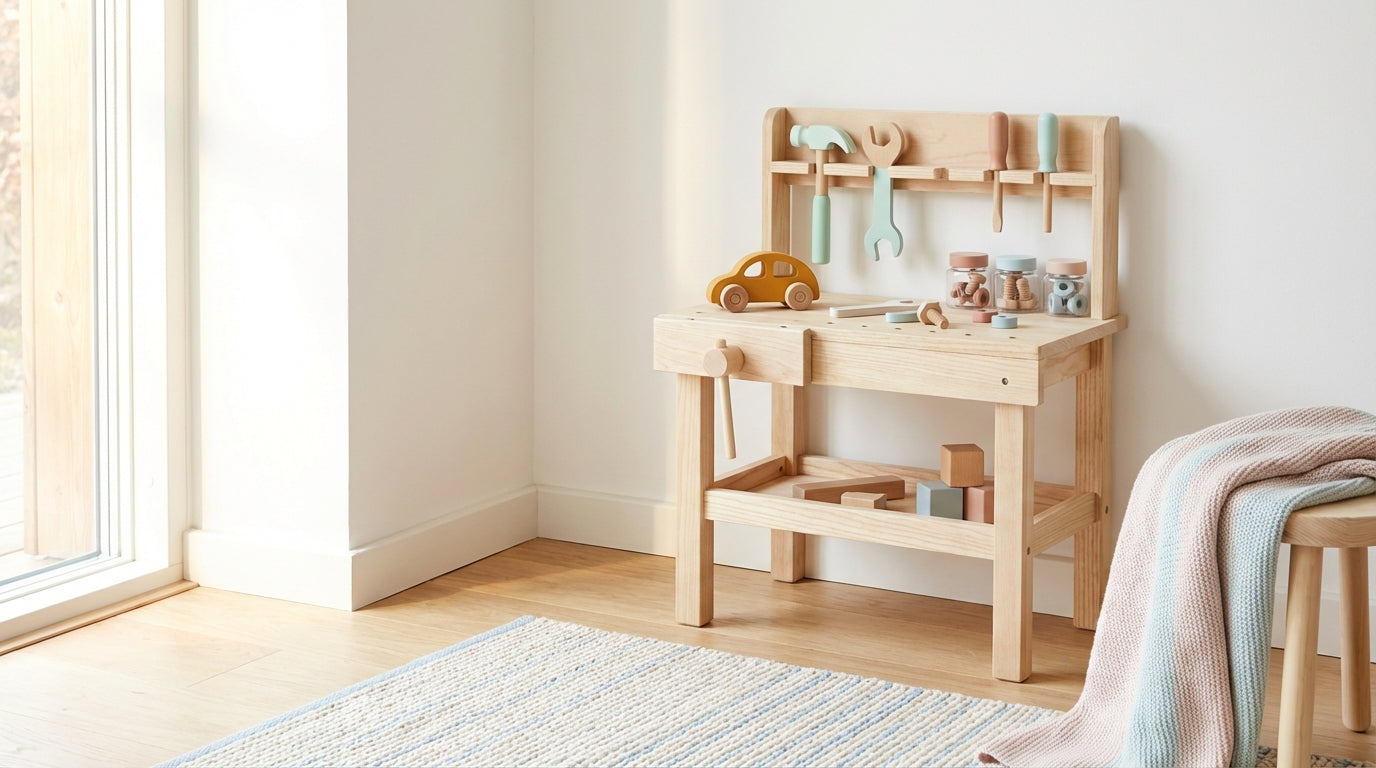
- Good: A tray/drawer right at the workbench, hooks for tools, clear “parking spots”.
- Also good: A small box next to it that always stays in the same place.
Cleaning & everyday suitability
Everyday-friendly means: wipeable, robust and not sensitive to little mishaps. Sticky hands are part of the job description “child” – the workbench should handle that without you breaking out in a sweat.
Buying advice in 60 seconds (checklist)
With this mini checklist you'll quickly make a good choice. Run through it once, then you're allowed to drink your coffee again – even warm, if things go well.
- Does the height fit? Wrist height when standing.
- Does it stand firmly? No wobbling when hammering.
- Are the parts big enough? Especially important for a toddler workbench.
- Is there storage? A shelf/drawer/box is a must for family happiness.
- Is the workmanship okay? Smooth edges, nothing splinters, nothing smells strongly.
- Are the warnings clear? Age recommendations and notes are easy to read.
Recommendations by age: 2–3, 4–5, 6+
Age is helpful as a guide – motor skills, patience and interest matter more. Some children are astonishingly focused at 2, others at 5 are still more of a “hit it once, done” team. Both are completely normal.
Ages 2–3: workbench for toddlers
For 2–3-year-olds, large pieces and simple movements are ideal. At this age it's mostly about imitating: hammering, turning, pushing in, pulling out again. Make sure there are few small parts and that everything stays easy to grip.
A calm start can also be a hammer bench or a pounding toy. If you like: you can find something like that with us, e.g. as a hammer bench.
Ages 4–5: more screwing, more ideas
From 4–5 years, “doing” often turns into real building. Screws and nuts are used more purposefully, and children have more patience for small “projects”. Here a toy workbench with good storage and a mix of accessories that isn't just decoration is worthwhile.
Practical tip: Write 3 mini assignments on slips of paper: “Tighten 2 screws”, “Build a bridge”, “Sort by color”. That brings structure to the play right away.
Ages 6+: sticking with it longer, more role play
From 6+, variety, sorting and the chance to carry out their own ideas count. Many children then play “workshop” with roles: customers, repair orders, cash register (yes, really). A kids' workbench with good storage options often stays exciting for longer.
Role play means: children act out everyday life and practice routines and language. That's handy because they plan, explain and stick with it along the way – without anyone calling it “practice”.
Material & safety: what you should really look out for
Safety is in the details: edges, connections, part size and instructions. Whether wood or plastic: take a look, run your hand over it once, and give it the 30 seconds. That saves discussions later.

- Edges & surfaces: smooth, no splinters, no sharp spots.
- Connections: nothing wobbles loose, but your child can operate it.
- Small parts: truly critical depending on age – better too big than too small.
- Smell: a strong chemical smell is a warning sign.
- Notes: age recommendations and warnings are easy to understand.
The EN 71 series of standards describes requirements for toy safety in Europe. According to DIN, it covers, among other things, mechanical/physical properties (EN 71-1), flammability (EN 71-2) and chemical requirements (EN 71-3) (DIN: Requirements for safe toys).
Honest northern German style: “Safe” also means you have the chaos under control. When small parts are involved, supervision helps – and a fixed place for everything. That's not strict, it's simply relaxed.
What can children build at the workbench?
At the workbench, small constructions and big moments of pride are created. Nothing has to be “perfect” – a robot is allowed to look like a cheese sandwich. The main thing: made by themselves.
- Screwing projects: frames, little “vehicles”, simple shapes made of strips and screws.
- Push-in and turning projects: laying out patterns, building rows, sorting, taking things apart again.
- Repair play: fixing “broken” toys (in play), opening a workshop, taking orders.
The most common reason play stops isn't boredom, but small-parts chaos. If 30 pieces end up living under the sofa after every round, a family eventually loses patience. A kids' workbench with storage is therefore often the better choice than the biggest set.
A bit of Bieco DNA from Hamburg (without much fuss)
We're a family business from Hamburg and have been doing this for 66 years. And when you've accompanied toys for that long, you learn two things: children are robustly honest – and parents need solutions that work in everyday life.

That's why we pay special attention to transparent information about materials and safety. If you'd like to browse: in our overview of workbenches you'll find different variants – and you can take your time to see what suits your pace.
FAQ
Which workbench is the best for kids?
The best workbench for kids is stable, the right height and not too fiddly. Look for a wobble-free stand, smooth edges and accessories that will really be used. For younger children, large pieces and simple connections are more practical. For older children, sorting, more building options and “workshop” role play count.
Wood or plastic: which is better for a kids' workbench?
More important than wood or plastic are clean workmanship and stability. Wood often feels heavier and stands more firmly, plastic is often lighter and easy to care for. Both materials can be loud, depending on the construction. Look for smooth edges, firm connections and make sure nothing comes loose easily.
How tall should a kids' workbench be?
The height is right when the work surface is at about wrist level. Have your child stand, let their arms hang loosely and aim for the wrist. That way they can hammer and screw without hunching their shoulders or bending over a lot. When in doubt, choose slightly lower.
From what age does a toddler workbench make sense?
Many children start with simple workbench movements from around 2 years. It's mostly about imitating: tapping, turning, pushing in. Large parts and few tiny pieces are important. If your child likes to sort and grasp purposefully, it may work earlier; if not, that's completely normal too.
How long do children play with a workbench?
A good kids' workbench can stay exciting for several years because the play grows with them. At first sound and movement are the hit, later building ideas and role play are added. Workbenches with storage, sorting options and variable building parts are often used for longer because they offer less frustration and more possibilities.
How can I tell if a kids' workbench is safe?
A safe workbench has smooth edges, stable connections and clear warnings. Check that nothing splinters, has sharp edges or smells strongly of chemicals. CE marking is mandatory in the EU; the Toy Safety Directive 2009/48/EC describes the basic safety requirements (EUR-Lex).
Bottom line: a workbench is a gift that really gets used in everyday life. It gets children doing, makes them proud and gives them that “I can do it!” feeling. If you're now in the mood: take a look at our workbench overview and pick the one that suits your pace.