Puzzles for Kids: How to Find the Right Puzzle for Ages 1–6
At a glance
- The best way to choose puzzles for kids is by piece size, motif and patience level.
- Under 3 years: large, sturdy pieces and regular safety checks.
- From 3–4 years: more pieces, more detail – and the first little strategies.
- Wood is often easy to grip and durable, while cardboard offers a huge choice of motifs.
- A permanent puzzle spot (board or mat) saves family peace.

Puzzling is most relaxed for kids when you start “too easy” rather than too hard. That way you get success instead of tears – and you don't have to negotiate before breakfast.

Ulli & Flo
Owners of bieco · Hamburg · parents themselves
We've learned that a puzzle is “right” when it makes your everyday life easier – not harder. Start small, and the rest usually follows by itself. Feel free to browse our Puzzle collection.
Want to know which puzzle suits which age? That's exactly what this guide is about: practical guidance from 1 to 6 years, plus a look at materials (wood vs. cardboard), a few everyday tricks and the most important safety information. We're writing this as parents (Ulli & Flo) – and as a family business from Hamburg that has been supporting toy play for 66 years. Not polished and perfect, but the way things really go in the children's room.
How do I choose puzzles for kids? (3 criteria that really matter)
The age on the box is a hint – your child is the benchmark. It sounds simple, but in the end it saves the most nerves.

- Piece size & grip: The smaller the hands, the thicker and easier to grip the pieces should be.
- Motif & visual calm: Clear areas and familiar things are easier than “busy scenes everywhere”.
- Frustration tolerance: Some children love a good brain teaser, others prefer “done in 2 minutes” – both are normal.
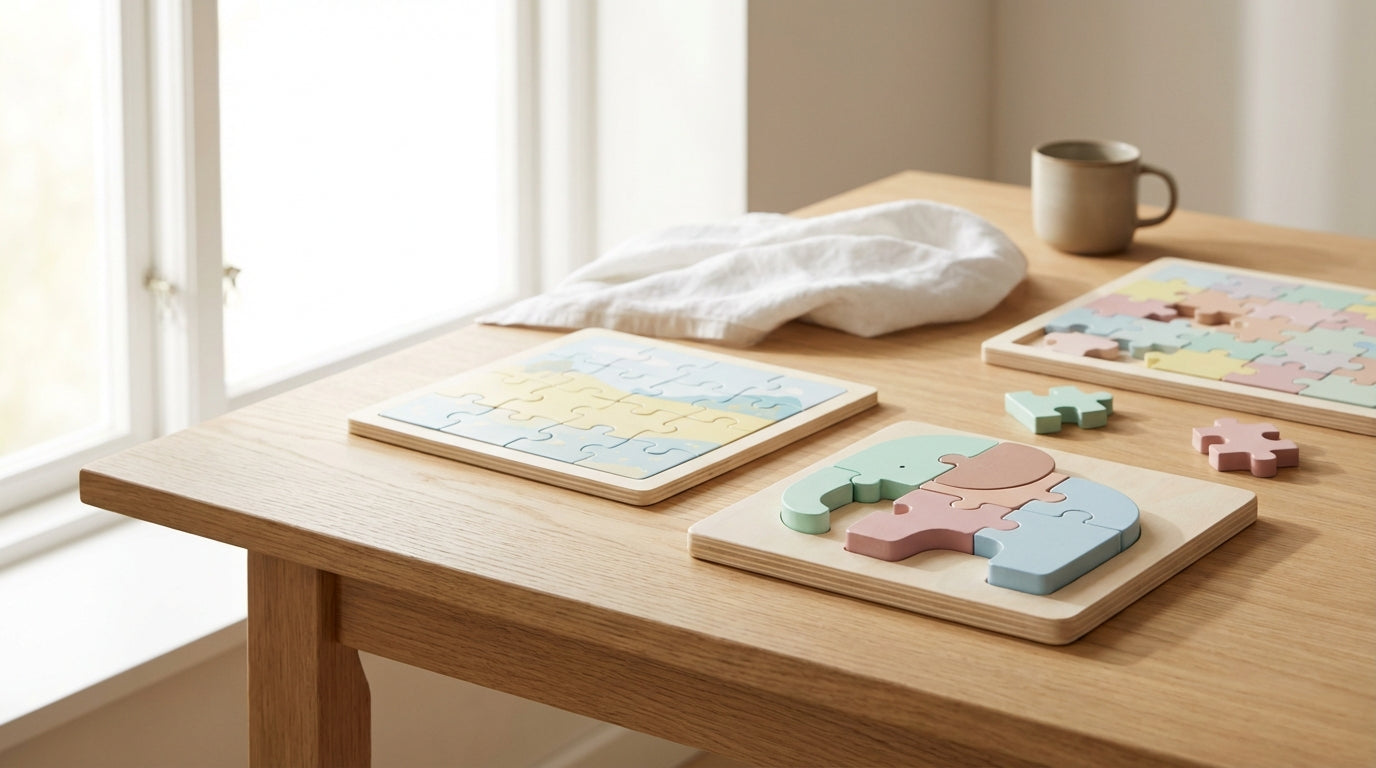
A peg puzzle (inset puzzle) is a puzzle with chunky individual pieces that are placed into cut-out spaces. It's often the most comfortable start for little hands because nothing slides away.
A puzzle mat is a base on which a puzzle can stay in place. That helps when a project takes longer – or when the dining table is needed again in the evening.
Practical tip: Start with “success in 3 minutes”: do 2–4 pieces together, then stop while it's still fun. That makes your child eager for round two.
Why puzzling is so popular (and why it helps in everyday life)
Puzzling is often one of the calmest activities in the children's room. And, hand on heart, that alone is sometimes reason enough.
Puzzling also has this lovely side effect: children stay with one thing without you constantly having to say “keep it down a bit”. Many families use puzzles as a little island in the day – after daycare, before dinner, or when guests arrive and everyone should settle down for a moment. It's not a magic trick, but it's a pretty reliable activity when the puzzle is a good fit.
Important: It doesn't have to sound “educational” to be worthwhile. If your child simply enjoys puzzling, that's already a big win.
Puzzles from 1 year: big, easy to grip, as indestructible as possible
At 1 year, a few large pieces are almost always the best choice. Little ones want to touch, turn and push things in – and happily test how things fall off the table, too.

To begin with, grasping puzzles and peg puzzles often work best: thick pieces, clear shapes, few distractions. Wood is often pleasant in everyday use because it's easy to grip and doesn't bend right away. Wood or not: what matters is that the pieces are large and easy to hold.
- Typically good: 1–6 pieces, simple motifs (animals, vehicles, fruit)
- Formats: peg puzzle, shape puzzle, matching “piece fits the shape”
- Everyday life: Short & often is better than one long session
Safety note: For children under 3 years, swallowable small parts are a real issue. According to the Bavarian consumer portal (Verbraucherportal Bayern), small parts are assessed using a test cylinder in accordance with DIN EN 71-1.
If you'd like an overview, you'll find suitable puzzles for kids for different age groups in our collection.
Puzzles from 18 months: “Me do it!” – but please with a sense of achievement
At around 18 months, short tasks and lots of repetition are what count. Children now want to do things themselves – and that's wonderful, even if it sometimes sounds like “no, the other way round”.
At this age it can be a little more than with the first peg puzzle, but still manageable. Good signs: your child recognizes the motif, can turn pieces and stays with it at least briefly. If it tips over after two minutes: no problem, then today was simply a mini round.
- Typically good: approx. 4–10 pieces, thick pieces, stable surface
- Formats: peg puzzles with more cut-outs, simple layered puzzles
- Routine: Offer the puzzle in the same place if possible – it makes things easier
Puzzles from 2 years: how many pieces really fit?
At 2 years, around 6–20 pieces is often a good starting range. Some children can do more, some want less – it's not a competition, it's wind-down time.
Many two-year-olds like motifs that “tell a story”: farm, construction site, animals. A frame puzzle can help because the edge is already “given”. If you like wood: wooden puzzles are often sturdy and forgive it when a piece is handled a bit roughly.
- Typically good: 6–20 pieces, clear outlines, not too busy
- Formats: simple frame puzzles, large cardboard pieces, wooden puzzles
- If it gets stuck: first the outline/edge, then the middle together
If you'd like to look specifically at wood: here you'll find our wooden puzzle selection.
Puzzles from 3 years: now it gets “properly puzzly”
From 3 years, details can come in – but please in moderation. Many children now recognize motifs better, sort by color and start to use small strategies (“corners first!”).

A good range is often 20–48 pieces, depending on how puzzle-experienced your child is. Floor puzzles are popular too: big pieces, lots of surface, and you can all sit around it together. And yes: it's perfectly okay if one piece ends up living under the sofa. That's part of family life.
- Typically good: 20–48 pieces, clear image areas, easily recognizable shapes
- Formats: frame puzzles, floor puzzles, first classic cardboard puzzles
- Play idea: sort pieces by color (red here, blue there)
Practical tip: If siblings join in: give the little one “search missions” (e.g. all the green pieces). It keeps things more peaceful.
If you'd like to know more about the differences between puzzle types: our guide to peg puzzles & magnetic puzzles sorts it out nicely and clearly.
Puzzles from 4 years: more pieces, more patience, more “I'll finish this!”
At 4 years, 48–100 pieces often work – depending on the motif. Puzzling now often becomes more of a “project”: children want to see the picture finished and stay with it longer.
Busy scene pictures can be fun, but they're also tricky. If your child gets overwhelmed quickly, choose a motif with clear areas instead. And feel free to leave the picture template in plain sight – that's not cheating, that's teamwork.
- Typically good: 48–100 pieces
- Formats: cardboard puzzles, floor puzzles, themed worlds (zoo, fire brigade, fairy tales)
- Trick: “Read” the motif together for a moment: what can you see where?
Puzzles from 5 years: learning strategies without it feeling like school
At 5 years, simple strategies like “edge first” help enormously. Many children now sort by color, pattern or shape all by themselves.
A range of around 80–150 pieces is often quite doable if the motif suits. And if not: then 60 pieces is a full success too. We're not at the world championships here, we're in the living room.
- Typically good: 80–150 pieces
- Motif tip: Not too much “the same blue” or “the same green” (sky can be nasty)
- Everyday life: Puzzle in stages: 10 minutes today, 10 minutes tomorrow
If projects tend to get left lying around at your place: a mat can be very calming. Here are our puzzle mats.
Puzzles from 6 years: more pieces, more planning – and a permanent spot
From 6 years, 150–300 pieces are often possible if the interest is there. Puzzle experience matters more than the age on paper.
Now a permanent spot is worthwhile because bigger puzzles stay out longer. Sorting trays (or small bowls) help so that everything doesn't end up in a colorful soup of pieces. And yes: the biggest challenge is sometimes that nobody “just quickly” clears the table.
- Typically good: 150–300 pieces (more for real fans)
- Motifs: animals with fur texture, vehicles, maps, detailed scenes
- Trick: First the edge, then big areas of color, then details
Wooden puzzle vs. cardboard puzzle: which suits you?
Wood is often durable and easy to grip, while cardboard offers lots of motifs and piece counts. Many families end up with both – depending on age, travel plans and how frayed the nerves are.
| Material | Practical in everyday life | Often a good fit for |
|---|---|---|
| Wood | Easy to grip, sturdy, more forgiving of drops | smaller children, frequent play |
| Cardboard | Many motifs, often more pieces per puzzle | older children, detailed pictures |
A frame puzzle is a puzzle with a fixed border that helps with placing the pieces. It gives orientation and is a real frustration-stopper for many children.
And in case you're wondering about brands: Eichhorn is a wooden toy brand of the Simba Dickie Group; the company lists wooden toys and puzzles as part of the brand. (Source: Simba Dickie Group)
Safety & quality: what to look for in kids' puzzles
Under 3 years, swallowable parts and loose coatings are the main concerns. Little ones explore with their mouths – that's normal, but it takes suitable products and a watchful eye.
According to the Bavarian consumer portal (Verbraucherportal Bayern), parts count as small parts if they fit into a test cylinder; this is one building block in the assessment under DIN EN 71-1. (Source: Verbraucherportal Bayern)
If you're wondering how this is tested in practice: LAVES Lower Saxony describes how swallowability is assessed using a test cylinder and test procedures. (Source: LAVES Niedersachsen)
And one more point that often gets mixed up: under EU Toy Safety Directive 2009/48/EC, warnings must not contradict the intended use. (Source: EUR-Lex)
Safety note: Check puzzles regularly for cracks, loose pieces and peeling layers – especially when younger siblings are in the room.
What we can say from experience at BIECO: Parents notice very quickly whether a toy is suited to everyday life. We're a family business from Hamburg, we've been doing this for 66 years, and we test a lot of things with one question in mind: “Will it survive Tuesday at 5:30 pm?”
Mini checklist: Does this puzzle suit my child?
If you nod at three points, you're usually on the right track.

- The pieces are big enough that you don't constantly have to say “spit it out”.
- The motif is familiar and not too busy.
- Your child quickly achieves a small success (even if it's only 2 pieces).
- You have a place where the puzzle can stay (board or mat).
- You're okay with a piece occasionally “going on an adventure”.
FAQ: short answers to the most common puzzle questions
How many pieces make sense for 2-year-olds?
For many 2-year-olds, around 6–20 pieces work well. What matters are large, easy-to-grip pieces and a clear motif. If your child gets frustrated quickly, choose fewer pieces or a frame puzzle. If they're already practiced, they may manage more – the motif often makes the difference.
Which is better: peg puzzle or frame puzzle?
Peg puzzles are often the easiest start for little hands. The cut-outs mean less slipping, and placing the pieces is straightforward. Frame puzzles also give orientation because the edge is fixed. For many children, peg puzzle first and frame puzzle afterwards is a relaxed order.
How can I tell that a puzzle is too hard?
It's too hard when frustration arrives faster than curiosity. If your child hardly has any successes with pieces, keeps saying “doesn't fit!” and gives up after a short time, the hurdle is too high. Then it helps to use fewer pieces, calmer motifs, or to lay just the edge together – and carry on later.
Which puzzles are suitable for traveling?
For on the go, smaller puzzles with sturdy pieces are the most rewarding. Frame puzzles or compact puzzles with few pieces are easier to keep complete. Pack the pieces in a small tin or a zip bag, so the car ride doesn't end with “Where is the last piece now?”
What's the best way to store a puzzle in progress?
The easiest way is with a mat or a large board. That way you can put the puzzle away without destroying everything. If you don't have a mat, a tray or a large flat cutting board works too. The main thing: it can safely “park” until you carry on.
And finally, nice and relaxed: The best puzzle is the one that actually gets played with at your home – not the one that “should actually fit”.
If you'd like to look at suitable options, you'll find them in our overview of puzzles for kids – and for every project that's allowed to stay put, puzzle mats are a pleasantly calm solution for the children's room.