Kids' Puzzle Play Mat: How to Choose One That's Safe, Non-Slip & Easy to Care For
At a glance
- Kids' puzzle play mat: check the recommended age, the material details and the testing information.
- A mat stays put mostly thanks to the right floor underneath and clean edges.
- Cleaning: wipe with a damp cloth, use mild soap, and let it air dry thoroughly.
- Designs (letters, numbers, animals) are a matter of taste – play ideas make the real difference.
- Mini checklist in this article: how to spot tested, clearly declared mats.

A kids' puzzle play mat is a good one when it is clearly declared as safe, doesn't wander around on your floor and can be wiped clean quickly. In this guide you'll get practical orientation: which designs suit which purpose, how to lay the mat so it slips less in everyday life, how to clean it without drama – and how to tell whether a manufacturer's information is truly transparent. We're writing this as parents (Ulli & Flo) and as a Hamburg family business that has been around toys for 66 years: relaxed in true northern German style, but rather picky when it comes to safety.

Ulli & Flo
Owners of bieco · Hamburg · parents ourselves
We've learned that a good puzzle mat doesn't have to look perfect – it has to stand up to your everyday life. If it's laid out quickly, doesn't constantly slip and is wiped clean in no time, you've already won a lot. Feel free to browse our Puzzle collection.
What is a puzzle play mat – and why do parents love them?
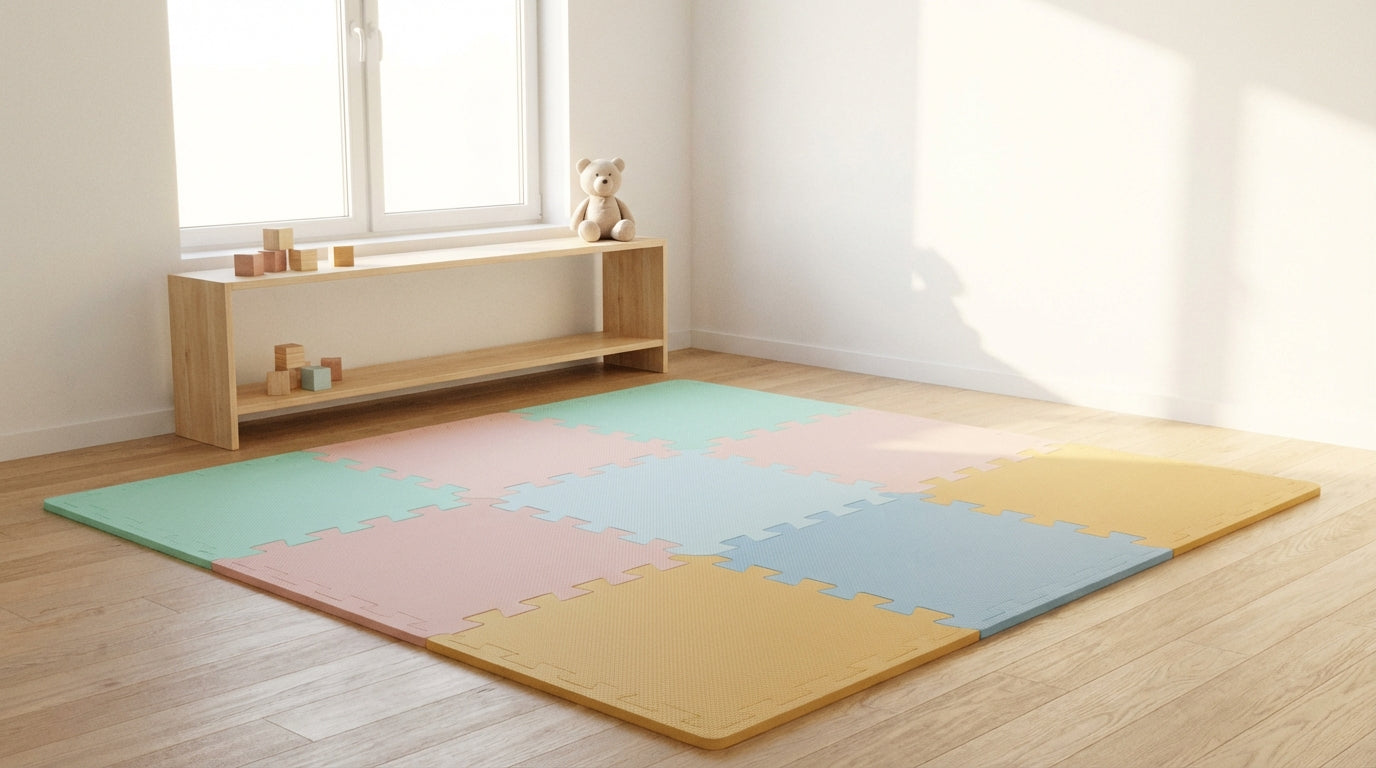
A puzzle play mat is a play mat made of interlocking individual tiles that you can flexibly assemble into a surface. That's practical because you can adapt it to the room, the play zone and your daily routine: a small island in the living room today, a larger area in the nursery tomorrow. In the product details, Bieco's mats are described as EVA foam (see the respective product page).
A play mat mainly helps against cold floors and the "thud" of play. It doesn't automatically turn a hard floor into a trampoline, but it can soften bumps and clattering a little – and you'll notice that in everyday life faster than you can say "Where is that pacifier again?"
"EVA foam" is a lightweight, elastic plastic foam that feels warm and wipes clean easily. It's no magic, but it's a very practical material property when something sticky regularly turns up at your place.
Practical tip: Place the mat so that at least one side rests against a sofa, wall or shelf. This keeps the edges calm and saves you from tripping moments.
Safety: What you should really look out for in a puzzle play mat
The younger the child, the more important the recommended age, warnings and regular visual checks become. For several Bieco puzzle mats, the product details state a recommended age of 12 months and up, along with a note that younger children should only play under supervision (see the respective product page).

Safety note: If your child still puts a lot of things in their mouth: use the mat only under supervision, check the edges and inserts daily, and remove any damaged pieces immediately.
"EN 71" is a European series of standards for toy safety and covers both mechanical and chemical requirements. The product details for the Bieco Number Puzzle Mat Black & White, for example, mention EN 71-1-2-3-9 as well as "independently tested and checked for harmful substances".
EN 71-3 describes requirements for the migration of certain elements from toy materials. According to DIN, it makes the EU Toy Safety Directive more specific with regard to chemical requirements (DIN: classification of EN 71-3).
The legal basis for toy safety in the EU is the Toy Safety Directive 2009/48/EC. You can find the original text on EUR-Lex (EU Toy Safety Directive 2009/48/EC).
Mini checklist: How to recognize "tested & clearly declared"
- Recommended age and warnings are clearly visible. Not hidden in the fine print, but unmistakable.
- The material is named specifically (not just "foam"). This helps you better judge odor and care.
- Testing and standard references are clearly stated. For example, EN 71 parts when it comes to toys.
- Care instructions are described in an everyday-friendly way. "Wipe with a damp cloth" is a clear instruction, not poetry.
- You can find contact and manufacturer details without guesswork. Transparency isn't a luxury, it's a good sign.
Material & odor: What's normal – and when does it get weird?
A slight new smell can occur with foam materials and should clearly fade after airing out. If the mat still smells strongly after a few days in a well-ventilated room, I'd let it air out longer and only then bring it into the nursery.
When manufacturers state the material, age and testing information transparently, you can better judge what you're bringing into your home. This openness matters to us – we're a family business from Hamburg and have been doing this for 66 years, and you learn a thing or two: parents don't want fairy tales, they want clear information.
Phthalates are a group of substances that can be used as plasticizers, which is why they are often discussed. The European Chemicals Agency offers background information (ECHA: Phthalates), without you having to study chemistry for it.
Slip resistance & floor: How to keep the play mat where it belongs
Whether an interlocking mat slips often depends more on the floor than on the mat itself. On smooth laminate, a mat can behave differently than on carpet – and dust, crumbs or a slightly damp spot make edges "wanderlust" faster, too.
What you can do right away (without special accessories)
- Quickly clean the floor before you set up. A quick sweep or vacuum is often enough.
- Place the mat against a solid edge. A wall, sofa or shelf makes the best "anchor".
- Build the area compact rather than ragged. Lots of corners and extensions are tripping hazards in a busy family household.
- Press down the edges regularly. Especially after tidying up or when someone has slid across it in socks.
Practical tip: If the mat is in the living room, build a simple "play island" (e.g. 2x3 tiles). Fewer edges = less tripping.
Comparing designs: letters, numbers or animals?
The best design is the one your child actually plays with – not the one that photographs best. Some children love sorting and lining things up, others latch onto animals right away. And some simply want to sit comfortably and throw building blocks (also a hobby).

| Design | What it's good for in everyday life | Typical play idea | What to watch out for |
|---|---|---|---|
| Letters | Naming, recognizing, a little "order" in play | Finding the first letter of their name | Inserts/small parts only under supervision during the mouthing phase |
| Numbers | Counting, laying out sequences, building (tiles also work as building pieces) | Lay out 1–10 as a path and walk along it | For wild romping, choose a compact surface without extensions |
| Animals | Language, role play, stories, a "quick way in" | Loading the animal train: "Who's coming along?" | Here too: check the edges if pieces are often pulled apart |
Letter puzzle mats: a play idea that brings structure along the way
Letter mats are great if your child likes to point, name and recognize things. According to the product details, the Bieco Letter Puzzle Mat Black & White contains 26 letters (52 individual pieces in total); one piece measures 32 x 32 x 0.9 cm, and depending on the layout the mat can grow up to 192 x 160 cm (Bieco Letter Puzzle Mat Black & White).
Everyday play ideas (without learning stress)
- Start small: 2–3 letters are perfectly enough. Leave the rest aside for now, otherwise it quickly becomes "too much".
- Build "parking spots". One area for cars, one for animals, one for building blocks – it looks like tidying up, but it's play.
- Feel the letters. Eyes closed, hand on top, guess – it takes 30 seconds and is still fun.
Number puzzle mats: counting, sorting, building – totally relaxed
A number puzzle mat works best when it stays play and doesn't turn into a lesson. According to the product details, the Bieco Number Puzzle Mat Black & White contains 10 numbers (26 individual pieces), is made of EVA foam, with an individual piece size of 32 x 32 x 0.9 cm; depending on the layout, the mat can grow up to 160 x 64 cm (Bieco Number Puzzle Mat Black & White).
Mini games that often work well for us
- Lay a "number path". 1 to 5 is enough to start, then walk or crawl across it.
- Sort by order. You give two numbers, and your child places the one "in between" (or you do it together).
- Tiles as building pieces. The product description also mentions building (e.g. cubes/little houses) as an idea.
Animal puzzle mats: for stories, sounds and imagination
Animal designs are often the quickest way in, because children connect right away: "Look, the elephant!" According to the product details, the Bieco Animal Motif Train Puzzle Mat (18 pieces) features animal designs, is made of EVA and has a recommended age of 12 months and up; individual pieces measure approx. 30 x 30 x 1 cm (Bieco Animal Motif Train Puzzle Mat).
Play ideas that need no preparation
- "Who's riding on the train?" Name the animals, make their sounds, invent little stories.
- Mini obstacle course. Lay 4–6 pieces as islands and walk or crawl from island to island.
- Sort into mini portions. Take out three pieces and leave the rest aside – less chaos, more focus.
Cleaning & care: getting it clean without stressing the mat
For everyday use, many mats need just this: wipe with a damp cloth, use mild soap, then air dry. This is exactly how the care instructions are described for several Bieco puzzle mats (e.g. the number and animal mats on their respective product pages).
How we do it at home (quick and painless)
- Remove crumbs dry first. Vacuum or shake them out, then you'll smear less.
- Wipe sticky spots individually. Damp cloth + mild soap, then wipe dry afterwards.
- Don't submerge it completely in water. The care instructions describe wiping, not "bathing" the mat.
Size, layout & space: where does the mat work best?
The best size is the one that fits your room and can be quickly rearranged or made smaller. The product details show how different the surfaces can be: depending on the layout, the letter mat can be considerably larger (up to 192 x 160 cm), the number mat up to 160 x 64 cm – so you can start small and expand later.
Good spots that have proven themselves
- In front of the sofa. You sit comfortably, your child plays on something soft, and everyone is reasonably relaxed.
- As a clear play zone in the nursery. An "island" often looks tidier than toys everywhere.
- Under noisy toys. Building blocks and the like usually sound friendlier on a mat.
If your child prefers "real puzzling": alternatives to the floor mat
If your child likes to tinker at the table, classic puzzles are often the better complement to a play mat. The puzzle mat then stays the cozy base on the floor – and the actual puzzling happens up above. For browsing, Kids' Puzzles makes a good overview, and for the tabletop version, Wooden Puzzles.
Short buying checklist: Does this puzzle mat suit us?
- Age & phase: Does your child still put a lot in their mouth? Then only use it under supervision, and rather fewer pieces at a time.
- Floor: Smooth or carpet? Plan an edge to lay the mat against.
- Care: Does "wipe with a damp cloth" fit your daily life? (Spoiler: usually yes.)
- Designs: Animals for a quick start, numbers/letters for sorting and naming games.
- Transparency: Are material, age and testing information clearly stated? Then you'll sleep a little better as a parent.
FAQ
From what age does a kids' puzzle play mat make sense?
A puzzle play mat makes sense when your child can sit or crawl safely and you can supervise well. For several Bieco mats, the product details state a recommended age of 12 months and up. For younger children, the rule is: only under supervision, because pieces can come loose and quickly end up in the mouth.
Is an EVA foam puzzle mat harmless?
What matters are clear material details, a recommended age and traceable testing information. EVA first of all describes the material, but on its own says nothing about testing. Look for transparent information on standards/tests (e.g. EN 71, if declared as a toy) and read the warnings – especially with children who still explore everything.
What's the best way to clean a foam mat / interlocking mat?
Usually, wiping with a damp cloth and mild soap and then letting it air dry is enough. This is also how the care instructions are described for several Bieco puzzle mats. It's important to remove crumbs dry beforehand and not to submerge the mat completely in water, but to clean it on the surface.
What helps if the play mat slips on laminate?
What helps most is a clean floor and a mat that rests against a solid edge. Vacuum or sweep, then build it compact and "anchor" it to the sofa or wall. Lots of small extensions make it slipperier and more of a tripping hazard. After romping, press the edges down briefly – that's often half the battle.
Which puzzle mat is better: letters, numbers or animals?
The better mat is the one your child is actually using right now. Animals are often the quickest way in through stories and naming. Numbers go well with sequences, counting and "path" games. Letters bring structure to naming and recognizing. If you're unsure: start with animals and expand later.
Bottom line: A puzzle play mat is a win when it fits your everyday life and is clearly declared. If you'd like to look at the variants, you'll find them in the Puzzle Mats overview – and if you all enjoy puzzling in general, Kids' Puzzles is a good starting point. Then: lay it down, sit down, take a deep breath – the floor is already on your side.