Kids' Chair with Table: How to Find the Right Set (Size & Safety)
At a Glance
- A kids' chair with table is the right fit when seat height, table height and foot support all work together.
- Take a few quick measurements: seat height, table height, space needed – then nothing wobbles.
- What works in everyday life is wipeable and stands firmly.
- Look for rounded edges, non-slip feet and no finger traps.
- Eco labels and emission labels help you judge indoor air quality.

A kids' chair with table is “right” when your child sits comfortably and the set doesn't get on your nerves in everyday life. That means: feet find support, arms rest loosely, nothing wobbles with every shift of weight – and you can clean the tabletop without any drama. In this guide you'll get practical, step-by-step help: which types of sets there are, how to check size and ergonomics, how to spot good materials and safety features, and how to set it up so it actually gets used.

Ulli & Flo
Owners of bieco · Hamburg · parents themselves
We've learned that a kids' chair with table is only loved if it's comfortable and doesn't wobble in everyday life. And yes – wipeable is sometimes half the battle. Feel free to browse our kids' chair collection.
Why a kids' chair with table is so handy in everyday life
A set of their own turns “a quick craft” into a fixed, calm spot. Kids love little “workstations”: this is where they draw, knead, build, do puzzles – and yes, sometimes share the cookie they “actually didn't have”. A table-and-chair set helps especially with these classics:

- Quiet playtime: puzzles, stacking games, small building projects.
- Creative stuff: drawing, stamping, play dough, stickers – everything has its own area.
- Independence: your child can sit down, get up, fetch things – without you constantly “handing” them over.
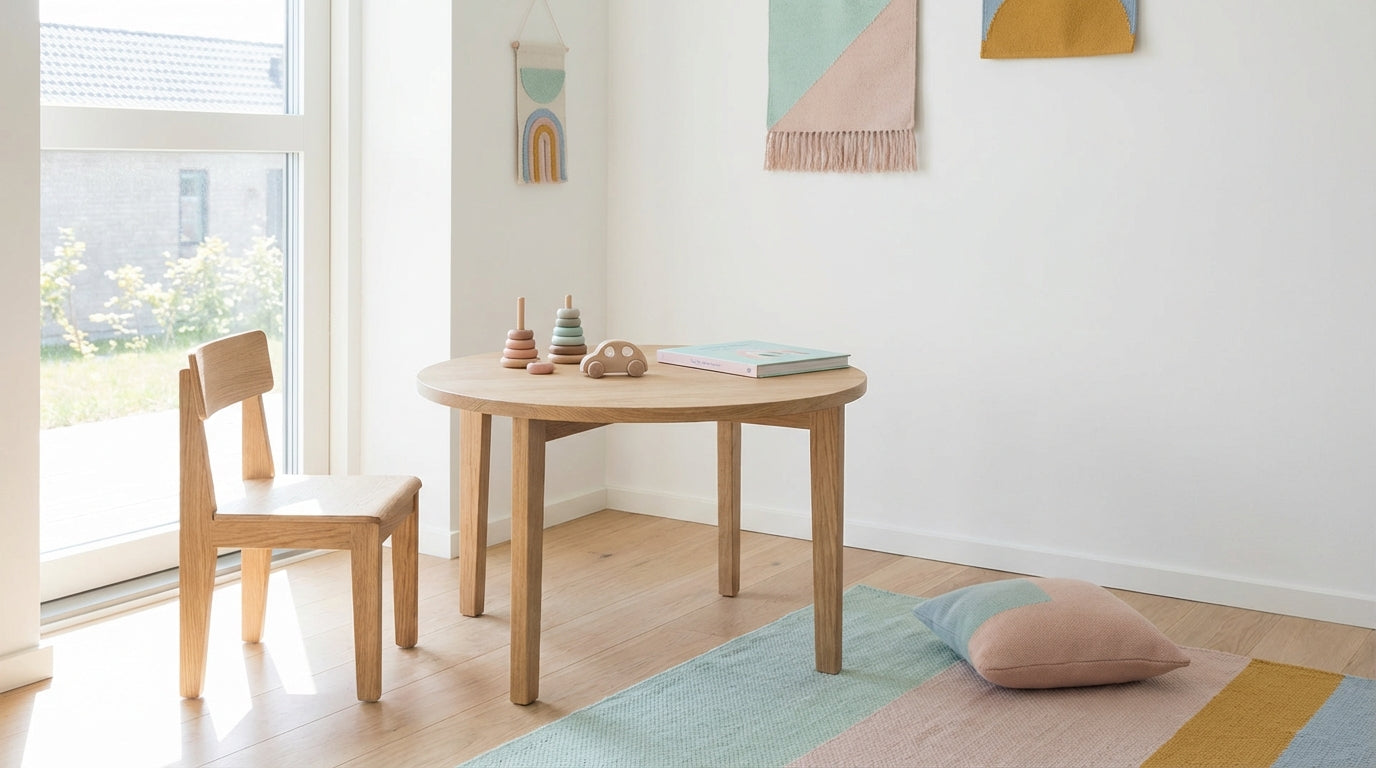
A kids' chair and table set is a matched furniture duo in which table height and seat height are planned together. That's the advantage over “any old chair + any old table”: it simply feels right to children, and you have less improvising to do.
Which types of sets are there – and who are they for?
The best type of set is the one that suits your everyday life – not the photo corner. Roughly speaking, you can tell these variants apart:
- Classic drawing and craft set: compact table, 1–2 chairs. Ideal for the children's room and play corner.
- Set with storage: table with compartment/drawer or baskets. Good if you want to tidy up “in a flash” in the evening.
- Growing/adjustable: height-adjustable table or chair. Handy if the set should fit for several years.
- Mini-desk feel: more for preschool and primary school age, when drawing turns into “concentrating”.
“Growing with your child” means for children's furniture: height or seat can be adjusted without the piece becoming unstable. That sounds obvious, but it's exactly the point that later decides whether the set is loved or ignored.
Size & ergonomics: How to check seat height, table height and age ranges
You can tell the size is right when your child sits relaxed – without hunched shoulders. No need to make a science of it; a few checks usually do the trick.
Seat height: How to spot it right away
The seat height is right when the feet stand firmly and the knees stay relaxed. Pay attention to these three things:
- Foot check: While seated, feet rest as steadily as possible on the floor (or a firm footrest).
- Knee check: Knees are at roughly a right angle, without the front edge of the seat pressing into the back of the knee.
- Slide check: If your child slides forward, it's often too high or too low – or the chair is simply uncomfortable.
Table height: So drawing doesn't turn into a shoulder workout
The table height is right when forearms rest loosely and shoulders stay down. Let your child draw or do a puzzle for a moment and watch: if the shoulders are pulled up or the upper body folds far forward, the height is usually off.
Age ranges: Use them as a rough guide, not a rule
Age recommendations help narrow things down, but they don't replace the sitting test. Children grow differently, and sometimes the legs are long before the rest catches up. So: better to measure and try it out once than to rely only on the label.
Standards can offer guidance on dimensions, even though not every piece of children's furniture falls under them. For chairs and tables in educational settings, EN 1729-1 describes functional dimensions and markings; according to DIN Media, the standard sets out exactly such functional dimensions and markings: DIN EN 1729-1 at DIN Media.
Practical tip: Let your child draw at the set for 3 minutes. If after 30 seconds they're kneeling, sliding or sitting sideways, the height/ergonomics aren't right yet.
Measure before you buy: A mini checklist for space & everyday life
Three quick measurements save you rearranging, cursing and returns later. Grab a folding ruler (or the tape measure that otherwise only shows up when you move house):
- Space needed: Picture the table plus chair and allow some extra room to push the chair back.
- Walkways: Does the path to the door, the bed or the wardrobe stay clear, without anyone bumping into things every day?
- Storage within reach: Where do paper, pens and play dough end up – and can your child reach them without climbing?
A practical rule of thumb: pushing the chair back must work without touching the wall. Otherwise “come sit down” quickly becomes “nah, this is annoying”.
Material & cleaning: What really counts in the children's room
In everyday life, the surface you can get clean without drama wins. A set in the children's room rarely looks like it does in the catalog. A few practical thoughts:
- Wood/solid wood: feels warm and is sturdy. Look for neatly sanded edges and a child-appropriate surface finish.
- Lacquered/sealed surfaces: often easier to clean – important with felt-tip pens, the greasy film from play dough and apple juice.
- Textile/upholstery on the chair: cozy, but crumbs love upholstery. If upholstered, then wipeable or removable.
Cleaning: How to keep it practical
Plan cleaning so it takes 60 seconds – not 60 minutes. Ask yourself: Can I wipe it damp without everything getting stained? Are there corners or edges where play dough and crumbs collect? And: Is the tabletop sturdy enough for watercolors and glue sticks?
For indoor air, “low-emission” is a helpful keyword. The Blue Angel (Blauer Engel) describes requirements for low-emission furniture and slatted bed bases made of wood and wood-based materials under DE-UZ 38; according to Blauer Engel, the focus is on low emissions and environmental criteria: Blauer Engel, Product World Furniture (DE-UZ 38).
If you prefer something more “verifiable”: emission labels provide classes for guidance. The Deutsche Gütegemeinschaft Möbel describes emission classes (A–D) in its award criteria for the emission label and names, among other things, limit values for formaldehyde and TVOC for each class: DGM emission label.
And because it helps in everyday life: good manufacturers state material, finish and care clearly and comprehensibly. It's not glamorous, but it's exactly what you'll need later when cleaning (and for peace of mind).
Safety: Keeping an eye on tipping protection, edges and “finger traps”
A good set stands firmly and has no spots that kids have to “discover” painfully. Sounds trivial – but it's the difference between “works great” and “ouch”.
Tipping protection: Wobbling is the beginning of the end
Tip-resistance means: table and chair stay steady, even when your child moves. Kids rarely sit like little accountants. They twist, lean, slide – and that's exactly when you see whether the footprint and construction are any good.
Edges & corners: Better round than “bluntly honest”
Rounded edges in the children's room aren't decoration, they're everyday protection. Especially important: the tabletop, the chair back and all areas children pass when getting up.
Trap points: Where little fingers like to get stuck
Avoid gaps, folding mechanisms or moving parts that could pinch fingers. Take a look with a “child's-hand view”: where would someone curiously reach in?
Safety note: Don't place the set directly next to radiators, windows or shelves that could be mistaken for a climbing aid.
If your set is more of a play-furniture type, toy standards can serve as a guide. For toys, Europe has the EN 71 series of standards; according to DIN, DIN EN 71 covers, among other things, mechanical/physical requirements, flammability and chemical aspects: DIN on EN 71.
Comparison: How to find the “best set” for your purpose
“Best set” means: it solves your problem – not that of other families. Here's a small, honest decision aid:
| If you mainly… | Then pay special attention to… | Why that helps |
|---|---|---|
| Draw & craft | wipeable tabletop, stable stance | Felt-tip pens & watercolors are merciless |
| Do puzzles & build | enough table surface, comfortable chair | otherwise everything ends up on the floor (including your nerves) |
| Eat snacks at the set | easy to clean, no fabric upholstery | crumb management is a full-time job |
| Live in a small space | compact dimensions, storage if possible | less “stuff wandering” around the room |
| Have several children | 2 chairs, sturdy construction | siblings are the best stress test |
As we say up north: if it wobbles, it won't get used. If it fits, it will be loved.
Setting up in the children's room: Small tricks, big effect
The location decides whether the set is used daily or quietly gathers dust. Three simple rules:

- Light: as close to daylight as possible (but not so that the sun dazzles).
- Supply station: pens/play dough/paper within reach – otherwise you're the walk-in customer.
- Distance from the wall: a little room to maneuver, so the chair doesn't constantly bang into the wall.
Practical tip: A wipeable mat under the table (or a washable mini rug) saves the floor and the mood.
What we keep in mind as a family (and for 66 years) with children's furniture
Good children's furniture is honest: material, workmanship and safety are transparent. Ulli & Flo write here as parents for parents – and bieco is a family business from Hamburg. We've been doing this for 66 years, and that experience keeps leading us to the same questions: Is the piece stable? Are the edges cleanly finished? Is there clear information on material and care? And does it feel good in real everyday life – not just when unpacking?
Transparency isn't an extra here, it's the basis for trust. When manufacturers clearly explain what something is made of, how it was tested and how to care for it, you can make decisions more calmly as a family.
Keep browsing at bieco: Chairs, sets and matching additions
If you'd like to get your bearings, a good overview helps more than 200 open tabs. For further clicking (completely stress-free), these pages fit:
- Kids' chair – as a hub if you first want to see what's out there in general.
- Kids' chair with table – if you're looking specifically for sets.
- Desk chair for kids – if it's more about sitting for longer.
- Travel kids' chair – in case you want to solve sitting on the go at the same time.
If you like: take a relaxed look at matching kids' chairs at bieco and use the measuring checks from this article. Then “looks nice” will hopefully become “gets used every day”.
FAQ
Kids' chair with table: From what age is a set worthwhile?
A set is worthwhile as soon as your child can sit safely and play purposefully at a table. That varies from child to child. Many families use a small set from toddler age for drawing, kneading and puzzles. What matters less is age and more the right seat and table height.
Which is better: buying a kids' table and chair as a set or separately?
A set is often easier because table height and chair already match. Buying separately can make sense if you already have a suitable table or want to combine deliberately. In that case, be sure to do the seat and table height check so your child doesn't sit hunched all the time.
How do I find the right height for a kids' table and chair?
It's right when feet stand firmly and forearms rest loosely. Make sure the shoulders stay relaxed and the front edge of the seat doesn't press into the back of the knee. When in doubt, let your child test it: kids show you quite honestly whether they're sitting comfortably.
How can I tell whether a chair for the children's room is tip-resistant?
A chair is tip-resistant if it doesn't “move along” or twist sideways when your child moves. Have your child stand up, sit down and turn slightly. If the chair wobbles or slides, non-slip feet help – or a different model with a more stable base.
Which materials make sense in the children's room (also with regard to indoor air)?
Materials and surfaces that are low-emission and easy to clean make sense. Eco labels and emission labels offer guidance, for example the Blue Angel (DE-UZ 38) for low-emission furniture. Also look for clear material and care information so you know what you're bringing into the room.
How do I best set up a kids' chair and table set?
The set is best placed in a bright spot, within reach of craft supplies and with some room to move. Right next to the box of paper and pens, it gets used more often. Avoid tight corners where the chair constantly bumps into things. A mat underneath protects the floor and the mood.
Finally, nice and relaxed: if the set stands firmly, is easy to clean and really fits your child, you've already won. And if you'd like to keep browsing: in the kids' chair overview you'll find more options – for the children's room and for on the go.