Garden Games for a Kids' Birthday Party: 10 Outdoor Ideas That Work
At a glance
- Garden games for a kids' birthday party: 10 ideas with materials, duration, age and a variation.
- Easy to plan: 60–120 minutes, alternating between action & calm.
- Not much stuff needed: chalk, buckets, rope, balls, blankets.
- Play it safe: quickly check water spots, tripping hazards and throwing zones.
- Extra handy: a printable materials checklist for your preparations.

For a kids' birthday party in the garden, games work best when they are short, quick to start and easy to adapt to the children's age. Below you'll find 10 tried-and-tested ideas for outdoors – each with the same recurring pattern (materials, set-up, duration, age, variation, safety). That's on purpose: when things get busy, you don't want to read a lot, you just want to get going. And yes, a little northern German calm helps. We're a family business from Hamburg, we've been part of playtime ideas for 66 years – and we know that it will never be perfect, but it will be really lovely most of the time.

Ulli & Flo
Owners of bieco · Hamburg · parents themselves
We've learned that being outside is loveliest when the games are short and you can switch at any time. With the checklist above, you'll be ready to go faster than you can say “cake”. Feel free to browse our collection Outdoor Toys.
Before you start: a mini plan that saves stress
It's better to plan several short games than a few long ones – that keeps the mood steady. As a rough guide, this often works: 10 minutes of arriving, then 2 active games, then something calmer, then action again. A drink break isn't a bonus, it's the secret main event.

- 60 minutes: 4 games (2 active, 1 calm, 1 active) + a short break
- 90–120 minutes: 6–8 games + a snack break in the middle
- 8 or more children: stations or two games in parallel (less waiting)
Pro tip: Write the order of games on a slip of paper. When things get loud, that slip is your lighthouse.
Materials checklist (to tick off before the doorbell rings)
This short list covers almost all of the games below. If you don't have everything: no big deal – improvising is an Olympic discipline at kids' birthday parties anyway.

- Buckets (2–4), cups or sponges
- Sidewalk chalk
- Rope or clothesline
- Blankets/towels (for “islands”)
- 2–3 soft balls (fabric or soft balls)
- Spoons + potatoes or ping pong balls
- Empty cans/cups (for throwing games)
- Pens + paper/clipboard
- Cones/markers (stones or chalk lines will do in a pinch)
Safety in the garden: one quick walk-around
A quick safety check before you start prevents most “ouch!” moments. According to the German Federal Association for Child Safety (Bundesarbeitsgemeinschaft Mehr Sicherheit für Kinder e.V.), it's especially worthwhile to remove tripping hazards, secure water spots and lock away tools (Mehr Sicherheit für Kinder e.V.).

Safety note: Unsecured ponds, rain barrels and paddling pools are dangerous for toddlers – stay right nearby or secure the area. According to Mehr Sicherheit für Kinder e.V., serious accidents keep happening here. (Source)
A station game means: small groups do several mini-tasks one after another. This reduces crowding, waiting time and the classic question “When is it my turn?!”.
A cooperative game means: the group wins together instead of against each other. That takes the pressure off, especially with mixed age groups or when the mood can tip quickly.
1) Water relay (bucket race)
The water relay is quickly explained and almost always gets everyone in a good mood right away. Two buckets per team: water at the back, an empty one at the front. The children carry water to the front with cups or sponges.
- Materials: 2 buckets per team, cups or sponges, marker (cones/chalk)
- Set-up: Start and finish buckets 5–10 meters apart
- Duration: 5–8 minutes
- Age: from approx. 3 years (with a short course)
- Variation: 8+: with a spoon instead of a cup (yes, things will get wet)
- Safety: Avoid slippery spots, barefoot only on suitable surfaces
You'll find suitable items for outdoor water play in our collection. This way: Water toys for the garden.
2) Nature scavenger hunt (calm, but not boring)
A nature scavenger hunt is the calm rescue when the energy dips for a moment. You give a list: “Find something round, something that smells nice, something soft…” – and without pulling up any plants.
- Materials: Paper + pen, baskets/bags if desired
- Set-up: Clearly mark off the search area (fence, hedge, chalk line)
- Duration: 10–15 minutes
- Age: from approx. 3 years (with pictures)
- Variation: 7+: time limit + bonus (“find 3 shades of green”)
- Safety: Only pick things up from the ground, nothing in the mouth
A quick plant check makes this game much more relaxed. According to kindergesundheit-info (BIÖG), poisonous plants in the garden can be dangerous for small children (BIÖG / kindergesundheit-info).
3) Sack race (short, soft, classic)
The sack race works brilliantly when the surface is right and the course stays short. Children step into sacks or large pillowcases and hop to the finish line.
- Materials: Sacks/pillowcases, start/finish line
- Set-up: 5–8 meters, ideally on grass
- Duration: 5–10 minutes
- Age: from approx. 4 years
- Variation: Relay instead of “everyone at once” (fewer collisions)
- Safety: Enough space between players, no hard edges in the finish area
Safety note: Don't play the sack race on paving or gravel. A soft surface reduces the risk in case of falls. (ADAC)
4) Can toss (quiet version: with soft balls)
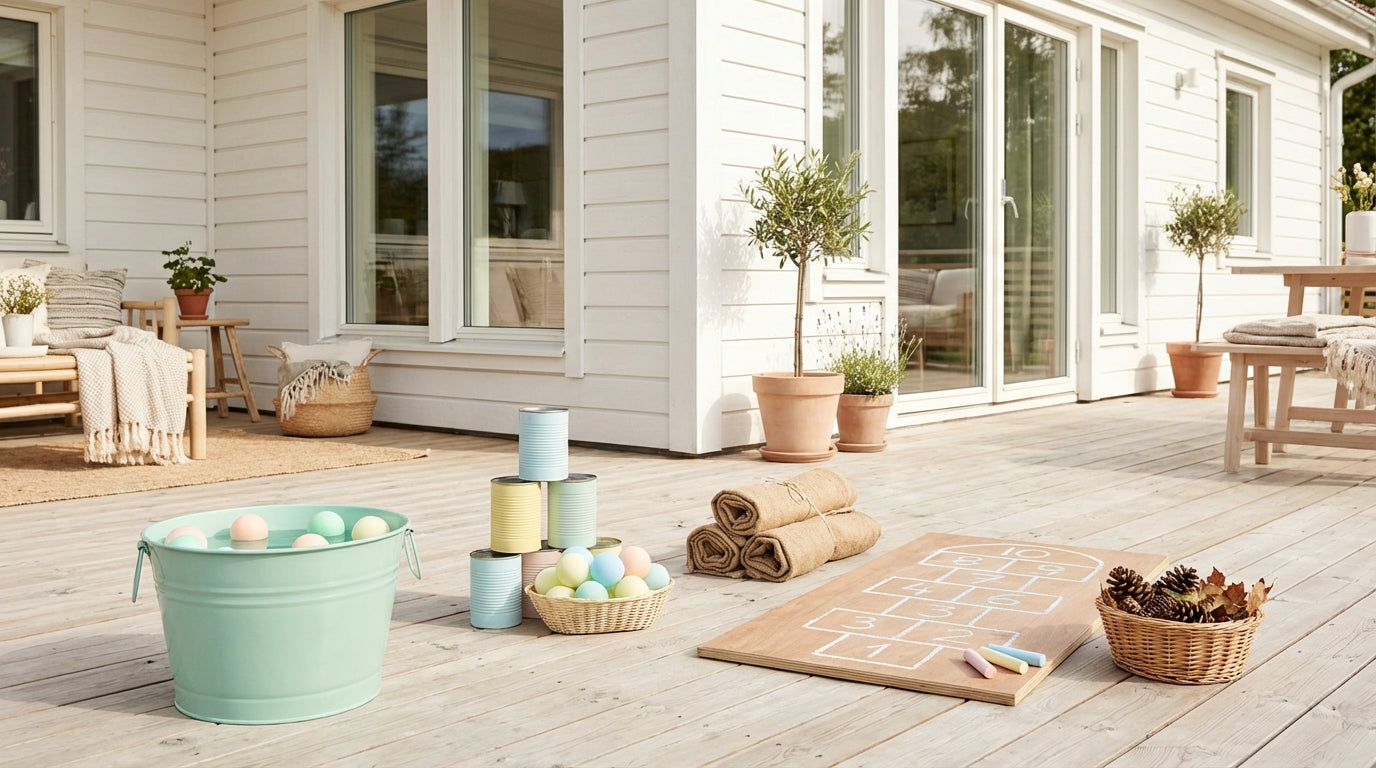
Can toss is quick to prepare and gives many children a small moment of success. Stack 6–10 cans or cups and throw soft balls from a short distance.
- Materials: Empty cans/cups, 2–3 soft balls, table or crate
- Set-up: Throwing line 2–4 meters away
- Duration: 10 minutes (longer as a station)
- Age: from approx. 3–4 years
- Variation: Write points on the cans or “30 hits all together”
- Safety: Clearly mark the throwing zone, nobody runs across in front of the target
Soft balls are often the most nerve-friendly choice outdoors. If you'd like to browse: Outdoor Toys go well with throwing and target games.
5) Egg-and-spoon race (with a potato or ping pong ball)
The egg-and-spoon race is an “everyone can join in” game if you keep the course short. Instead of a raw egg, use a potato or a ping pong ball – that saves cleanup and drama.
- Materials: Spoons, potatoes or ping pong balls, markers
- Set-up: Circular course or there-and-back
- Duration: 5–8 minutes
- Age: from approx. 4 years
- Variation: Relay in teams or “with an obstacle” (around a tree)
- Safety: Keep the course free of holes/hoses so nobody trips
Pro tip: Start with a practice round without competition. Then “Now it counts!” – that greatly reduces frustration for the little ones.
6) Chalk obstacle course (hopping, turning, balancing)
A chalk obstacle course is the most flexible game because you can adapt it in minutes. Draw squares and tasks: “Spin around”, “Hop like a frog”, “Balance”, “Backwards” – done.
- Materials: Sidewalk chalk, rope or small cones if desired
- Set-up: Circular course so nobody runs “against the traffic”
- Duration: 10–15 minutes
- Age: from approx. 3 years
- Variation: 8+: time it or a “backwards round”
- Safety: Not on slippery surfaces, draw curves generously
For the little ones, sturdy toys are especially worthwhile outdoors. If you're looking for ideas: Outdoor toys for toddlers.
7) Sponge toss target (hits instead of speed)
Sponge throwing brings action, but without racing and bumping into each other. Set up a bucket (or hang a hoop) and let the children throw wet sponges into it.
- Materials: Bucket/hoop, sponges, water
- Set-up: Throwing line 2–5 meters away
- Duration: 8–12 minutes
- Age: from approx. 4 years
- Variation: Two targets: “easy” and “hard” (different points)
- Safety: Keep an eye on slipping hazards, clearly separate the throwing zone
8) “Save the balloon” (cooperative game)
This cooperative game stops arguments surprisingly reliably. Everyone works together to keep a balloon from touching the ground – tap only, no holding on.
- Materials: 1–3 balloons
- Set-up: Open area without thorny hedges (balloons are delicate)
- Duration: 5–10 minutes
- Age: better from approx. 4–5 years (with supervision)
- Variation: Every child must have had a turn before the next hit
- Safety: Collect balloon scraps immediately, better to skip it with very young children
Safety note: Balloons can be dangerous for small children if pieces get into their mouths. Dispose of balloon scraps immediately and choose alternative games for toddlers.
9) Obstacle relay with “garden stuff”
An obstacle relay looks like a lot, but it's made of completely ordinary things. Stations: crawl under a rope, run around a tree, “island hopping” across blankets, walk backwards to the line.
- Materials: Rope, blankets, cones/chalk, hoops if desired
- Set-up: 6–8 stations, clear running direction
- Duration: 10–15 minutes
- Age: from approx. 5 years (earlier with simple stations)
- Variation: “Quiet round” (tiptoeing only) or “animal round” (like a bear)
- Safety: No wobbly furniture, no sharp edges, space between stations
If you're generally looking for inspiration for outdoors, the collection is a good starting point. Here: Outdoor Toys.
10) Garden bingo (perfect for winding down)
Garden bingo is a calm finale that still stays exciting. You make a bingo card: “something yellow”, “a leaf with points”, “a stone”, “a sound (write it down)” – and the children tick them off.
- Materials: Bingo sheets, pens, clipboard or cardboard
- Set-up: Mark off the search area
- Duration: 10–15 minutes
- Age: from approx. 4 years (with pictures)
- Variation: Everyone works together to fill one card instead of competing
- Safety: Clear boundaries, don't touch anything that pricks or crawls and shouldn't
Which games suit which age?
The younger the children, the shorter the rules and the more repetition. For ages 3–4, chalk obstacle courses, water relays (short), can toss and calm search games often work well. From 5–7, relays and obstacles go well. From 8, it can get trickier (time, points, team tactics) – but please without winner drama.
What to do if it gets too hot, too wet or too windy?
A good kids' birthday party doesn't fail because of the weather, but because of a missing plan B. In heat: more shade, shorter rounds, a water game as a “cool-down break”. In rain: move games under an awning or do search games in rain jackets. In wind: better to skip balloons and light targets.
After the birthday comes the tidying up – and it can be easy. If you're using outdoor items: How to store, protect & clean outdoor toys properly.
FAQ
Which garden games are suitable for a kids' birthday party with 10 children?
The best games are those that avoid waiting and can be split up. Go for relays (water relay, egg-and-spoon race as a team), stations (chalk obstacle course, obstacle relay) and one calm game (scavenger hunt or garden bingo). That way everyone is busy without you having to be the referee all the time.
Which garden games work with 3- to 4-year-olds?
Short games with lots of demonstrating and few rules are ideal. A chalk obstacle course, can toss with soft balls and a mini scavenger hunt often work very well. Keep the courses short, do two rounds rather than one long one – and plan a drink break right from the start.
What are good garden games without much material?
Anything that works with chalk, buckets and household items is usually a hit. A chalk obstacle course, nature scavenger hunt, obstacle relay with blankets/rope and the egg-and-spoon race need hardly any preparation. That saves time – and you don't have to dash to the store at the last minute.
How long should games last at an outdoor kids' birthday party?
Allow 5–10 minutes per game and switch sooner rather than later. Otherwise children lose interest or things get restless. Two short rounds are better than one long one. For 90 minutes, 6 games plus a snack break are usually enough – and you'll still look surprisingly organized.
Which safety rules are especially important when playing in the garden?
Remove tripping hazards, secure water, lock away tools – one quick check is often enough. According to Mehr Sicherheit für Kinder e.V., unsecured ponds/rain barrels and equipment left lying around are typical garden hazards. A quick walk-around before you start significantly reduces the biggest risks. (Source)
What do I do if a game causes arguments?
Switch to a cooperative game or take the competition out. “Save the balloon” or a scavenger hunt as a team takes the pressure off the group. You can also drop the points and only play “achieve it together”. That's not giving up – it's smart steering to keep the mood good.
To finish: a little “it'll be fine” is often the best plan
If you pull off 3–4 games well, the kids' birthday party is usually already a success. For even more outdoor ideas, you can browse our collection: Outdoor Toys. And because we've been working with toys for 66 years as a family business from Hamburg, we'll be honest: better sturdy, safe and doable than polished and stressful.