Electric vs. Classic Wooden Train Set: Which One Suits My Child?
At a glance
- An electric wooden train is a great fit if your child likes to “let it run” rather than just push.
- Classic wooden trains are often quieter, sturdy and perfect for free play.
- Electric locomotives usually work more smoothly from around 3 years old.
- Important with motorized locomotives: a secured battery compartment, clear age recommendations and stable couplings.
- Many families do well with this approach: start classic, then add a motorized locomotive later.

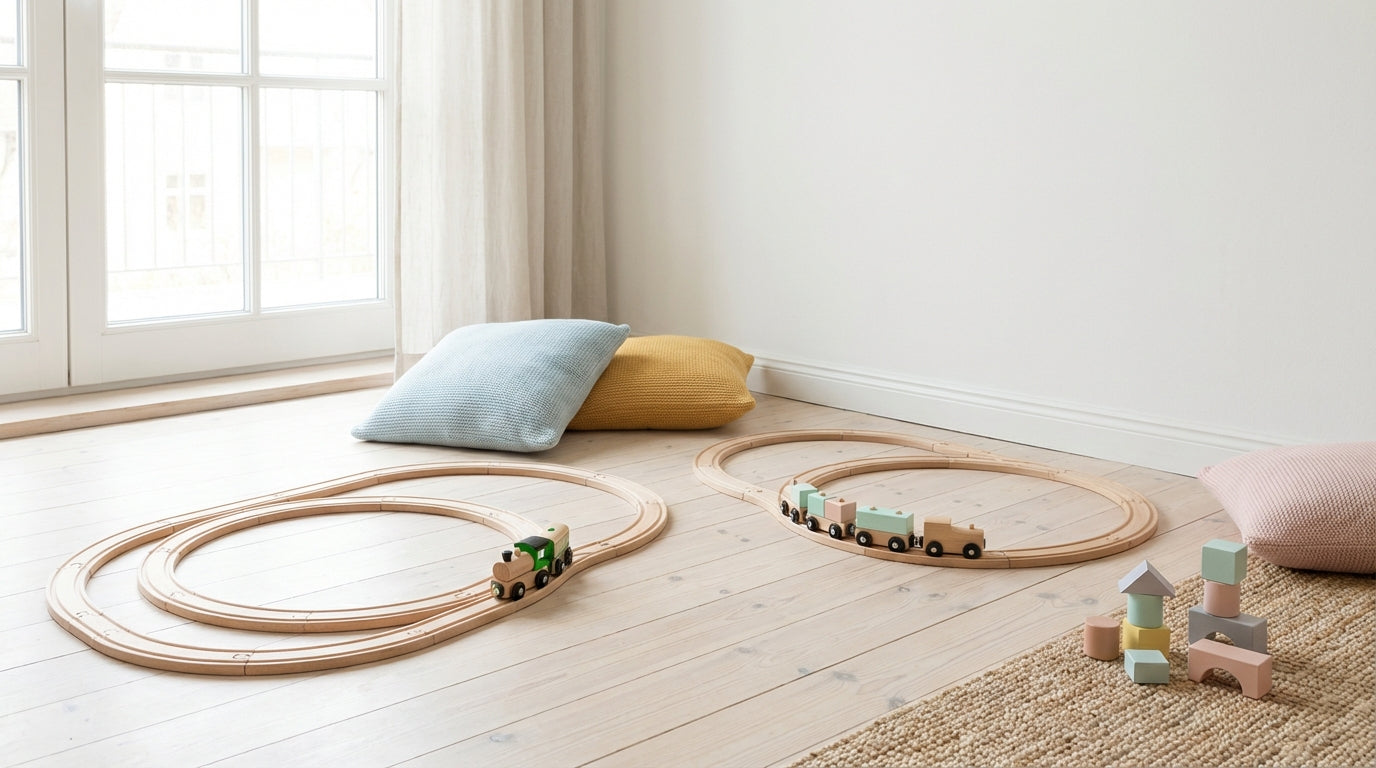
Electric or classic is the right choice when it fits your everyday play routine. An electric locomotive is wonderful for children who love watching the train circle “all by itself” – start, stop, change direction, and the little train cinema is ready. Classic wooden trains are often the calmer evergreen: pushing, shunting, playing train station, building bridges, inventing stories. Here you'll find a clear decision guide, a safety checklist and a few practical tips so the train doesn't end up stranded in the toy basket after three days.

Ulli & Flo
Owners of bieco · Hamburg · parents themselves
We've learned that the best train is the one that gets played with on a perfectly ordinary Tuesday. With the questions and checklists here, you'll quickly find the relaxed solution for your family. Feel free to browse our wooden train collection.
What's the real difference: electric vs. classic?
The motor doesn't just change how the train moves, it changes the play idea. With a classic wooden train, your child is the engine and the signal box in one: pushing, stopping, coupling, rebuilding. With a motorized locomotive, the motor takes over the driving – your child steers and observes what happens.

An electric wooden train is a wooden track system with a motorized locomotive. Tracks, switches and wagons can be completely “normal” wooden ones; only the locomotive runs on a battery and motor.
A classic wooden train is a wooden track system without a motor that is moved by hand. Its charm lies in building, pushing and free play with roles and rules.
What age is an electric locomotive really right for?
Electric often brings more joy than frustration from around 3 years old. Not because younger children are “too small” – but because putting the train back on the track, pressing the button, keeping the track clear and the battery topic (yes, that will come up) take a bit of maturity. Many manufacturers recommend electric locomotives from 3 years; according to BRIO, electric locomotives are suitable from 3 years.

Practical tip: If your child is only just getting into the “trains” topic, start classic – and put the motorized locomotive aside as an “upgrade” for later.
For the very little ones, “pull and push” is often the more relaxed way in. A pull-along train has no motor but is still on the move – and fits nicely into the phase of “I want to pull something behind me.” If you like: at BIECO you'll find, for example, the Pull-Along Train with Plug-in Blocks (age recommendation and standards information are listed transparently there).
What suits which child? 6 quick questions
The best choice is the one your child really enjoys playing with. Take a moment for these questions – they're often more honest than any glossy product description:
- Does your child like watching things roll? Then a motorized locomotive scores (let it run laps, marvel, start again).
- Does your child like acting out stories? Then classic is often stronger (train station, inviting animals aboard, construction site, rescue mission).
- Does your child get frustrated quickly when something derails? Then rather start classic – “a quick push and back on the track” means less drama.
- Does your child like buttons, switches, cause and effect? Electric can hit exactly that nerve.
- Is quiet play more your thing (baby sleeping, thin walls)? Classic is usually quieter.
- Do you enjoy building together? Classic invites more of the “come on, let's make one more bridge” spirit.
Electric wooden train: advantages & typical stumbling blocks
Electric is strong when “driving it myself” is the main fun. You often get more “wow” per minute – especially at the start. Children love it when they trigger something and then something visibly happens.
Stumbling block no. 1 is batteries – and not just the cost. Batteries run out, the locomotive slows down, and suddenly the mood is… let's say: grey and overcast, Hamburg-style. Plan for it: keep spare batteries ready or agree on a clear rule (“the loco runs again tomorrow”).
Stumbling block no. 2: the battery compartment and small parts must be truly child-safe. With electric toys, the battery compartment is a central safety topic. The standard for electric toys (DIN EN IEC 62115) describes requirements for the design and accessibility of batteries; according to VDE Verlag (DIN EN IEC 62115:2021-04), batteries must not be accessible, and requirements for secured battery compartments are specified.
Safety note: Check regularly that the battery compartment cover sits tightly and the screw holds. If the cover wobbles: put the locomotive aside before small hands can get to it.
Stumbling block no. 3: derailments are more common with motor operation. The train keeps pushing, even when it jams at the front. That's normal – but annoying for some children (and parents). What often helps right away: build a simpler track, use fewer tight curves, and make sure the switches click in cleanly.
Classic wooden train: why it so often stays around longer
Classic is the “bread-and-butter toy”: unspectacular, but reliable. No charging, no running out of power, no “it won't go!” And the play grows with your child. First it's pushed, later planned (“here's the construction site”), later still sorted (“freight train vs. passenger train”).
For free play, classic is often the stronger foundation. Children rebuild tracks, invent rules, make sounds (yes, that's play too), and you can easily join in – without first having to explain technology.
Even with wooden toys, it's worth checking for tested safety and materials. The DIN EN 71 series of standards describes safety requirements for toys; according to DIN, it covers, among other things, mechanical/physical requirements and limits on the migration of certain elements.
Materials, colors, harmful substances: what to look out for
With wooden toys, it's not just the wood that counts, but also paint, glue and workmanship. Especially when things are still being “tested” with mouth, teeth and plenty of saliva, you want clear information and proper workmanship.
- Smooth edges, solid connections: Nothing should splinter, wobble or have sharp edges.
- Colors and paints: Reputable manufacturers state that testing was done according to toy standards.
- No detachable small parts for toddlers: Especially important with add-ons, magnetic couplings and decorative parts.
Independent consumer advice makes a good cheat sheet. The Verbraucherzentrale Schleswig-Holstein (consumer advice center) recommends, among other things, that no small parts should come loose on wooden toys for babies and toddlers, and that treated paints/varnishes should comply with the toy standard.
Compatibility: do tracks and trains fit together?
Many wooden track systems are similar, but not automatically always compatible. In everyday life that means: sometimes the hand-me-down from your cousin fits perfectly – sometimes it sits crooked and causes constant derailments (and with them, constant discussions).
Compatibility means: track connectors, gauge and transitions fit together mechanically. Sounds dry, but it saves nerves: if the connections don't engage cleanly, “the train is running” quickly turns into “the train pushes itself off the track.”
- Check the transitions: Differences show up first with bridges, crossings and switches.
- Test with an oval: A simple loop is the best “stress test” for mixed systems.
- Plan for expansions: If you want to add a motorized locomotive later, make sure it runs smoothly on your tracks.
Electric vs. classic: table for a quick comparison
If you only have 30 seconds: this table puts things in order.
| Question | Motorized locomotive | Classic |
|---|---|---|
| Play feel | Steering & watching | Building, pushing, shunting |
| Volume | Depending on the model, rather audible | Usually quieter |
| Everyday life | Batteries can become a “topic” | Always works |
| Frustration factor | Derailments can be annoying | Derailments are quickly fixed |
| Growing with your child | Strong as an addition/upgrade | Strong foundation for years |
Checklist: what to look for when buying
With this checklist you avoid the typical “oh, I see…” surprises.
- Age recommendation & warnings: Does it suit your child (and what your child really does with it)?
- Secured battery compartment: Cover with a screw, batteries not accessible (especially important with motorized locomotives).
- Stability: Tracks sit firmly, switches click in cleanly, nothing wobbles.
- Couplings: Easy to connect and release – without small parts coming off right away.
- Cleaning: Smooth surfaces are simply a blessing in family life.
- Expandability: Are there matching tracks, switches, bridges, wagons?
Batteries/rechargeables & sustainability: what makes sense in everyday life?
What's sustainable is often what's used for a long time and doesn't constantly annoy. A classic set lasts without any energy source, while a motorized locomotive brings plenty of play appeal – and both can make sense if they're really played with.

- If batteries are inside: Store spare batteries out of children's reach and change them calmly, not “on the fly.”
- If the locomotive rarely runs: Take the batteries out during longer breaks (prevents trouble from leaking batteries).
- Less is more: One well-running locomotive on a stable track beats three locomotives that constantly jam.
Practical tip: First build a “safe loop” (oval). Expansions come as a reward: “If the oval works for 5 laps, we'll build a bridge.”
Why we see it this way at BIECO (short, honest, the Hanseatic way)
We like toys that work in everyday life – not just in photos. We're a family business from Hamburg, we've been doing this for 66 years, and we know: a toy has to cope with children's hands. That's why transparent information on age, warnings and testing isn't an “extra” for us, but a matter of duty.

If you'd like to browse: start with a solid base and expand from there. The wooden train category gives you an overview, and for expanding, our guides on Types of Wooden Trains Compared: Sets, Accessories & Expansions and Accessories for Wooden Trains: Switches, Tracks & More make practical kitchen-table reading.
FAQ
From what age does an electric wooden train make sense?
Usually from around 3 years, because operating it and putting it back on the track become easier then. Many manufacturers recommend motorized locomotives from 3 years; according to BRIO, electric locomotives are suitable from 3 years. What matters is: can your child use buttons purposefully and take derailments in stride?
Is a motorized locomotive more dangerous than a classic wooden train?
Not inherently, but the battery compartment is an additional safety topic. Make sure the batteries are not accessible and the cover is secured. DIN EN IEC 62115 describes requirements for electric toys and battery accessibility; according to VDE Verlag, these include requirements for secured battery compartments.
What's better for imaginative play: electric or classic?
Classic is often stronger because your child controls everything themselves. Pushing, stopping, shunting, rebuilding – these are lots of small decisions that let stories unfold. Electric can foster imagination too, but the focus is often more on “letting it run.”
What do I do if the motorized locomotive keeps derailing?
Build the track simpler and more stable before making it bigger. Start with an oval, use fewer switches and make sure the connections sit cleanly. With motor operation, the locomotive keeps pushing even when it jams – so “less track, more success” almost always helps.
How can I recognize good materials in wooden toys?
Good workmanship and transparent information are half the battle. Look for smooth edges, stable connections and clear information on paints/varnishes. The Verbraucherzentrale Schleswig-Holstein (consumer advice center) advises, among other things, that no small parts should come loose on wooden toys for babies and toddlers.
Does “classic first, electric later” really make sense?
Yes, because you cover two play phases without having to rush into buying something new. Classic is the stable foundation for building and storytelling. When the wish for “more action” comes later, a motorized locomotive is often exactly the upgrade that brings fresh energy back.
Bottom line: choose what actually ends up on your living room rug. If you're looking for a solid base, take a look at the wooden train overview – and when it's time to expand, our guide to Accessories for Wooden Trains will help with your next track upgrade.