Christening Piggy Bank: Gift Ideas, How Much Money & Choosing a Safe One for Baby
At a Glance
- A christening piggy bank is a long-lasting gift: a symbol today, a wish-granter later.
- A small starting amount and a line on the card make it personal right away.
- For babies: sturdy, no loose small parts, and easy for parents to open.
- Wood feels warm and robust, ceramic is more classic – both have pros and cons.
- If you're not sure: just ask the parents whether a piggy bank or an envelope suits them better.

A christening piggy bank is a gift that gathers money gifts beautifully and stays as a keepsake for years. You're not just passing on a few bills, but a little "for later" fund for the child. And the best part: it's uncomplicated – for godparents, grandparents, friends and anyone who likes to give something meaningful without agonizing over it for weeks. Here you'll find down-to-earth guideline amounts for money gifts (as orientation only), a safe selection for babies, a material guide (wood vs. ceramic), wrapping ideas without craft stress, and short card messages.

Ulli & Flo
Owners of Bieco · Hamburg · parents themselves
When it comes to christening gifts, we love things that don't disappear into a drawer right away. A piggy bank is that kind of quiet classic: practical, personal and useful for years. Feel free to browse our piggy bank collection.
Why a piggy bank is such a good fit for a christening
A christening is often about a good start – and a piggy bank fits that wonderfully. Many christening gifts are symbolic, and money is, well... money. In a piggy bank it becomes a little ritual: drop it in, clink, done. And one day the child will understand: "Someone was already thinking of me when I was tiny."
A piggy bank is a container that collects coins and bills for later. The benefit is simple: less paper clutter, fewer "Where did that envelope go?" moments – and a visible place where saving becomes tangible in the first place.
How much money for a christening piggy bank? (Guideline amounts, not an obligation)
There is no fixed sum – take guideline amounts as orientation only. What "fits" depends mostly on your relationship and your budget. As a rough range, online sources often mention: godparents about €100–150, close family €50–100, friends €20–50, acquaintances €10–20 – according to rauhes.de. (Source)

More important than the number: your gift should feel good to you. If money is tight right now, that's not a character flaw. Then €20 plus an honest sentence on the card is often "more christening" than a big amount that gives you a stomachache.
Practical tip: If you're giving as a group: one person gets the piggy bank, everyone else adds cash. That saves nerves and duplicate gifts.
Piggy bank for baby: what to look for in terms of safety and everyday use
With a piggy bank for a baby, stability, clean edges and firmly attached details matter. Babies test everything: touching, pushing, dropping, putting in their mouth. That's why it's worth taking a quick look at the craftsmanship and at whether anything could come off.

The DIN EN 71 series of standards describes safety requirements and tests for toys. It's not a magic seal, but a good compass: according to DIN, DIN EN 71 covers mechanical/physical properties, flammability and chemical aspects, among other things. (Source)
Safety note: Make sure no small decorative parts are loose or can come off (choking hazard).
For parents, an opening that's easy to use is often more important than the cutest design. Honestly: if you want to take the money out later, it should work without tools, without shards and without swearing. Some models are deliberately "made to be broken" – that's a nice gag, but not always a hit in everyday family life.
If you'd like to browse: you'll find various designs for children in our piggy bank overview. We're a family business from Hamburg and have been doing this for 66 years – and we know that a children's room has to withstand a bit more than good intentions.
Material guide: wood vs. ceramic (and what suits everyday life better)
Wood feels warm and robust, ceramic is classic – both can be right. What matters is how the piggy bank is used: does it sit decoratively on a shelf, or might it occasionally "fly" off the changing table?
- Wood: Often pleasantly light, feels warm and is more forgiving of the odd bump. Practical if the piggy bank later moves into the children's room and isn't meant to be just decoration.
- Ceramic: Often looks very classic and feels like a "keepsake." On the other hand, it's naturally more fragile – a safe spot helps here (and parents who don't put everything on windowsills).
An "everyday piggy bank" is one that parents can handle without drama. That means: easy to clean, not too heavy, no delicate add-on parts – and built so it doesn't take its final bow at the first mishap.
Personalized baby piggy bank: when personalization really makes sense
A piggy bank with a name is ideal if you want to give a real keepsake. The name turns "a piggy bank" into "yours." Especially for a christening or birth, that's lovely, because later a lot gets mixed up: "Who gave what again?" – you know how it is.
Personalization is especially practical if there are several children around. That means fewer mix-ups and fewer arguments when everyone wants to save at the same time (and of course everyone had the biggest coin).
If you're looking for ideas, our article Personalized Piggy Banks: The Perfect Gift with Name & Engraving will help. It covers practical ways to make it look lovely without being delicate.
DIY: Make a christening piggy bank personal (no engraving, no craft chaos)
You can make a piggy bank personal with three little tricks – no professional tools needed. That's perfect if you don't want to have it engraved or need it done quickly. And don't worry: this is "kitchen-table friendly."
Option 1: The starting amount with meaning
A small starting amount feels bigger when you "explain" it. Instead of just putting in €20, turn it into a mini story: "For your first ice cream after a big day" or "for your first outing alone with Grandma/Grandpa."
- 5–10 euros in coins (it's fine if it rattles)
- a small note with a purpose (short, friendly)
- the remaining amount (if desired) in an envelope alongside
Option 2: Wish note (which parents will love later)
A wish note turns money into a gift for the future. You write 1–2 sentences: "For your first bike" or "for later, when you choose something yourself." It's touching without becoming kitschy.
Option 3: Mini time capsule in the card
A time capsule is a short glimpse of "today" that people love to read later. Write in the card: the weather, a sentence about the baby ("already has the most serious frown line in the family") and a wish. It takes 2 minutes and is priceless later.
Practical tip: Add whether the money is meant "for later" or whether the parents may also use it for everyday needs (e.g. diapers). That takes the pressure off.
How to wrap a christening piggy bank (pretty, quick, frustration-free)
Good wrapping doesn't need a crafting exam – just a clear idea. Here are four options that also work when you've got a child on your arm (or the bus is about to arrive).
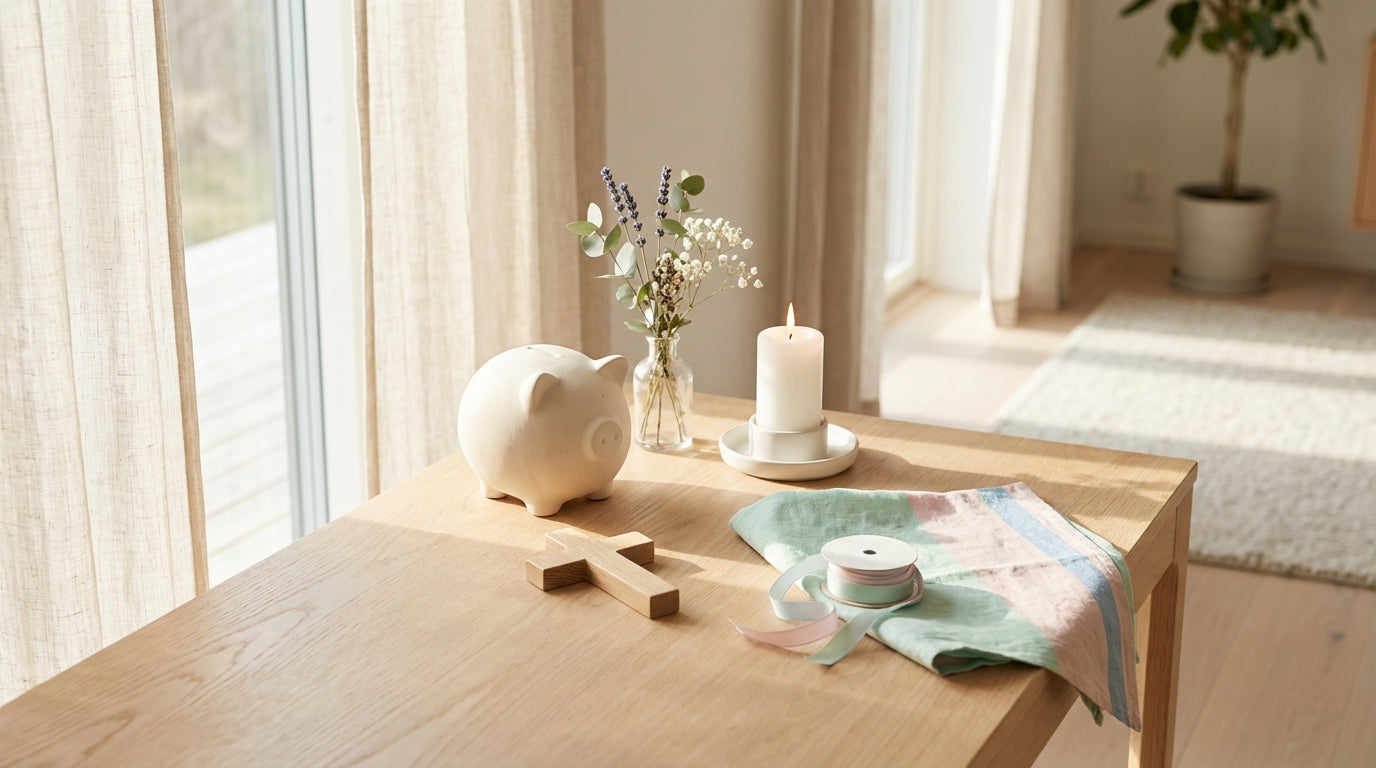
- The "rattle" option: Coins in, ribbon around, card alongside. Done. Everyone gets it right away.
- The "wish" option: A small tag on the piggy bank: "For your first bike" or "for later."
- The "parent-friendly" option: Give the piggy bank as a symbol, with the money in a separate envelope. Then parents can decide whether it should go into a bank account.
- The "treasure chest" option: Place the piggy bank in a small box and pad it with tissue paper. It looks high-quality and protects it in transit.
If you put money in the piggy bank, think about how it comes out again. Sounds trivial, but it's the classic: you don't want parents wondering later how to get the bill back out without taking half of it apart.
What do I write on the card? Short messages for christening & birth
One honest sentence is better than a novel – and sticks more. Here are a few short messages you can use as they are or adapt.
- For the christening: "For your path – small today, big later. All the best on your christening."
- For a birth: "Welcome to the world. For later, when you can wish for something yourself."
- From grandparents: "A small beginning for your big plans. We're always here."
- From godparents: "I'll accompany you – and your wishes too."
- Neutral, if you like it simple: "For later. And for everything that becomes important to you."
If you'd like to write something religious: keep it short, friendly, no pressure. Especially in mixed families, a warm wish is often more fitting than a long sermon (that usually comes along in church all by itself).
Why we're so picky about piggy banks at Bieco (briefly explained)
A children's piggy bank has to work in real life – not just in photos. As a family business from Hamburg, we've spent 66 years looking at things children really touch. That includes naming materials and craftsmanship openly, paying attention to safe details, and preferring everyday-friendly over over-the-top. And yes: we always test mentally with "What happens if this falls off the table?" – parents think that way.
FAQ
How much money is appropriate for a christening?
What's appropriate is what fits your relationship and your budget. As orientation, ranges like €100–150 (godparents), €50–100 (close family) and €20–50 (friends) are often mentioned – according to rauhes.de. (Source) If it's less: a good card makes up for a lot.
Which piggy bank is safe for a baby?
A safe piggy bank has no loose small parts, clean edges and sturdy construction. Make sure nothing sticks out or wobbles. Standards like DIN EN 71 are an important reference point in the toy sector; according to DIN, the series includes tests on mechanical/physical properties and chemical aspects, among other things. (Source)
Ceramic vs. wood: which is better as a christening gift?
The better material is the one that suits the family's everyday life. Ceramic looks classic and like a "keepsake," but is more fragile. Wood feels warm, is often lighter and is more forgiving of the odd bump. If the piggy bank is meant to move into the children's room later, robust is usually more relaxing.
Should I put the money in the piggy bank or give it separately in an envelope?
Both are fine – what matters is what the parents prefer. Putting it in the piggy bank is lovely for the ritual (clink!). An envelope is practical if parents want to put the money straight into a bank account. If you're unsure, just ask – that's not unromantic, but considerate.
How do I make a christening piggy bank more personal without a name or engraving?
It becomes personal through a small idea and a few genuine words. A starting amount in coins, a wish note ("for your first bike") or a mini time capsule in the card is quite enough. That way the gift stays individual, even if the piggy bank itself is simple.
Is a piggy bank also a good gift for a birth?
Yes, because it can be used for a long time and doesn't get "outgrown." Clothes are quickly too small, toys are a matter of taste – a piggy bank stays. With a short sentence ("for later") and a small starting amount, it becomes a gift that can keep being filled for years.
Bottom line: A christening piggy bank is quiet, practical and stays important for a long time. If you're now looking for a suitable shape, feel free to browse our piggy bank collection – and if you'd like to personalize it, you'll find ideas here: Personalized Piggy Banks: The Perfect Gift with Name & Engraving.