Which Bath Toys Are Best? How to Find the Right Ones for Your Child
At a glance
- Which bath toys are right for you depends on age, cleaning and shape.
- Open cups & scoops dry faster than hollow toys.
- For babies, large, easy-to-grasp pieces without small parts are the most relaxed choice.
- Wall toys & foam figures keep little ones busy during hair washing.
- Fewer pieces = less stress: 5–8 pieces are often plenty.

The right bath toy is safe, easy to care for and genuinely fun for your child. And yes: "easy to care for" is sometimes the loveliest quality feature of all in family life. Here you get an honest overview of the common types, what to look for in materials and cleaning, and which choices work well at each age. Plus a little look at how we test toys in everyday bath time – no lab coats, but plenty of wet socks.

Ulli & Flo
Owners of bieco · Hamburg · parents themselves
Bath time has taught us this: the best toy is the one that also dries well afterwards. And that doesn't consist of 27 pieces you later have to fish out of the drain. Feel free to browse our bath toys collection.
Table of Contents
With these jump links you can quickly find the section you need right now.
- What is the "best" bath toy?
- Types of bath toys compared
- Criteria: safety, material, cleaning
- Bath toys by age
- How many pieces make sense?
- Cleaning & drying in everyday life
- How we test bath toys in everyday life
- FAQ
Which Bath Toy Is Really "the Best"?
"The best" is the one that suits your child and your patience. Three questions usually get you there faster than any top-ten list:
- How old is your child – and what do they enjoy right now? Grasping, squeezing, pouring, sorting, role play … it changes faster than the weather on the coast.
- How easy to care for does it need to be? Anything that collects water inside needs more attention.
- How do you bathe? Quick & practical, or a long splash session with a mountain of foam and "I'm a whale!"
A bath toy is a toy that is used in the tub and has to withstand moisture. That sounds simple, but it means: it should be easy to grip, not break quickly, and be able to dry properly after the bath.
"Water toys" is the umbrella term for toys used around water at home. This also includes things for the shower, the sink or a paddling pool – handy if you're looking for something that can do more than just "tub."
Comparison: These Types of Bath Toys Are Out There (With Honest Pros and Cons)
Usually it's not "lots" that wins, but "well thought out." Here are the classics – and how they hold up in real family life.
1) Pouring Cups, Scoop Cups & Stacking Cups
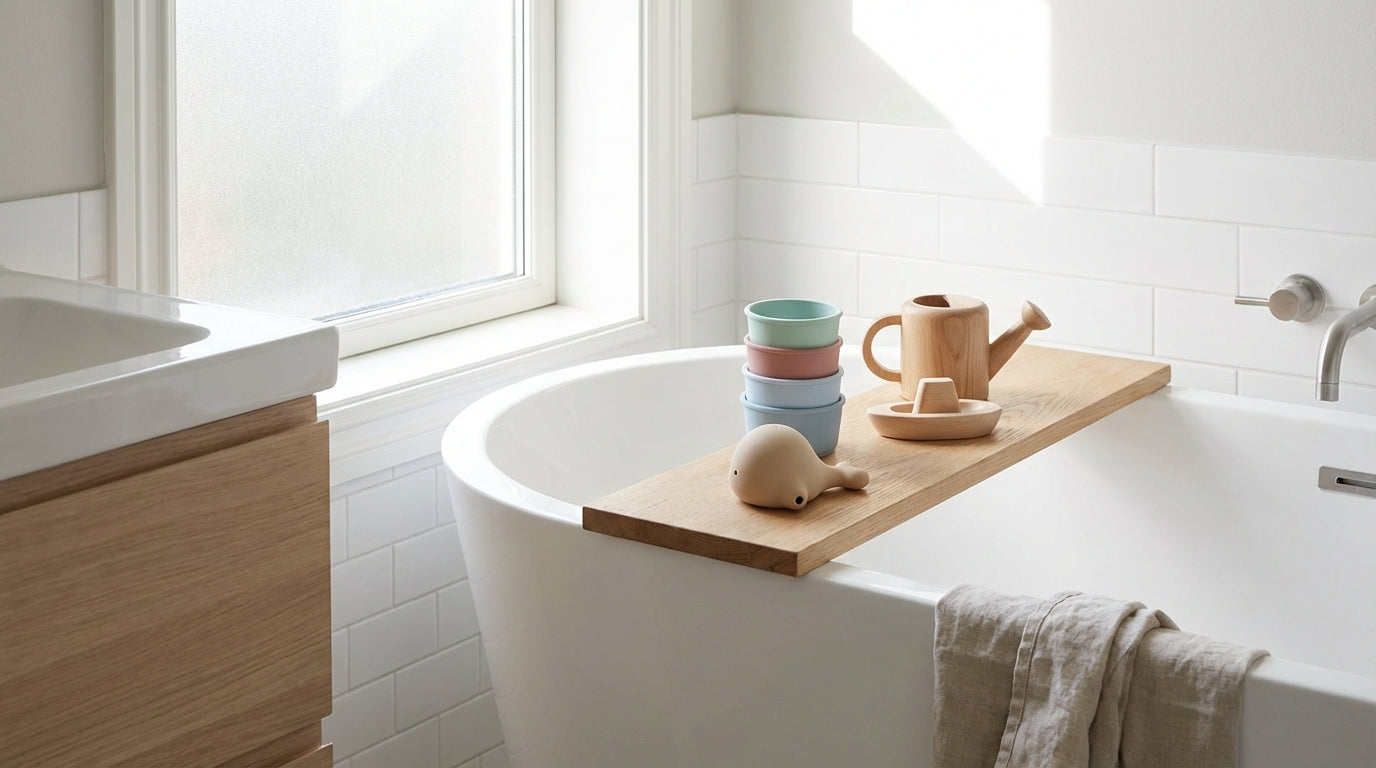
Open cups are often the easiest-care and longest-lasting choice. For babies, simply letting water run is already great entertainment; later come stacking, pouring and "cooking soup" (which sadly tastes like bath water).
- Pro: open design → dries faster, fewer "water leftovers inside"
- Pro: grows with your child (from grasping to role play)
- Con: small cups can vanish down the drain – and like to resurface only at the next house move
If you like to browse: In our overview you'll find various options under bath toys.
2) Floating Toys (Boats, Ducks, Animals)
Floating toys are great for role play, as long as they are easy to clean. Check whether there is a squeaker hole: with some models, water can get inside and stay there for a while. That's not "automatically bad," but it makes care and drying much more important.
Practical tip: Two good floating toys are often plenty. Less clutter = quicker tidying up = fewer arguments before bedtime.
3) Squirt Animals & Squeeze Toys
Squirt animals are fun, but they are the most demanding when it comes to hygiene. If water gets in and is hard to get out again, you need consistent drying and regular cleaning. According to the German Federal Institute for Risk Assessment (BfR), the health assessment of toys deals, among other things, with chemical substances in toy materials. (BfR: Health assessment of toys)
Safety note: Toys with small detachable parts do not belong in baby hands. Follow the age recommendations and warnings on the product.
4) Waterproof Bath Books
Bath books are great when you need a moment of calm during bath time. They are often light, easy to hold and add variety when splashing isn't the main event. Important: after the bath, open them up and let them dry – don't leave them folded shut while wet.
For a suitable selection by age: Take a look at baby bath toys or bath toys for kids.
5) Foam Figures, Bath Puzzles & Wall Toys
Wall games keep little ones busy without everything sinking. Foam figures stick to tiles, can be sorted and tell stories. Wall toys (e.g. water runs) are fantastic, but need space and quickly become a permanent bathroom resident.
Which Criteria Matter Most? (Safety, Material, Cleaning)
If you only check three things: age recommendation, cleanability and workmanship. The rest is a matter of taste – and whether your child is a pirate, a starfish or a "bathtub engineer" today.
- Age recommendations & warnings: They help you judge whether size, function and possible small parts are suitable.
- Cleanability: Open shapes dry more easily; cavities and narrow openings need more care.
- Material & smell: Strong-smelling material is best aired out first and checked critically.
- Surfaces: No sharp edges, no splintering parts, nothing that comes loose easily.
EU rules set the framework, but you see the details in everyday life. According to the European Commission, stricter toy safety rules are linked to the Toy Safety Regulation; details can be read in the EU legal text. (EU Commission) (EUR-Lex: Regulation (EU) 2025/2509)
And quite down to earth: We are a family business from Hamburg, we've been doing this for 66 years – and when it comes to materials and safety, we'd rather be once too thorough than once too relaxed.
Bath Toys by Age: Baby, 1 Year, Toddler, Preschool
The number matters less than what's currently ending up in their mouth. Here is a relaxed guide – without pressure to be perfect:
- Baby: large, easy-to-grasp pieces; as few individual parts as possible; easy to rinse.
- From about 1 year: pouring, stacking, floating – cups, boats, large figures.
- Toddler: cause and effect (water runs, something spins), sorting, simple role play.
- Preschool: stories, "building projects" on the wall, small sets (but still easy to tidy up, please).
Practical tip: If you're unsure, choose a piece that does one thing really well (pouring or floating or sticking). That saves your nerves.
How Many Pieces Make Sense? (Spoiler: Fewer Than You Think)
For most families, 5–8 pieces are plenty. More toys don't automatically bring more fun, but almost certainly more tidying time. A small mix is often perfect:
- 2–3 cups (pouring/stacking)
- 1–2 floating toys (boat/animal)
- 1 book or 2–3 foam figures (quiet moments)
Extra relief: If today you only manage "cups + a boat," that is a completely valid bath plan.
Cleaning & Drying: How to Keep Bath Toys Pleasant
The most important thing: let them drain after the bath and store them dry. Sounds mundane, but it's the difference between "all good" and "What is that smell?"
- After every bath: empty out, rinse briefly, let drain.
- Regularly: visual and smell check (residue, sticky spots, mustiness).
- For hollow toys: dry especially thoroughly; once water is sitting inside, it quickly becomes an ongoing project.
If you want a step-by-step guide: Here is our detailed guide: Cleaning Bath Toys & Tub Toys: The Ultimate Guide Against Mold.
How We Test Bath Toys in Everyday Life (No Drama, but With Wet Hands)
Our everyday test looks at the things parents really notice. We don't check "pretty in photos," but "pretty after the tenth bath":
- Drying: Does water stay anywhere, or does everything come out easily?
- Cleaning: Can you reach the corners, or do you need dental training for it?
- Material smell: Does it smell strongly, and does the smell linger stubbornly?
- Small parts & edges: Are there parts that could come loose, or spots that feel unpleasant?
- Everyday suitability: Can you operate it with one hand while the other hand "stops a child from slipping"?
Transparency is part of it: If a toy is hard to dry because of its design, we say so – because parents already have enough projects.
FAQ
Which bath toy is best for babies?
Best are large, easy-to-grasp pieces without small parts that dry quickly. Cups for pouring or a simple floating toy are often enough. Check the age recommendation and make sure no water stays inside – that saves you a lot of cleaning-mood later.
Which is better: bath toys with a hole or without?
Without a hole is usually easier to care for, because no water gets inside. Toys with a hole (for squeaking or squirting) can be a lot of fun, but need consistent drying and regular cleaning. If you're short on time, open or completely sealed versions are more relaxed.
How many bath toys do you really need?
Usually 5–8 pieces are enough to keep bath time fun and keep the bathroom from "overflowing." A mix of 2–3 cups, 1–2 floating toys and possibly a waterproof book or foam figures covers many play ideas. Fewer pieces are also easier to dry.
How can I tell if a bath toy is safe?
Look for age recommendations, warnings and sturdy workmanship without sharp edges. EU rules regulate toy safety; details on the Toy Safety Regulation can be found with the EU Commission and on EUR-Lex. In everyday life, the most helpful thing is to actually read the information on the product once.
Which bath toys are easiest to clean?
The easiest are open toys such as pouring and stacking cups or scoops. They dry quickly and have fewer hidden spots. Closed hollow bodies or squeeze animals are often more work, because water can remain inside – and eventually that smells like "yesterday."
When do bath toys start to make sense?
They often make sense from the moment your baby grasps on purpose and finds water exciting. Then simple things like a cup or a floating toy are enough. What matters is that it suits their stage of development and that you can dry it well after the bath.
Finally, nice and relaxed: If you're looking for bath toys that fit your pace, take a look at our overviews for bath toys, tub toys, baby bath toys and bath toys for kids. Better to choose fewer, but fitting ones – then bath time stays what it should be: warm, entertaining, and in the end everyone is clean. Mostly, anyway.