Unique Piggy Banks for Kids: Ideas, DIY & Age Tips
At a Glance
- Unique piggy banks for kids are practical, safe and actually get used.
- Animal designs make dropping coins in playful – “feeding” instead of “saving”.
- DIY works best with a few sturdy materials and plenty of drying time.
- For toddlers: no detachable small parts, smooth edges, a stable base.
- A small routine (e.g. a weekly coin) brings calm to the topic of money.

Unique piggy banks for kids are good when they work in everyday life. In other words: coin in, done – and opening it should not turn into a “just a quick peek” every two hours. In this guide you’ll find creative ideas (animals, colors, wood), a simple DIY tutorial, age recommendations and a safety checklist. No crafting degree required – we stay northern German about it: practical, friendly, and with as little mess on the kitchen table as possible.

Ulli & Flo
Owners of bieco · Hamburg · parents themselves
We’ve learned that a piggy bank works best when it’s simple and doesn’t get in the way of daily life. With a small ritual, saving becomes truly tangible for kids. Feel free to browse our piggy bank collection.
Table of contents: jump straight to the topic you need.
- What really makes a piggy bank special?
- Recommendations by age: 2–3, 4–6, 7+
- Why animal piggy banks work so well
- Safety & everyday life: what to look for
- Decorating a piggy bank yourself: step by step
- Wood & personalization: simple stays beautiful
- When do children understand saving?
- FAQ
Unique Piggy Banks for Kids: What Really Makes Them “Special”?
“Special” means: it suits the child – and survives everyday life. A piggy bank can be as pretty as you like: if the coin slot is too small, it keeps tipping over, or it takes offense at the first fall, it turns into decoration. And decoration in a kid’s room is… let’s say: brave.
A children’s piggy bank is an everyday object that makes saving visible. It helps kids understand money as “something to keep” – not just jingly stuff that vanishes into sofa cracks.
- Design: Recognizable (animal, vehicle, favorite color) – then it becomes “mine”.
- Coin slot: Big enough for small hands to hit (otherwise it ends in frustration).
- Removal: Easy for adults, not constantly “open” for kids.
- Material: Sturdy, smooth, no nasty edges.
Practical tip: Put the piggy bank where your child can see it – but not where it can sail off the shelf at night. A low shelf is often the golden mean.
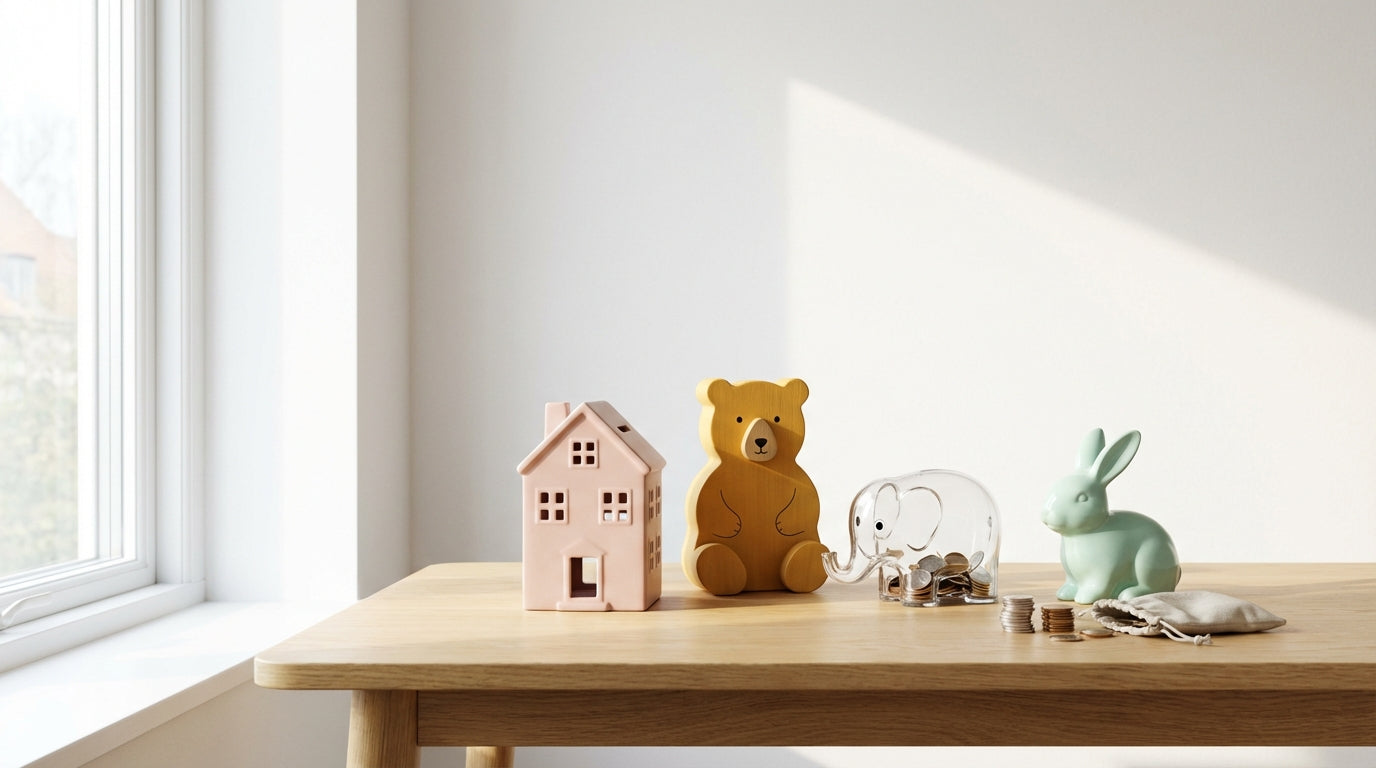
If you want to gather ideas, one look at real shapes helps more than saving 30 pictures. In the piggy bank overview you’ll find different variations – great for judging sizes, openings and designs.
Recommendations by Age: Which Piggy Bank Suits 2–3, 4–6, 7+?
The best piggy bank is the one that fits your child’s stage of development. Not every child wants (or is able) to count, plan and think “for later” right away – and that’s perfectly okay.
| Age | What often works well? | What to look for? | Good everyday idea |
|---|---|---|---|
| 2–3 years | Dropping coins in as a game (jingling, “feeding”) | Stable base, no small parts, smooth edges, opening only with adults | “Today you may drop in 1 coin” |
| 4–6 years | First goals (“for the book”, “for the trip”) | Easy-to-reach slot, regulated removal, sturdy material | Stick a wish picture next to it (a picture, not small parts on the piggy bank) |
| 7+ years | Counting, planning, their own pocket money | Overview (e.g. a see-through window depending on the model), fair access | A monthly “counting day” with a small plan |
If you’re unsure: start simpler and “level up” later. Kids grow into it – and you don’t have to draw up the perfect financial plan for the year 2043 today.
Animal Piggy Banks: Why Animals Work So Well for Kids
Animal piggy banks translate saving into a picture children understand right away. A pig, dinosaur or bunny has character – and suddenly “putting money away” becomes more like “feeding” or “guarding”. That saves (ha) a lot of lengthy explanations.
An animal design can make rules friendly without feeling strict. For example: dropping coins in is always okay – opening only together with Mom/Dad/Grandma/Grandpa. It’s clear, but not unpleasant.
- “The dino is saving up for the zoo.”
- “The bunny is looking after your birthday money.”
- “The fox gets two coins for supper today.”
And yes: kids are creative – especially when it comes to “How do I get this back out?”. That’s why a removal method that only adults can operate is often what keeps the peace at home. Not always. But often.
Piggy Banks for Kids & Toddlers: Safety, Materials, Certifications
For small children, the safest piggy bank is the one that doesn’t give anything off and doesn’t shed anything. That means: no protruding decorative parts, no sharp edges, no materials that splinter or come loose.
Safety note: If you decorate a piggy bank yourself, only use products that are expressly suitable for children’s toys, and let everything cure completely.
The EU Toy Safety Directive 2009/48/EC sets out basic safety requirements for toys. You can find the legal text on the EU legal portal: EUR-Lex: Directive 2009/48/EC.
For chemical aspects of toys, standards such as EN 71 are often referenced. According to DIN e. V., DIN EN 71-3 describes test methods for the migration of certain elements from toy materials: DIN e. V. on DIN EN 71-3.
And quite down-to-earth: if something smells strongly, we eye it with suspicion first. It’s better to ventilate well, stick to drying times and, when in doubt, choose a different product.
Checklist: child-safe piggy bank (short & useful)
- No small parts: nothing that can be pulled or picked off.
- Smooth surface: no splinters, no sharp edges.
- Stable: doesn’t tip over at every nudge.
- Regulated removal: adults can get in, kids can’t just do it “quickly”.
- Material/finish: suitable, cured, easy to clean.
We’re not dramatic about this – just thorough. As a family business from Hamburg, we’ve been doing this for 66 years and we know: in the kid’s room, what wins in the end is what is safe and sturdy.
Decorating a Piggy Bank Yourself: Step by Step (Without Craft Chaos)
A piggy bank you decorate yourself often becomes a keepsake – and that’s lovely. To keep it from peeling or turning sticky after two weeks, preparation and drying time matter most.
“Curing” means: the surface is not just dry, but fully durable. That’s the moment from which little hands (and little teeth, we know how it goes) don’t leave marks right away.
DIY materials list (clear and simple, think toy-safe)
- Masking: painter’s tape, old newspaper/protective sheet
- Applying: 1 wide brush + 1 thin brush
- Decorating: suitable paints/varnishes (follow the manufacturer’s instructions)
- Protecting: optional clear coat, if appropriate and suitable
- Staying clean: damp cloth, cup of water, apron/old shirt
DIY Idea 1: Color-Block Design (quick, modern, forgives mistakes)
Color blocks look tidy even if they’re not accurate to the millimeter. Especially with kids, this is the most relaxed option, because little wobbles don’t stand out – they simply become “part of the style”.
- Clean: Make sure the surface is dry and dust-free.
- Mask off: Use painter’s tape to divide clear areas (e.g. bottom 1/3, top 2/3).
- First coat: Apply thinly and let dry.
- Second coat: If needed, go over it once more thinly.
- Remove the tape: Peel off carefully while the paint is still slightly “soft” (follow the manufacturer’s instructions).
- Dry/cure: Really leave the piggy bank alone.
Practical tip: Two colors almost always do the job. Five colors often just look like “birthday party on a Monday morning”.
DIY Idea 2: Animal Face “Light” (no small parts, but plenty of charm)
An animal face works great if you paint everything instead of gluing things on. For toddler piggy banks, this is usually the safer and more durable solution.
- Sketch: Lightly mark the position of the eyes/nose with a pencil.
- Paint big: Make the eyes big and friendly – it instantly works.
- Keep details sparse: Dots, stripes or whiskers are plenty.
- Add a name: On the back or underneath – short and easy to read.
If you do want to stick something on, double-check that it’s firmly attached and big enough. With very small children, “painted on” is usually the better deal for everyone involved.
DIY Idea 3: “Seasons” Piggy Bank (lovely as a gift, without the kitsch)
With a seasonal design, the piggy bank feels like a proper gift. And you don’t have to paint a landscape for it – dots, lines and one symbol are enough.
- Spring: small blossom dots
- Summer: sun + wavy line
- Autumn: leaves in orange/brown
- Winter: snow dots + star
If you want to give the piggy bank as a gift, a little occasion plan helps. You’ll find ideas here: Piggy Banks as Gifts: For Baptisms, Births & Other Occasions.
Wooden Piggy Banks & Personalized Wooden Piggy Banks: Warm, Durable, Easy to Read
Wood feels warm, is often durable and fits into almost any kid’s room. It’s also easy to paint or label – and even after years it still looks intentional, not like “that was once a trend”.
A wooden piggy bank is a piggy bank made of wood that collects money and stays sturdy. It’s especially popular as a gift because it feels high-quality without being loud.
Personalization is most beautiful when it stays simple. A name is often plenty – and later, when your child is learning to read, it’s even a little bonus.
- Name + small symbol (star, paw print, dot)
- Name + year (for a birth or baptism)
- A short phrase: “For big wishes”
If you’re looking for specific instructions, we’ve written them down neatly for you. This way: Personalized Piggy Banks: The Perfect Gift with Name & Engraving.
When Do Children Understand Saving? (And How to Keep It Stress-Free)
Small children first understand saving as an action – not as a long-term plan. Drop in, listen, repeat: that’s the entry point. The “wish in three months” comes later for many children, often only in preschool or primary school age.
The educational value lies less in the amount and more in the routine. When children experience that something grows (the coins add up) and that you decide together when to open it, that’s already a lot of learning – with no pressure at all.
- For 2–3-year-olds: Dropping coins in as a little game, 1–2 coins at most.
- For 4–6-year-olds: A goal picture next to it (book, trip) and a fixed “coin day”.
- For 7+: Count, write things down, set small goals (short-term often works better).
And if it doesn’t work out once: that’s fine too. It’s a family tool, not a performance test. Sometimes a lot is already won if the loose change doesn’t end up in the washing machine.
FAQ
Which piggy bank is best for 2-year-olds?
For 2-year-olds, a stable, sturdy piggy bank without small parts makes the most sense. Your child will mainly use it for dropping coins in, not for planning. Look for smooth edges and make sure removal only works with an adult. Animal designs often work especially well.
How do you open a piggy bank in a child-safe way?
Child-safe means: adults can get in, kids can’t just do it “quickly”. Solutions that need a tool or a key, or an opening that can’t be pried open with fingers, are practical. The everyday rule matters too: it’s opened together – not spontaneously in between.
Wood vs. ceramic: which is better for kids?
Wood is often more forgiving in children’s everyday life, while ceramic is usually heavier and can break. For small children, sturdiness is a big issue, which is why wood is often preferred. If you choose ceramic, pick one that is especially stable and place it where it can’t easily fall.
How can I decorate a piggy bank myself without the paint peeling?
Durability comes from preparation, thin coats and enough drying time. Clean the surface, mask off neatly and apply two thin coats rather than one thick one. Only use products that the manufacturer states are suitable for children’s toys, and let the surface cure completely.
What matters with paints and varnishes for the kid’s room?
What matters are clear manufacturer statements on suitability, plus enough ventilation and curing time. For toy materials in Europe, standards from the EN 71 series are often used; DIN e. V. provides information on DIN EN 71-3 here: DIN e. V.. If something smells strongly: better to pause and check.
If you’re now looking for a piggy bank, start with everyday practicality – the looks will follow on their own. To browse and gather ideas, take a look at our piggy bank selection here. When it comes to materials and safety, we traditionally prefer to look once more – for 66 years now, relaxed in the northern German way, but never sloppy.