Make Your Own Advent Calendar: 3 DIY Guides & Filling Ideas
At a Glance
- Making your own advent calendar: choose bags, boxes or a garland – and the basic shape is done.
- Filling it on a budget works with vouchers, mini activities and cleverly split multipacks.
- For babies & toddlers: go for big, safe items and little rituals instead of small parts.
- Last-minute works too: 24 envelopes + slips of paper, ready in 20 minutes.
- Hanging it without wall stress: clips, ribbon on furniture or removable adhesive pads (test first).

You can make your own advent calendar by numbering 24 bags, boxes or envelopes and filling them with little surprises. In this guide you'll find three simple DIY tutorials, plenty of filling ideas (including budget-friendly ones), a last-minute version and a few tricks that really work in everyday family life. That means somewhere between the lunchbox, the laundry pile and “Who took my pen…?”.

Ulli & Flo
Owners of bieco · Hamburg · parents themselves
These days we'd rather make our advent calendar “doable” than “perfect” – that leaves more good mood for December. With vouchers and little rituals, things stay the most relaxed in our home. Feel free to browse our Advent Calendar collection.
A homemade advent calendar doesn't have to be perfect – just loving and practical for everyday life. If it hangs a little crooked: congratulations, that's real December decor.
How can I make an advent calendar myself?
The easiest way is to prepare 24 small containers, number them and collect or hang them in one place. You don't need a craft degree, just one decision: should it hang, stand or live in a box?
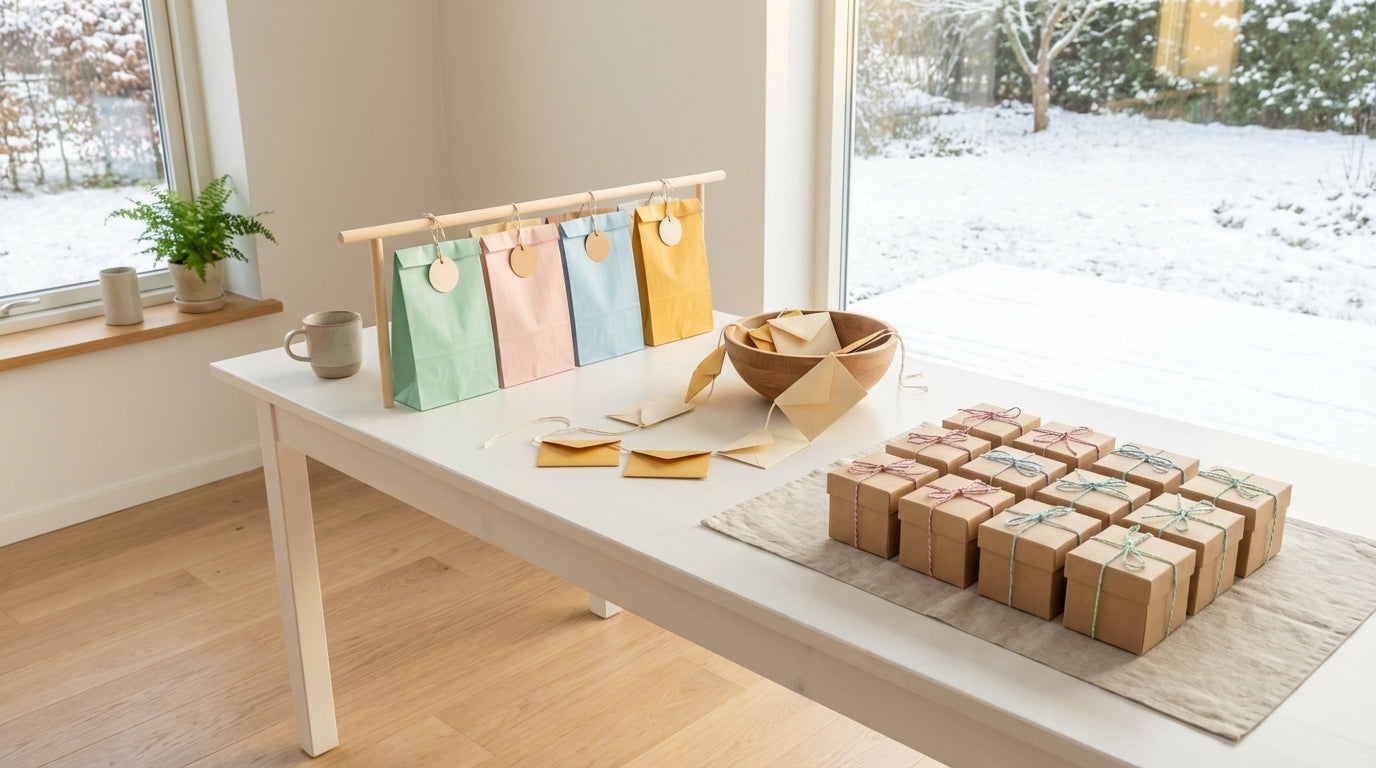
- Bag calendar: quick, inexpensive, easy to hang.
- Box calendar: looks tidy, needs a bit of folding time.
- Garland calendar: space-saving, cozy look.
- Envelope calendar: the premier league of last-minute options.
An advent calendar is a collection of 24 surprises from December 1 to 24. It makes the wait for Christmas tangible, especially for children, who tend to measure time in “how many more sleeps?”.
Practical tip: Finish the wrappers completely first (number + hang), then fill them. Otherwise you'll end up with 24 open bags and zero overview.
Materials checklist: what you really need (and what's nice to have)
A small checklist saves you from the classic: “Oh no, it's the 3rd and number 17 is missing.”

- 24 containers: bags, pouches, boxes or envelopes
- Numbers: stickers, pen, tags
- Hanging: string/ribbon + clips or adhesive pads/masking tape
- Scissors, glue (optional), hole punch (optional)
- Decoration (optional): washi tape, paper stars, stamps
Masking tape can often be removed without leaving residue, but walls are sometimes sensitive. Always test adhesive materials on an inconspicuous spot first and let them hang briefly before you attach 24 little doors.
DIY guide 1: Advent calendar from paper bags (15–30 minutes)
The bag calendar is the fastest way to 24 little doors – without a craft workshop in your living room.

You'll need:
- 24 paper bags (small to medium)
- Pen or number stickers
- String + 24 clips or adhesive pads/masking tape
- Decoration as you like: paper stars, washi tape, stamps
How to do it:
- Number them (1–24). Numbers first, then decoration – otherwise you'll be hunting for number 13 in a glitter fog.
- Fill them (ideas are coming up, promise).
- Close them: fold over, staple or secure with a clip.
- Hang them: on a string, on a shelf, on the side of a cupboard or on a pinboard.
For children, the “searching” is often half the fun. Feel free to mix the bags up – but please make sure nobody needs a ladder (not even Grandpa).
DIY guide 2: Advent calendar as a garland (pretty & space-saving)
A garland is ideal if you have little floor space but still want that Christmas feeling.
You'll need:
- 24 small pouches/bags or mini boxes
- 2–3 meters of sturdy string or ribbon
- 24 mini clips
- Numbers (pen, stickers or tags)
How to do it:
- Stretch the string (e.g. between two hooks, on a curtain rod or on a shelf).
- Number and fill.
- Clip them on – ideally in two rows (1–12 and 13–24), which looks calmer.
Small parts are small detachable pieces that children can swallow or inhale. They are especially critical for children under 3 years because of the choking hazard.
Safety note: For children under 3 years, don't include detachable small parts (e.g. mini figurines, marbles, small magnets). According to the Bavarian consumer portal, toys are tested, among other things, with the “small parts cylinder test” under DIN EN 71-1 to check whether parts can be swallowed. Source
DIY guide 3: Advent calendar from boxes (for everyone who likes things neat)
A box calendar looks store-bought – just with your own style and without the “where is number 17?!” drama.

You'll need:
- 24 small boxes (bought or folded)
- Cardboard/shelf board/old fruit crate as a “stage”
- Numbers + decoration
How to do it:
- Prepare the boxes and number them.
- Set them up (e.g. 4 rows of 6 or 6 rows of 4).
- Fill and close them.
If your child likes to sort things: let them arrange the boxes. It's an activity that doesn't beep and needs no batteries.
Last-minute: Advent calendar in 20 minutes (envelopes + slips of paper)
If December is already at the door, the envelope calendar with paper and a pen will save you. It looks simple but works brilliantly – and you can reuse it every year.
You'll need:
- 24 envelopes
- Pen + numbers
- 24 slips of paper (or a notepad you tear up – no shame at all)
- Adhesive pads/clips/pinboard
How to do it:
- Number the envelopes and arrange them (pinboard, clothesline, crate).
- 1 slip per envelope: voucher, mini task or riddle.
- Optionally add 5–8 envelopes with little extras if you have something on hand.
Practical tip: Write down 24 ideas on a list once, cut them out, done. That's faster than coming up with something “real quick” every evening.
What homemade ideas are there for an advent calendar?
The best homemade ideas are small, quick and really make everyday life nicer. Not “one more thing”, but “oh look, that's nice”.
Homemade – without a material overload:
- Mini vouchers: pick an audio story, 15 minutes of extra reading aloud, hot-cocoa date, choose a game.
- Riddles & mini scavenger hunt: one clue per day, a shared experience waits on the 24th.
- Collector cards: 24 cards with jokes, questions, family photos or “Christmas bingo”.
- “Helper elf” tasks: set the table, sort socks, stick on a window picture (yes, sometimes they love it).
- Mini craft sparks: one craft idea per week, split into small steps.
Time together is often the little door that lingers the longest. And even if it's just 10 minutes: in December, that counts double.
How can I fill an advent calendar on a budget?
Filling it on a budget means: less stuff, more idea – and splitting multipacks cleverly. You don't have to think “big” 24 times. Children are surprisingly often happy about repetition, as long as it's wrapped with love.
Budget-friendly filling ideas (that still make an impression):
- Creative odds and ends: stickers, small stamps, erasers, a mini notebook, a pretty pencil.
- Everyday upgrades: socks, reflector tags, hair clips, a new sippy cup design (if you use those).
- Play ideas: dice, a small puzzle card, “1 game rule per day” for a bigger game.
- Reading moments: 24 slips saying “Today you read on Daddy's lap” (an official agenda item).
Fewer sweets can be more relaxed, especially when December is busy anyway. According to the World Health Organization (WHO), free sugars should make up less than 10% of daily energy intake; below 5% brings additional benefits. Source (WHO)
A simple budget formula that often fits well: 8 experience doors + 8 mini items + 8 “mix” (sweets, riddles, odds and ends). It feels varied without you having to shop 24 times.
What can you put in on a budget? (Ideas by budget)
With a clear budget, the advent calendar becomes not only cheaper but also less stressful. You decide once – and after that it's just distributing.
| Budget | What works well | How to keep it varied |
|---|---|---|
| Very small | Paper vouchers, riddles, small everyday tasks | One “highlight” day every week (baking, lantern walk) |
| Small | Stickers, pen, mini book, dice, individual little things | Split multipacks + deliberately set 6–8 sweet days |
| Medium | A few bigger items + many experience doors | 2–3 theme weeks (e.g. crafting, reading, playing) |
The trick isn't “more”, but “better distributed”. One small thing feels huge when it's announced well (“Today we get creative!”) and doesn't get lost among 23 other items.
What can you make for an advent calendar (by age)?
The best filling suits the age – and the question: can the child use it safely? If you're unsure: go bigger, simpler, sturdier.
0–2 years (baby & toddler):
- Experience doors: music on, looking at lights, a tickle round, bathtub play
- Big, safe items: teether toy, cloth book, teething ring (age-appropriate, without detachable parts)
- Everyday helpers: washcloth, bib, small picture books (sturdy)
When it comes to food for toddlers: better to plan carefully than to be frightened afterwards. According to the German Federal Institute for Risk Assessment (BfR), nuts pose a choking hazard for toddlers because they can easily get into the airways. Source (BfR)
3–6 years (kindergarten):
- Sticker books, small stamps, mini books, play dough (age-appropriate)
- Vouchers: “cut out cookies”, “lantern walk”, “choose a game”
- Small figures/cars only if they are age-appropriate and have no swallowable parts
6–10 years (elementary school):
- Brain teasers, riddles, small projects in 3–4 steps
- Friendship bracelets, craft supplies for a hobby, collector cards (if that suits your family)
- “You decide” vouchers: movie night, game night, menu
If you'd like to browse more deeply by age group, our overview will help. This way: Advent Calendars for Kids: Comparison, Age Groups & Recommendations.
How do I attach it without damaging the wall?
The most wall-friendly solutions are those that hang on furniture, trim or existing hooks. That way the wall stays relaxed, and so do you.
- Garland on a shelf: string around shelf supports or on existing handles (please make sure they're sturdy).
- On a curtain rod: clip them on – done.
- Pinboard/cork: envelopes or small bags with pins (out of reach of small children).
- Removable adhesive pads: test beforehand, especially on fresh paint or woodchip wallpaper.
Safety note: Hang advent calendars so that children cannot reach strings, clips or adhesive parts and pull on them. Especially with toddlers, plan for higher up and out of reach.
Materials & safety: briefly and honestly (without panic)
If toys end up in the calendar, age labels and clean workmanship matter more than glitter. This is especially true for toddlers, who “inspect” everything with their mouths first.
The DIN EN 71 series of standards describes safety requirements for toys. According to DIN, this covers mechanical/physical properties, flammability and chemical aspects, among other things. Source (DIN)
And a little behind-the-scenes: we at BIECO are a family business from Hamburg and have been doing this for 66 years. Ulli & Flo write here as parents for parents – relaxed in a northern German way, but pretty particular (in a good way) when it comes to child safety.
FAQ
From what age does an advent calendar make sense for children?
Many families start with an advent calendar as soon as the child understands simple rituals and enjoys “one every day”. For very young children, experience doors often work better than objects. If you're unsure, read on here: Advent Calendars for Toddlers & Babies: From What Age?.
How can I make an advent calendar myself?
The easiest way is with 24 bags or boxes: number, fill, close and hang them. Decide on a basic shape (garland, wall calendar, box set), and then it goes quickly. Finish the wrappers first, then fill them – that saves chaos and searching.
What homemade ideas are there for an advent calendar?
Homemade ideas are mainly vouchers, small riddles, collector cards and mini activities in everyday life. That could be a “hot-cocoa date”, “extra reading time” or a mini scavenger hunt. Often the nicest door isn't the biggest one, but the one with time together.
How can I fill an advent calendar on a budget?
Filling on a budget works with little things from multipacks, homemade vouchers and a few sweets. Plan, for example, 8 experience doors, 8 mini items and 8 mix days. That way it feels varied without you having to shop 24 times.
What can you put in on a budget?
Budget-friendly are paper-slip ideas (vouchers, riddles), stickers, a nice pen, an eraser or small everyday helpers. Even “Today you choose the game” costs nothing and is still celebrated. If sweets are included, deliberately set them as highlight days.
How do I attach the advent calendar without damaging the wall?
It's best to use furniture, trim or a curtain rod instead of the wall directly. Garlands work great on a shelf or on existing hooks. If you use adhesive pads, test them beforehand on an inconspicuous spot, because surfaces react very differently.
How do I make a 7-day advent calendar?
Choose a time frame (e.g. December 18–24) and prepare seven numbered bags/boxes or envelopes. Pick a theme like “7 reading moments” or “7 little games” and plan one simple, slightly bigger surprise per day. That's ideal if you prefer a more relaxed Advent.
If you now feel like clicking through some variations: in our overview you'll find lots of ideas around advent calendars – and if you're collecting for grown-ups too: Advent Calendars for Adults: Inspiration, Filling Ideas & Tips.