
Wooden Xylophone
Sort by
1 product
zuletzt angesehen
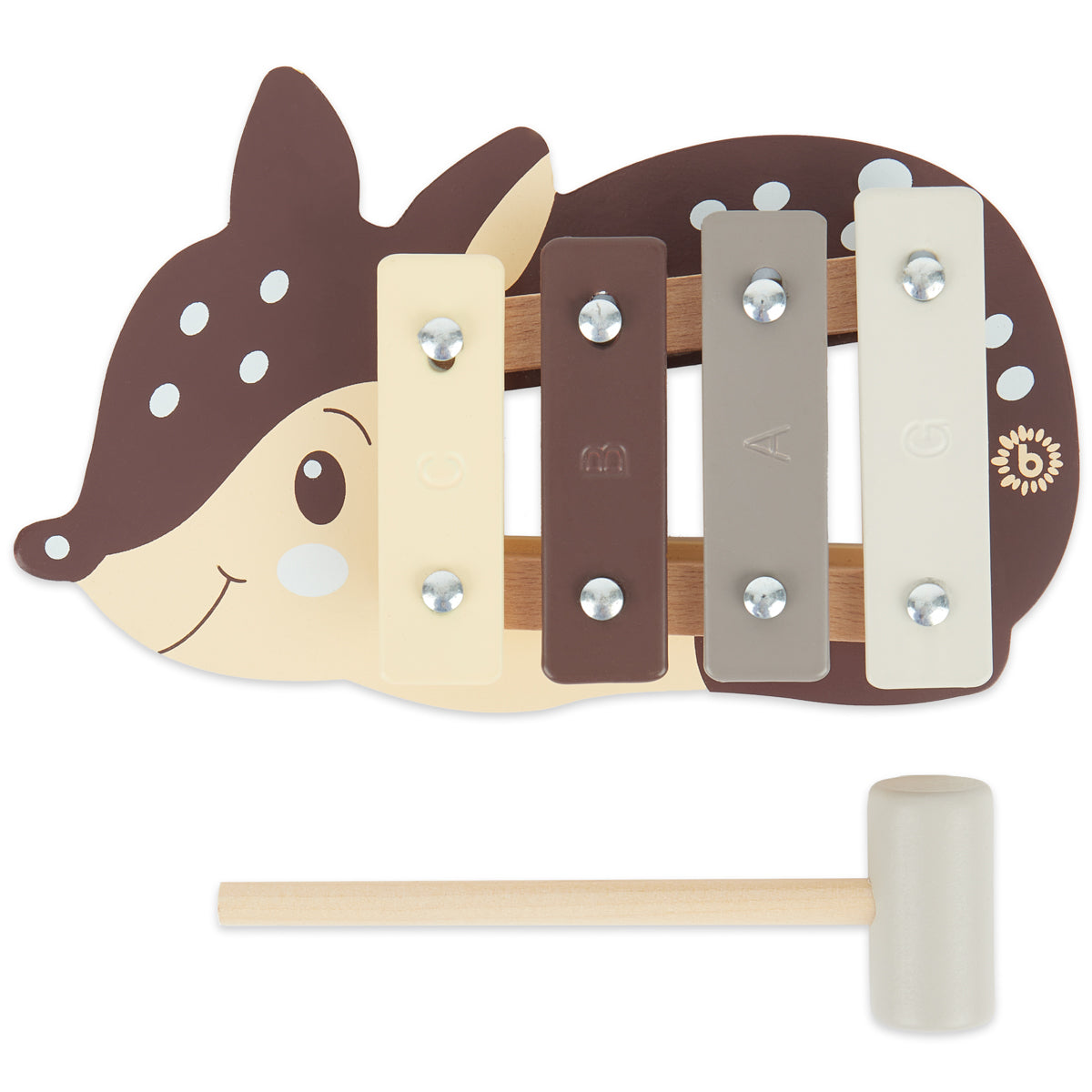
A wooden children’s xylophone is a toy xylophone that makes sounds and rhythm instantly easy to understand. One mallet in hand—and something happens right away, with no instructions and no “practice first.” This collection is for anyone looking for a wooden xylophone: as a small wooden musical instrument for the nursery, as a gift, or as an introduction to the world of sound. If you generally enjoy browsing our wooden world, you’ll find more in the big overview Wooden toys.
How to quickly find the right wooden xylophone for kids:
- Roughly match the age (from around 1 year: sturdy & simple; from 2 years: more notes are welcome).
- Check stability (if it slides, a cloth underneath can help).
- Mallets: easy to grip, not too small, ideally stowable “right with it”.
- Surface: neatly finished, no sharp edges, varnish/paint suitable for toys (EN 71-3 is a common reference).
Browsing now is worth it—and if there’s not much selection at the moment: Then the range is probably being built up, or individual versions are sold out. In that case, take a look at our Wooden toys as an alternative, or at little “sound & grasp” favorites like Rattles and teething rings—they often mark the musical starting point.
Quick takeaway for busy readers: A wooden xylophone for kids is a great fit if you’re looking for a warm sound and a living-room-friendly toy. Look for good stability, easy-to-grip mallets, and solid workmanship. For safety in the EU, the CE marking is key—it’s a requirement for toys on the EU market (European Commission: Placing toys on the EU market).
Why a dedicated “wooden xylophone” corner makes sense
Wooden xylophones are often chosen for their warmer, softer sound. That’s pleasant in everyday life when your child is discovering that repetition is an art form. A kids’ xylophone made of wood also often feels “calmer” in the room—visually and acoustically—and pairs well with other wooden musical instruments.
A toy xylophone is, above all, a “I can do it myself” instrument. Kids can quickly make a sound, notice cause and effect, and stick with it—that’s the real magic. And yes: at first it’s rhythm research, not a concert. That’s completely fine.
Wooden kids’ xylophone: which version suits which age?
For little ones, it’s less about “perfectly tuned” and more about being easy to use and robust. Especially with searches like “kids’ xylophone from 1 year” or “from 2 years,” it’s usually about handling: gripping, tapping, repeating—without everything sliding around or causing frustration.
A wooden xylophone for children from around 1 year should be stable and straightforward above all. Fewer sound bars aren’t worse—they’re often even more relaxing, because your child finds “their” pattern faster. From around age 2 (when fine motor skills develop further), a wider range of notes is more fun because simple melodies become easier.
Smart cheat sheet: mallets & stability matter more than “more is more.” If the xylophone keeps sliding away, the fun disappears quickly. A non-slip spot (or a folded towel underneath) can work wonders.
Safety & materials: short, clear, no panic
In the EU, only toys with a CE marking may be sold. The European Commission explains that only toys with a CE marking may be placed on the EU market because it signals compliance with safety requirements (European Commission – Toys: placing on the EU market).
For painted wood, standards such as EN 71-3 are an important reference. DIN explains that DIN EN 71-3 (“Migration of certain elements”) specifies the requirements of the Toy Safety Directive and includes test methods for the release of certain elements (DIN – DIN EN 71-3 explained).
The BfR points out that children can also absorb substances through the mouth. The German Federal Institute for Risk Assessment describes that substances from toys can be released and absorbed when put in the mouth (BfR – Health assessment of toys).
A concrete number for context: the EU names “19 heavy elements” with limit values. The EU toy safety page mentions that limit values apply to 19 so-called “heavy elements” (European Commission – Toy safety).
And another number that surprises many: 55 allergenic fragrances are banned in toys. According to the European Commission, 55 allergenic fragrances are banned in toys; additional substances may be subject to labeling requirements (European Commission – Toy safety).
Care & everyday use: how to keep your wooden xylophone looking lovely for a long time
It’s best to clean a wooden xylophone with a quick wipe using a damp cloth, then dry it. Wood doesn’t like baths or dishwashers—less a “rule,” more life experience. A slightly damp cloth is usually enough; for sticky fingers, a tiny bit of mild dish soap on the cloth helps.
- Please don’t soak it (wood can warp).
- Store it dry so the surface stays beautiful.
- Store the mallets with it—otherwise they’re surprisingly quick to “disappear.”
BIECO & wooden toys: what we love about them (and why that matters)
BIECO is a family business from Hamburg—now for 66 years. Our focus is on toys that work in everyday life: touch them, drop them, pick them up again, keep playing. And if it also looks like Scandi design—happily, we’ll take that too.
If this collection doesn’t have quite the right thing right now, there are great wooden alternatives. Many families like to combine “sound toys” with entertainment on the go (Stroller toys) or calm table-time moments like Wooden puzzles.
Pros & cons: wooden xylophone for kids—honestly, in brief
A wooden xylophone is often a relaxed introduction to music in the nursery. So you don’t have to overthink it, here’s the quick trade-off:
- Pro: warm sound, visually “calm,” a lovely gift.
- Pro: rhythm, coordination, and experimenting—without performance pressure.
- Con: wood is sensitive to lots of water and hard edge impacts.
- Con: if they love it, it often gets played very regularly (surprise!).
FAQ about wooden xylophones
From what age does a wooden children’s xylophone make sense (from 1 year, from 2 years)?
A toy xylophone is often a great fit once your child can purposefully grasp and tap. For “kids’ xylophone from 1 year,” stability and an easy-to-grip mallet matter more than lots of notes. From age 2, a wider range of notes is more fun because melodies are easier to manage.
How can I tell if a wooden xylophone for kids is “safe”?
Look for the CE marking, clean workmanship, and no detachable small parts. According to the European Commission, the CE marking is a requirement for selling toys in the EU (European Commission). For painted parts, EN 71-3 is a common reference for the release of certain elements (DIN: DIN EN 71-3).
How do I clean a wooden xylophone without ruining it?
Wipe with a damp cloth, dry it off—and please don’t soak it. If there was porridge, juice, or sticky fingers on it: mild dish soap on the cloth is usually enough. Always wipe dry afterwards so the wood stays beautiful and doesn’t swell.
Is a wooden xylophone quieter than a metal xylophone?
Many people find wood “warmer” and less shrill, but it depends a lot on the model. What matters most is size, the resonating body, and how enthusiastically it’s being played. If you have particularly noise-sensitive moments (nap time, calls), a rug underneath and a dedicated “tapping spot” in the room can help.
One last browsing tip: If you don’t find what you’re looking for in this collection right now, feel free to check out Gift ideas or browse across all our Wooden toys. And if the first “concert” starts exactly when you’re on the phone: that’s not a bug—that’s childhood.
About this page (as of 02/2026)
This text was written for parents and gift-givers and is editorially maintained. We use practical, everyday criteria (age, handling, care) and, for safety topics, we deliberately link to official sources such as the European Commission, DIN, and BfR.
Von Ulli & Flo · Inhaber & Eltern Mehr über uns ↓

Über diese Seite
Ulli & Flo
Inhaber von bieco · Hamburg · selbst Eltern
Wir mögen Spielzeug, das ohne großes Erklären sofort funktioniert – ein Xylophon aus Holz ist da oft ein Volltreffer. Und wenn’s mal ausverkauft ist: Lieber eine gute Holz-Alternative nehmen, als frustriert weiterzusuchen.